
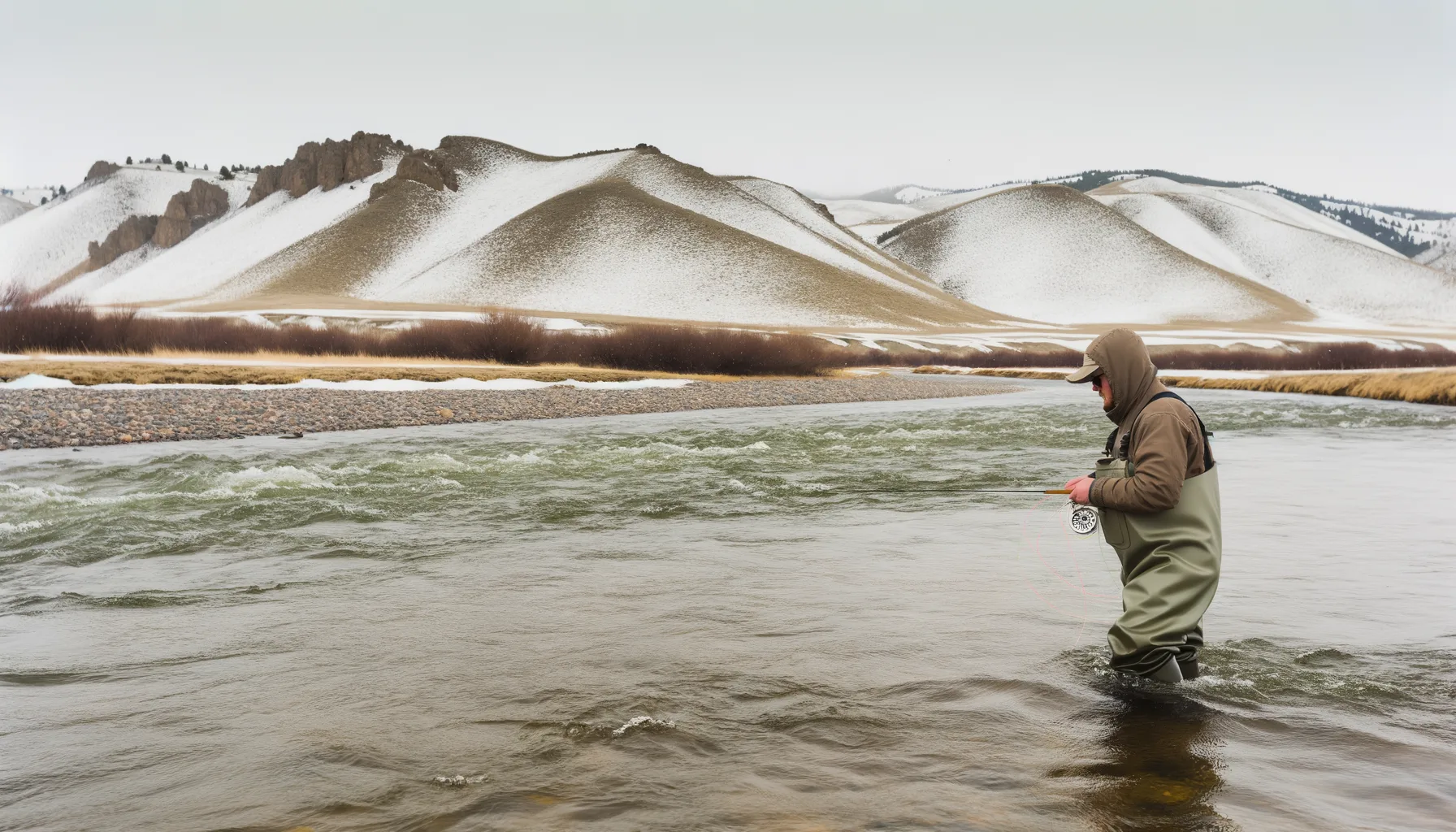
March is showing its split personality across Montana this week. While the Madison and Missouri are locked into excellent stable flows, we’re watching significant bumps on the Big Hole, Clark Fork, Bitterroot, and Blackfoot as warming temps and precipitation push water levels up. A substantial storm system is working through the state right now, bringing heavy snow to Central Montana and rain-snow mixes to the Southwest and West—expect changing conditions through the weekend before things settle by Monday.
Water temps in the low 40s have fish starting to think about spring, but they’re not fully active yet. Nymphing remains your bread-and-butter technique statewide, with midges your most reliable pattern. The rising rivers in Western Montana will fish dirty for a few days, while the stable Southwest systems are your best bet for clear water and consistent action.
Current Conditions at a Glance
| River | Flow (cfs) | Temp (°F) | Trend | Fishing |
|---|---|---|---|---|
| Madison River | 349 | 43.3°F | Stable | Excellent |
| Gallatin River | 292 | No data | Stable | Good |
| Yellowstone River | 1,280 | No data | Stable | Good |
| Big Hole River | 584 | 39.2°F | Rising +17% | Fair |
| Missouri River | 3,030 | 43.0°F | Stable | Excellent |
| Clark Fork River | 2,090 | 37.8°F | Rising +12% | Fair |
| Bitterroot River | 1,490 | No data | Rising +12% | Fair |
| Blackfoot River | 1,140 | 36.5°F | Rising +17% | Fair |
Madison River — Southwest Montana
Flow: 349 cfs | Water Temp: 43.3°F | Trend: Rock solid stable
The Madison is fishing as well as it gets in mid-March. Flows have hovered in the 330-350 cfs range all week—absolutely perfect winter conditions. Water temps in the low 40s mean fish are starting to get more aggressive during the warmest part of the day, but you’re still not seeing explosive activity.
The midge bite is your primary game plan right now. Focus on the classic runs from Varney Bridge down to Ennis Lake, working seams and soft water with two-fly nymph rigs. I’m running a #18-20 zebra midge or black beauty trailer behind a #16 pheasant tail or hare’s ear. Get deep—4-6 feet with split shot or a tungsten dropper. The afternoon window from 11 AM to 3 PM is producing the most consistent action as water temps tick up a degree or two.
With the current storm bringing rain and snow to the area today through Saturday, visibility might drop slightly, but the Madison typically clears quickly thanks to Quake Lake’s settling effect. If you’re fishing Saturday afternoon as the weather clears, expect improving conditions. The $3 Bridge, Lyon Bridge, and Varney access points are all fishing well. Wade carefully—rocks are still slick with early-season algae.
Gallatin River — Southwest Montana
Flow: 292 cfs | Water Temp: Data unavailable | Trend: Stable
The Gallatin is holding steady around 290 cfs, which is solid for March fishing. Without current temperature data, I’d estimate we’re seeing similar conditions to the Madison—low 40s during afternoon hours. This river fishes well through winter thanks to its snowmelt-fed clarity and consistent flows.
Focus your efforts on the canyon section between Big Sky and the mouth of the canyon near Gallatin Gateway. The pocket water and runs here hold fish year-round, and the nymphing is productive when you work the deeper slots methodically. Standard midge patterns are working, but don’t overlook small stonefly nymphs in #14-16. The Gallatin has a strong stonefly population, and fish key on these patterns even in winter.
Access is good at most pullouts along Highway 191, though be prepared for icy conditions on trails and banks. The storm system moving through will bring additional snow to the canyon, so plan accordingly if you’re heading up there this weekend.
Yellowstone River — South-Central Montana
Flow: 1,280 cfs | Water Temp: Data unavailable | Trend: Stable
The Yellowstone below Livingston is running at a very fishable 1,280 cfs—right in the sweet spot for winter conditions. These stable flows are creating excellent nymphing opportunities, particularly in the runs from Ninth Street Island down through the Paradise Valley stretch to Carter Bridge.
The key to success on the Yellowstone right now is covering water efficiently and getting your flies to the bottom. At these flows, you’re looking at 4-8 feet of depth in prime runs, so weight up appropriately. Two-nymph rigs with a #12-14 pat’s rubber legs or twenty incher as your lead fly, followed by a #16-18 midge or small mayfly nymph, are producing steady results.
The Yellowstone sees less pressure in March than the Madison, so if you’re looking to avoid crowds while maintaining good fishing, this is your river. The tradeoff is colder water temps—likely in the upper 30s to low 40s—which means fish are a bit less active. But quality over quantity applies here; when you hook up, there’s a good chance it’s a solid fish.
Big Hole River — Southwest Montana
Flow: 584 cfs | Water Temp: 39.2°F | Trend: Rising +17%
The Big Hole is showing a significant bump this week, up 17% as warming temperatures and precipitation push water levels higher. At 584 cfs, we’re still in fishable territory, but visibility is compromised and conditions are tougher than the stable rivers to the east.
Water temps at 39.2°F put this river on the cold end of the spectrum—fish are less active and holding tight to structure. If you’re fishing the Big Hole this weekend, focus on slower, deeper runs where trout can hold without fighting current. The inside bends below Melrose and the runs near Divide are your best bets.
With the rising water, adjust your approach: heavier flies, brighter colors (hot pink or chartreuse can help in off-color water), and slower presentations. A #12 copper john or similar attractor nymph with a midge dropper will get down in the column and provide enough visibility to get eaten. This isn’t a numbers game right now—expect slower fishing, but the Big Hole always holds quality fish if you’re patient.
As the storm clears out by Monday, conditions should improve. If you can wait until midweek, you’ll likely find better clarity and more responsive fish.
Missouri River — Central Montana
Flow: 3,030 cfs | Water Temp: 43.0°F | Trend: Stable
The Missouri below Holter Dam is fishing lights-out right now. At 3,030 cfs with water temps at 43°F, this tailwater is offering some of the most consistent action in the state. The dam-controlled flows mean you’re not dealing with the fluctuations hitting freestone rivers, and that stability translates directly to catchable fish.
The Missouri’s midge populations are legendary, and March is prime time for this hatch. Focus on the classic runs from Holter Dam down through Craig—areas like Beartrap, Trout Creek, Williams Bridge, and the Craig section are all producing. You’re looking at standard Missouri tactics: double nymph rigs with midge larvae and pupae patterns in #18-22, fished under an indicator at 6-8 feet deep.
The afternoon midge emergence brings fish up in the column, and if conditions are right (overcast, minimal wind), you might see sporadic surface activity. Keep a handful of #20-22 griffith’s gnats or CDC midge adults handy for those moments. They don’t last long, but when fish are sipping midges on the Missouri, it’s some of the most technical and rewarding dry fly fishing you’ll find.
The storm system is hitting Central Montana hard with snow, which might impact access roads, particularly on the less-maintained stretches. The river itself will remain clear and fishable—one of the major advantages of fishing tailwaters during weather events. If you’re planning a trip this weekend, check road conditions and be prepared for winter driving.
Clark Fork River — Western Montana
Flow: 2,090 cfs | Water Temp: 37.8°F | Trend: Rising +12%
The Clark Fork is coming up this week, gaining 12% over the past few days as the Western Montana storm system brings rain and snowmelt. At 2,090 cfs with water temps at 37.8°F, you’re looking at fair but challenging conditions. Visibility is down, and the cold temps mean fish are sluggish and holding deep.
The stretch from Missoula downstream through the Alberton Gorge is your best bet right now. Focus on the deeper pools and slower runs where trout can hold without fighting the increased current. Large, weighted nymphs are the way to go—#10-12 stonefly nymphs, rubber legs, or san juan worms will get noticed in the murky water.
The Clark Fork typically clears within a few days of a weather system passing through, so if you’re planning a trip, aim for Tuesday or Wednesday of next week. By then, flows should be dropping back toward the 1,800 cfs range, clarity will improve, and fish will be more active as water temps hopefully tick up into the low 40s.
Bitterroot River — Western Montana
Flow: 1,490 cfs | Water Temp: Data unavailable | Trend: Rising +12%
Like the Clark Fork, the Bitterroot is showing a 12% increase in flows this week. At 1,490 cfs, we’re seeing elevated but still manageable water levels. The challenge is visibility—rising water brings increased turbidity, which makes fishing tougher.
The Bitterroot fishes well in the stretches from Hamilton down to Missoula, with numerous access points along Highway 93. Focus on the bank-side runs and softer water near structure. Fish are holding tight to avoid the main current, so target seams, eddies, and pockets behind boulders and logs.
Big, bright nymphs are your primary tools here. A #10 pink san juan worm or #12 copper john with a midge dropper will provide enough visual contrast to get attention. Based on similar rivers in the region, water temps are likely in the upper 30s, so don’t expect aggressive takes—set the hook on anything that feels
Montana's outdoor week, in your inbox at 7am Friday.