
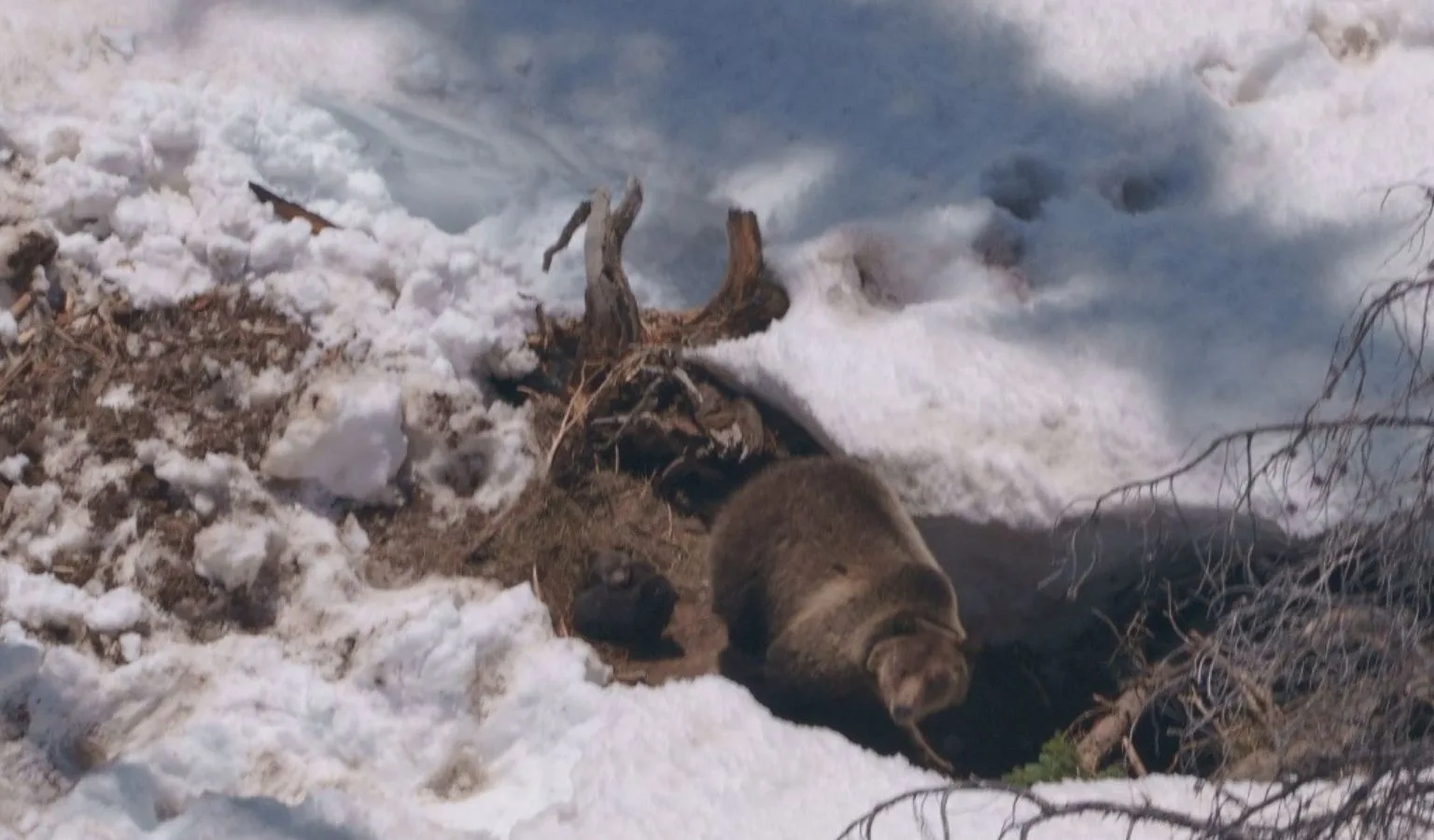
Top photo: The female grizzly bear, captured in Montana and released in Wyoming in the summer of 2024, recently emerged from her den with two cubs) taken during routine WGFD bear monitoring flight
HELENA – Within just two years, the female grizzly that was released in the Greater Yellowstone Ecosystem (GYE) emerged from her den this spring with two cubs in tow – a welcoming sight that represents successful population genetic enhancement and state collaboration. This event marks a milestone for grizzly bear management in America, establishing certain genetic interchange between the Northern Continental Divide Ecosystem (NCDE) in Montana and the GYE.
Biologists released the bear in Wyoming two years ago as part of a joint effort between Wyoming and Montana to establish genetic exchange between the two ecosystems. She was recently seen and photographed with cubs at her den site during a radio-telemetry monitoring flight.
“This is concrete evidence that Montana and Wyoming are committed to sustaining a recovered population of grizzly bears and is a major success in our continued efforts to ensure genetic diversity in these two recovered populations of bears,” said Montana Fish, Wildlife & Parks director Christy Clark.
The female was one of two grizzlies that were translocated through a partnership between FWP, the Wyoming Game and Fish Department (WGFD) and Yellowstone National Park. The other bear was a subadult male. The female was 4 years old at the time of the translocation and is now 6.

The female grizzly from Montana was released in Wyoming during the summer of 2024.
“Grizzly bears in these populations usually give birth for the first time at 5 or 6 years old, so it’s not surprising from an age standpoint,” said FWP grizzly bear researcher Cecily Costello. “It is more surprising because last year she was still very mobile and made many large, wandering movements. We wondered if that energy expenditure might reduce her chances of reproducing, but, from the photo, she appears to be in great condition.”
For many years, Montana and Wyoming have focused on managing an ever-growing bear population in the GYE and NCDE. Recovery levels in the two ecosystems were surpassed years ago.
The current health of the GYE grizzly bear population is sound. The translocation of the bears provided new genetics into the currently isolated GYE grizzly bear population as part of an agreement signed by the states of Montana, Idaho and Wyoming to address a U.S. Ninth Circuit Court ruling following the 2017 delisting of the GYE population. While the best available science indicated genetic exchange among distinct grizzly bear populations was not essential for recovery, increased genetic diversity is advantageous for robust populations.
“This multiagency effort was a shining example of interstate/interagency collaboration and cooperation to address long-term genetic viability concerns raised and embodies both on-the-ground conservation and a commitment to fulfill obligations toward grizzly bear management in the contiguous United States,” said Wyoming Game and Fish Director Angi Bruce.
Annual cub survival rates are just above 50 percent, and they are often slightly lower for first litters.
“So, we do have to wait and see about the survival of this litter,” Costello said. “Even if this litter does not survive, we expect she will be successful in the future.”
Reproduction by the translocated male will be harder to document since it can only be done through the opportunistic capture and genetic sampling and analyses of offspring.
“We are hopeful that he has or will produce offspring, too,” Costello said.
Male mating success is often tied to large body size, and the male is estimated to be 7 years old, which is considered a bit young for challenging other adult males for females.
For more information on grizzly bear management in Montana, including the statewide management plan and dashboards on bear relocation, conflicts, and mortalities, please see FWP’s website.
-fwp-
The above press release is shared by MontanaOutdoor.com as a courtesy to MT FWP