
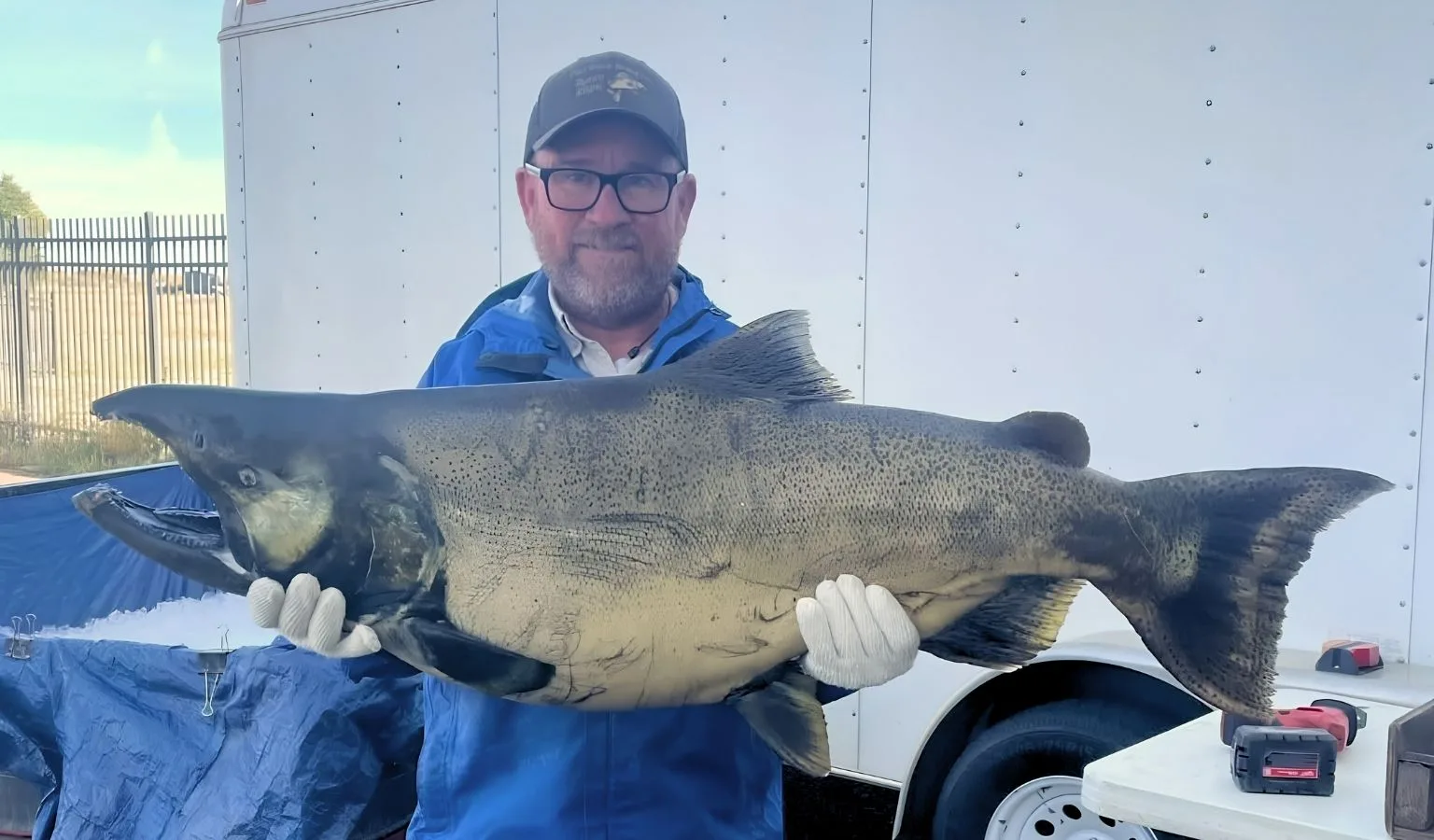
There are fish stories, and then there is the rumor coming off Fort Peck this fall, delivered with a jolt…word around the ramps is that the biggest king Montana FWP crews have shocked up for the annual egg take is a 36-pound male–a hook-jawed brute held up for the camera by hatchery culturist Ryan Lott. Salmon rumors on this reservoir are like wind forecasts…everyone has one, and none ever seems exaggerated. But 36 pounds isn’t a fish story. That’s a lightning rod!!
Montana’s record king is the 32.65-pounder Jim Fauth trolled out of this same reservoir on Aug. 8, 2024. Fort Peck is also the only water in Montana where you can legally snag one, Oct. 1–Nov. 30 (via FWP regs), and a snagged fish counts as legally harvested — FWP’s record book lists its 142.5-pound paddlefish with one word in the tackle column: “Snagged.” So, this 36-pound king would have taken the record by 3.35 pounds, snagged or lured.
But, this big one met the electrofishing boat and the spawn-taking probe. Wade Geraets, FWP Hatchery Manager, says this year’s egg capacity is about 800,000, with 361,000 eggs collected as of Friday, Oct. 9, 2026, per Tyler Haddix, FWP fisheries biologist…which is roughly 45 percent of capacity, so the take is still short. And a fish that never took a hook doesn’t make the record book.
Fort Peck and Chinook Salmon: An Unlikely but Real Fishery
If you’ve never fished Fort Peck Reservoir, the idea of chasing king salmon in northeastern Montana might sound like a tall tale in itself. Fort Peck is a massive Missouri River impoundment — one of the largest reservoirs in the United States by surface area — and it sits in country most people associate with walleye, northern pike, and paddlefish. So how did Chinook salmon end up here, and why do they grow to record-shattering sizes?
The answer lies in FWP’s stocking program. Fort Peck doesn’t have a self-sustaining wild salmon population the way Pacific coastal rivers do. Instead, FWP stocks Chinook periodically, and the reservoir’s combination of deep, cold water and an extraordinary forage base — primarily abundant shad and other baitfish — gives those salmon the fuel to grow fast and grow large. The fish that show up at the ramps in late summer and fall are fat, muscular, and built differently than the river-run kings most anglers picture when they hear “Chinook.” These are reservoir fish, conditioned by a very different environment, and they can clearly pack on weight that rivals anything caught in traditional Pacific salmon country.
The fact that a hatchery electrofishing crew is shocking up 36-pound males during the egg take tells you something important: the fish that anglers never see may be the biggest fish in the lake. The ones that get pressured and caught are, in many cases, not the absolute giants. The giants are sometimes the ones that simply avoided every lure, every hook, and every snagger — right up until the moment the electrofishing boat came around the corner.
How the Annual Egg Take Works at Fort Peck
The annual egg take is central to understanding why this 36-pounder exists and why it will never count as a record. Each fall, FWP hatchery crews run electrofishing operations on Fort Peck specifically to collect eggs and milt from mature Chinook salmon. The process involves temporarily stunning fish with an electrical current — hence “electrofishing” — scooping them up, taking eggs or milt from ripe fish, and then releasing or using the broodstock.
Wade Geraets, FWP Hatchery Manager, confirmed that this year’s egg capacity goal is approximately 800,000 eggs, with 361,000 collected as of October 9, 2026 — roughly 45 percent of the target, meaning crews were still actively working the reservoir. Tyler Haddix, FWP fisheries biologist, provided those numbers, and they illustrate just how significant this operation is. Those eggs will eventually become the juvenile Chinook stocked back into Fort Peck and potentially other Montana waters, continuing the cycle that produces the reservoir’s salmon fishery.
The 36-pound male that Ryan Lott held up for the camera was a broodstock fish — captured for the spawn-taking operation, not by any angler’s rod and reel or snagging hook. Under FWP’s record fish criteria, a fish must be legally caught by an angler using legal tackle to qualify. A fish collected by hatchery crews, no matter how massive, simply doesn’t meet that threshold. The record book is an angling record, not a biological survey record.
The Snagging Question: One Record or Two?
Here’s where things get genuinely interesting for anyone who cares about record keeping, fishing ethics, or both. Fort Peck is unique in Montana because FWP regulations allow anglers to legally snag Chinook salmon during the fall season — check current FWP regulations for exact dates and legal methods, as these can change year to year. Snagging involves casting a weighted treble hook and retrieving it with sharp jerks, intentionally foul-hooking a fish in the body rather than enticing it to bite. It’s controversial in many fishing circles, but it’s a legal and culturally established method at Fort Peck during the salmon season, particularly for anglers who simply want to harvest fish for the table rather than chase the sport of a strike.
FWP’s own record book reflects this reality. The Montana state record paddlefish — a 142.5-pound giant — is listed with a single word in the tackle column: “Snagged.” That fish counts. So when the question comes up about whether a snagged Chinook should share record status with one caught on conventional tackle, FWP’s own precedent says yes — at least for the purposes of the all-tackle record. Had any angler legally snagged that 36-pound male this fall, it would have beaten Jim Fauth’s 32.65-pound record by 3.35 pounds, snagged or lured.
But that opens a debate that has simmered in fishing communities for as long as multiple legal methods have existed for the same species. Should a fish caught by actively enticing a strike — requiring the fish to cooperate, in a sense — carry the same prestige as one foul-hooked while it holds in shallow water? Purists say no. Pragmatists and harvest-oriented anglers say the record book should reflect what’s legal, full stop. There’s no clean answer, and FWP’s current approach of maintaining a single all-tackle record (inclusive of snagging where legal) is one reasonable resolution — though not everyone finds it satisfying.
What This Means for Fort Peck Anglers This Fall
For anglers planning to fish Fort Peck for Chinook this fall, the rumor of a 36-pound fish in the system should be genuinely motivating. If hatchery crews are shocking up males of that size, it’s reasonable to assume there are other large fish moving and staging in the reservoir. The fall season coincides with the salmon’s spawning behavior — fish that would normally migrate upstream to spawn are instead congregating in shallower areas of the reservoir, making them more accessible to anglers than at any other time of year.
Trolling remains the most popular and productive method for Fort Peck Chinook during the open-water season, with deep-diving plugs, spoons, and flasher-and-fly rigs all producing fish. As water temperatures drop in fall, fish movements change, and anglers who stay mobile and pay attention to where hatchery operations are occurring — fish tend to stage near spawning habitat — often find the best action. Always check current FWP regulations before heading out, as methods, seasons, and bag limits are subject to change.
Fort Peck also has a well-developed network of boat ramps and access points, making it fishable for trailered boats of most sizes. The reservoir’s sheer scale — over 134,000 surface acres — means that finding fish requires homework, but the reward when you locate a school of staging Chinook is hard to overstate.
The Record That Wasn’t — And What Comes Next
Jim Fauth’s 32.65-pound Montana record Chinook still stands. The 36-pound male that Ryan Lott held up for the camera will go down in Fort Peck lore, passed around at boat ramps and bait shops, growing slightly with each retelling — that’s the nature of fish stories. But the underlying fact is remarkable enough without any embellishment: a reservoir in northeastern Montana is producing Chinook salmon large enough to challenge the kinds of weights that make headlines in Alaska and the Pacific Northwest.
With roughly half of this year’s egg-take target still uncollected as of mid-October, FWP crews will continue working the reservoir. And somewhere out there in Fort Peck’s cold, deep water, there may be another fish pushing 30 pounds or more — one that hasn’t met an electrofishing boat, and just might find itself on the business end of a snagging hook or a trolling rod before the season closes.
So, what do you think? If somebody had boated this brute by snagging, do you agree that it should still be listed under the same record as one caught on tackle? This is an ongoing debate that most likely will not ever be settled.
Feature photo: Montana Fish, Wildlife and Parks hatchery culturist, Ryan Lott
Montana's outdoor week, in your inbox at 7am Friday.