
BRETT FRENCH | bfrench@billingsgazette.com
As the Thanksgiving holiday draws near, Montana downhill skiers and snowboarders are anxiously awaiting the opening of mountain resorts, but the long-range weather forecast is more Grinch than grin right now.
“We have nothing in the forecast, and temperatures for the next month are for much above normal,” Michael Downey, Drought Program coordinator for the Montana Department of Natural Resources and Conservation, wrote in an email.
The National Weather Service’s three-month outlook shows northwest Montana fairing poorly through January, with below-normal precipitation and above normal temperatures forecast.
“Conditions in northwest Montana are beginning to look bleak,” Downey said.
The rest of the state may fare a little better, but overall the trend for the end of 2026 and the start of next year is for mild weather.
“The only thing anyone can agree on is that this winter will be warmer than average,” Downey said. “We will still get some cold snaps but they will be short. When we get snow, be prepared to pack up your skis and go because it is unlikely to last.”
Big Sky Resort advertised it’s not sweating an El Niño year, touting it consistently receives an average of 400 inches of snow a year.
The El Niño effect
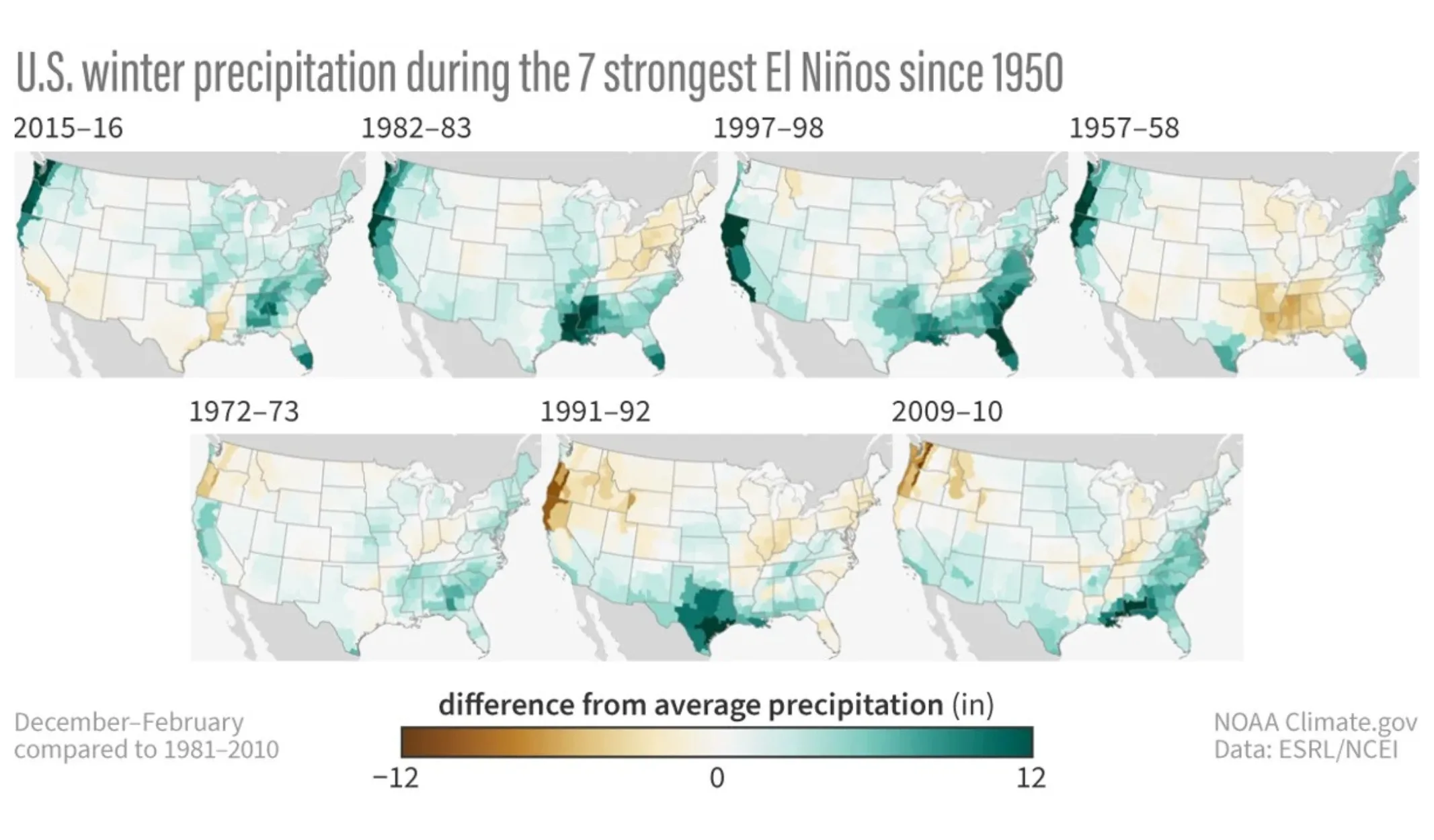
Across the United States, this winter’s weather will be affected by a “potentially record-setting El Niño” due to the Pacific Ocean’s warming surface waters, according to the U.S. Department of Agriculture.
In a USDA graphic looking at the last seven strongest El Niños since 1950, precipitation in Montana was mostly average with the northwest corner seeing the greatest variation between below- to above-normal precipitation.
However, Downey doesn’t put a lot of stock into forecasts looking too far into the future.
“All the long-range forecasts are dominated by El Niño projections which are notoriously unreliable,” he said. “Long story short, nobody knows where this is headed except it’s likely to be warm.”
Southeast MT still dry
In southeastern Montana, where portions of Powder River, Carter, Fallon and Custer counties remain in moderate to extreme drought, a drier winter is concerning.
Downey said this rural area near the borders of Wyoming and the Dakotas can’t seem to catch a break.
“The biggest challenge right now is surface water which all the locals are saying hasn’t been this low since 1988,” he said. That’s the year Yellowstone National Park caught fire.
“I worry that it will be a long, warm and dry winter for those folks, but conditions can change quickly.”
Where to ski?
Onthesnow.com doesn’t mention any Montana ski areas as good places to visit in November, although it highlights nearby Grand Targhee in Idaho and Jackson Hole in Wyoming as possible options.
The website nevertheless touts five ways to “experience a Montana winter” in a post sponsored by the Montana Department of Commerce. In addition to touting local ski areas “full of heart and stoke,” the post also highlights soaking in hot springs, scenic drives and small town vibes.
Big Sky Resort is scheduled to be the first ski area in Montana to open on Nov. 25, although Great Divide outside Helena often likes to squeeze in an early opener to claim first place. Otherwise, the area’s opening date is set for the day after Thanksgiving, Nov. 27, as is Red Lodge Mountain.
Discovery near Anaconda, Whitefish Mountain and Montana Snowbowl in Missoula are all tentatively scheduled for Dec. 4 opening days. They are followed by Bridger Bowl, Lost Trail-Powder Mountain south of Hamilton and Showdown Montana near White Sulphur Springs which are set to open Dec. 11.
This year it looks like the earliest opening Montana ski areas will need cold nights and snowmaking machines to deliver slope access.
Widespread drought
Last season saw record-setting low amounts of snow in much of Colorado and Utah, starving the region’s ski economy, but this month and into January the outlook for precipitation is above normal, especially in southeastern Colorado.
Portions of the Southwest have already been hammered by heavy rains. That was evident at Lake Powell, along the Utah-Arizona border, where the water level has climbed almost 20-feet since Oct. 2. Despite the influx of floodwater, the long reservoir is only 26% full. And fall rains don’t necessarily translate into wet winters.
The South has also seen drought conditions, raising feed costs for cattle producers in 13 states. Across the nation almost half of the cattle were in areas that are experiencing some type of drought, with a third in severe drought or worse.
Drought has forced many ranchers to reduce their cattle herds, hitting a record low in July of about 28.5 million beef cows.
Montana's outdoor week, in your inbox at 7am Friday.