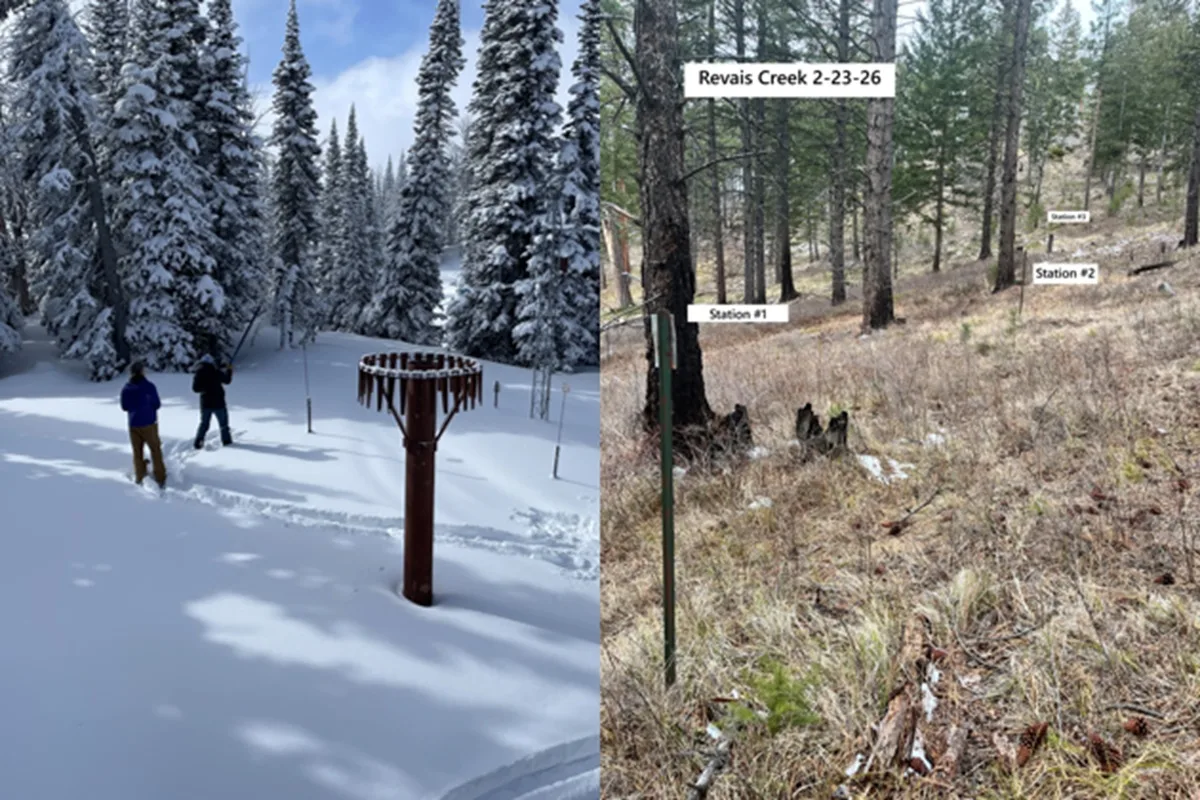
As of March 1, most Montana basins are now reporting below normal snowpack, ranging from around 60% to 95% of median.
“The current snowpack percentages compare the amount of snow water equivalent in the mountains to the median amount typically seen on March 1. During March and April, these values generally remain more stable than people might expect. For example, during a low‑snow year like the one Montana is currently experiencing, snowpack often sits around 70-80% of median. In contrast, a high‑snow year might reach 120-130%,” explains Florence Miller, USDA Natural Resources Conservation Service (NRCS) Hydrologist. “Percentiles provide a different perspective by telling us how conditions rank compared to all others on record. Think of lining up all winters from lowest to highest snowpack, this year’s conditions largely range from the 5th to 30th percentiles, meaning our current snowpack ranks in the bottom 5% to 30% of all seasons.”
There are some notable exceptions. The Upper Clark Fork currently ranks at the 45th percentile, the 50th percentile would be considered a normal winter. The Tongue River basin is currently in the 0th percentile, setting the record for lowest snowpack documented on March 1. A stark elevational contrast persists in this year’s snowpack. Higher elevation SNOTEL sites are reporting closer to normal values, and lower elevation SNOTELs and snow courses are reporting record breaking lows. Of the 232 SNOTEL and Snow Course snow monitoring stations measured on March 1 with at least 30 years of data, 24 experienced their lowest snowpack on record, 26 their second lowest, and an additional 28 were in the lowest five years on record.
February brought well below normal precipitation (35% to 80% of median) to SNOTEL sites in northwest and central Montana, as well as the Powder and Tongue river basins. Southwest and south central Montana received near to slightly below normal monthly precipitation (90% to 100% of median). Water-year-to-date precipitation remains at 100% to 135% of median, thanks to the record breaking precipitation delivered by December’s atmospheric river. The full influence of this early season moisture remains to be seen. While December precipitation likely helped recharge groundwater sources and stock high elevation snowpacks, warm temperatures and the lack of valley snow coverage may reduce those benefits. This year has brought above normal temperatures to every month of the snowpack accumulation season. Drought conditions worsened in February, with 95% of the state now experiencing drought conditions. This is a drastic increase from the December 30 drought conditions, where only 52% of the state was experiencing drought conditions, and is an example of the diminishing influence of December precipitation.
NRCS Water Supply Forecasts are published March through June. March 1 forecasts provide an initial look at what snowmelt driven runoff might look like this year. Water supply volumes for April-July and April-September are forecasted at near to below normal across the state.
“The March 1 forecasts are reflective of high water-year-to-date precipitation and high elevation snowpack,” explains Miller. “Given the inherent uncertainty of early spring forecasts, and the lack of valley snow, it could be prudent for water users to make conservative management decisions that take into account the full suite of forecast predictions, especially on the lower end.”
Uncertainty in this month’s forecast is derived from the uncertainty of future spring weather. Seasonal snowpack typically peaks in early to late April. How close middle and high elevation snowpacks come to reaching their normal peak will largely determine snowmelt driven runoff. Although snowpack deficits are unlikely to make a full recovery, ample spring precipitation could moderate the effect on summer streamflow. Likewise, a continuation of warm and dry conditions could further diminish forecasts.
More Information
A full report of conditions on January 1 can be found in the monthly Water Supply Outlook Report available on the Montana Snow Survey website. In addition, real-time snow survey data can be found at nrcs.usda.gov/montana/snow-survey.
For 90 years, NRCS has helped farmers, ranchers and forestland owners make investments in their operations and local communities to improve the quality of our air, water, soil, and wildlife habitat. NRCS uses the latest science and technology to help keep working lands working, boost agricultural economies, and increase the competitiveness of American agriculture. NRCS provides one-on-one, personalized advice and financial assistance and works with producers to help them reach their goals through voluntary, incentive-based conservation programs. For more information, visit nrcs.usda.gov.
Source: NCRS press release
Montana's outdoor week, in your inbox at 7am Friday.