
Genome analysis of over 800 polar and grizzly bears reveals no new hybrids and confirms the eight previously-known “grolar bears”

Genome analysis of over 800 polar and grizzly bears reveals no new hybrids and confirms the eight previously-known “grolar bears”

Posted by Moosetrack Megan on June 26, 2024

Bozeman, Montana and Winnipeg, Canada — June 13, 2024 — Researchers from Environment and Climate Change Canada, Polar Bears International, University of Manitoba, MacEwan University, Government of Northwest Territories, and San Diego Zoo Wildlife Alliance today published “Development of an 8K SNP chip to assess adaptive diversity and hybridization in polar bears” in the Conservation Genetics Resources journal. This is the first-ever large-scale analysis of how often hybrids of polar and grizzly bears exist in the wild, made possible by developing an innovative SNP genetic sequencing chip, which is a new tool to analyze samples from polar and grizzly bears. This report analyzed 371 historic polar bear and 440 historic grizzly bear samples from across Canada, Alaska, and Greenland and confirmed that only the eight already-known are hybrids, thus underscoring the rarity of hybridization.

Range expansion, facilitates hybridization of two large carnivores: “Polar bears evolved from grizzly bears several hundred thousand years ago and although gene flow has occurred between the two species in the past, it appears that recent hybridization is restricted to a small group of polar bears and brown bears in the western Arctic,” says co-author Evan Richardson, Research Scientist at Environment and Climate Change Canada, adding, “This study develops a new genomic toolset to rapidly detect hybrids and indicates that contemporary hybridization is not a conservation concern.”

Hybridization, increasing but rare: This report answers the question of, “How many polar-grizzly bear hybrids are there?” which responds to an expectation that the numbers of polar-grizzly hybrids were increasing. Out of 819 wild grizzly and polar bears across Canada, Alaska, and Greenland, encompassing four subpopulations, this report found that only eight hybrids exist, or 1% of the samples. This report analyzed samples of polar bears, grizzly bears, and known hybrids collected between 1975 and 2015, with the first hybrid not appearing until 2006. While it is a rare occurrence, it is a recent one, suggesting hybridization is a result of warming temperatures causing their habitats to increasingly overlap.

“We were surprised to find no new cases of polar-grizzly hybrids despite speculation of increasing numbers,” says co-author Dr. Ruth Rivkin, postdoctoral research fellow with Polar Bears International, University of Manitoba, and the San Diego Zoo Wildlife Alliance, “We’re proud that this new chip allows rapid identification of polar-grizzly bear hybrids, which will be an important tool as the climate warms and polar and grizzly bears come increasingly into contact.”

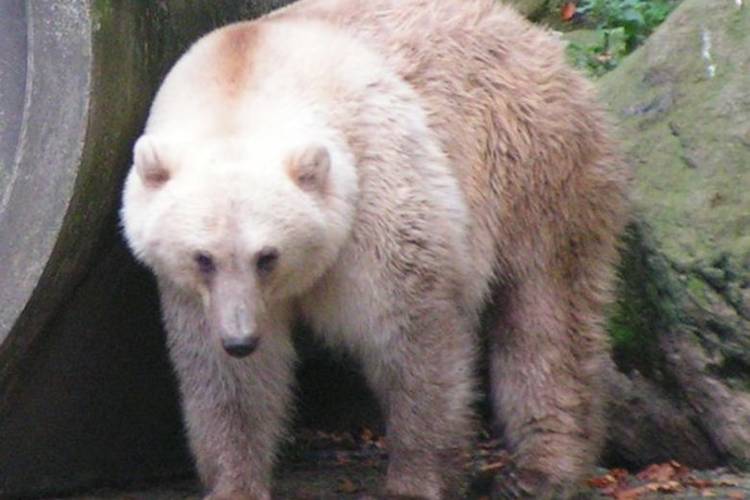
A grizzly-polar bear hybrid at Osnabrück Zoo.

Photo: Corradox

A grizzly-polar bear hybrid at Osnabrück Zoo.

About hybrids (also known as pizzly bears or grolar bears): Hybrids of grizzly and polar bears are often referred to as grolar or pizzly bears depending on the paternal lineage, i.e., a grolar bear when the father is a grizzly bear, and a pizzly bear when the father is a polar bear. This study confirms the existence of eight known grolar bears in the wild as the descendants of one female polar bear. Hybridization is only possible in areas where grizzly and polar bear distributions overlap (thus excluding regions like the high Arctic). Hybridization is uncommon but expected to increase as climate change pushes grizzly bears northward, increasingly into polar bear territories, but hybrids are still ill-suited to adapt to the changing Arctic.

“This report underscores that hybridization is remarkably rare, and that hybridization is not an adaptive capability of polar bears,” says Geoff York, senior director of research and policy at Polar Bears International, who was not involved in the report. “The report introduces a new tool for wildlife managers to use as they evolve their strategies due to a warming climate and changing ecosystems.”

Technological breakthrough: This research developed the new 8K genotyping chip, called the Ursus maritimus V2 SNP chipwhich is a genetic tool used to analyze polar bear samples in a lab. It reads the genetic samples, allowing rapid and reliable genome analysis, and spots polar bear-grizzly hybrids with 100% accuracy. The Ursus maritimus V2 SNP chip is a result of years of development through the Genomics Research and Development Initiative STAGE funding by Environment and Climate Change Canada. The authors had access to long-term, robust polar bear data from Canadian government and territorial monitoring programs, which have been collecting data since 1966, and which were critical to the research and Ursus maritimus V2 SNP chip development. This chip is an important tool for wildlife managers, scientists, policymakers, and conservationists to identify hybrid bears and further enable their protection and more effective wildlife management.

“Our newly developed technology allows rapid and accurate consideration of over 8,000 genetic markers in polar bears,” notes lead author Dr. Joshua Miller, Assistant Professor, Biological Sciences, MacEwan University, adding “This will allow for the assessment and monitoring of genetic diversity, which is a key part of a species’ ability to survive changing environmental conditions.”

About Environment and Climate Change Canada
ECCC is the lead federal department for a wide range of environmental issues, including taking action on clean growth and climate change. The Department is also engaged in activities aimed at preventing and managing pollution, conserving nature, and predicting weather and environmental conditions.

About MacEwan University
Founded in 1971, MacEwan University inspires its students with a powerful combination of academic excellence and personal learning experiences. Offering more than 90 programs including undergraduate degrees, applied degrees, diplomas, certificates, continuing education, and corporate training, the university provides a transformative education in a creative, collaborative, and supportive learning environment where creativity and innovation thrive. Located in Edmonton, Alberta Canada, MacEwan University offers a unique student experience that opens up diverse pathways for achievement and growth.

About the University of Manitoba
The University of Manitoba is recognized as Western Canada’s first university, with more than 29,000 students, 5,000 academic staff, 3,900 support staff, and more than 188,000 alumni. It is part of the U15, ranking among Canada’s top research-intensive universities, and is Manitoba’s only medical-doctoral post-secondary institution. The University provides exceptional liberal arts, science, and professional programs of study, inspiring undergraduate and post-graduate students to positively impact their communities as globally engaged citizens. UM campuses are located on the original lands of Anishinaabeg, Ininiwak, Anisininewuk, Dakota Oyate, and Dene, and on the National Homeland of the Red River Métis. We respect the Treaties that were made on these territories, we acknowledge the harms and mistakes of the past, and we dedicate ourselves to move forward in partnership with Indigenous communities in a spirit of Reconciliation and collaboration. For more information, please visit umanitoba.ca.

About San Diego Zoo Wildlife Alliance
San Diego Zoo Wildlife Alliance, a nonprofit conservation leader, inspires passion for nature and collaboration for a healthier world. The Alliance supports innovative conservation science through global partnerships. Through wildlife care, science expertise and collaboration, more than 44 endangered species have been reintroduced to native habitats. Annually, the Alliance reaches over 1 billion people, in person at the San Diego Zoo and San Diego Zoo Safari Park, and virtually in 150 countries through media channels, including San Diego Zoo Wildlife Explorers television programming in children’s hospitals in 14 countries. Wildlife Allies—members, donors, and guests—make success possible.

About Polar Bears International
Polar Bears International’s mission is to conserve polar bears and the sea ice they depend on. We also work to inspire people to care about the Arctic, the threats to its future, and the connection between this fragile ecosystem and our global climate. Polar Bears International is the only nonprofit organization dedicated solely to wild polar bears and Arctic sea ice, and its staff includes scientists who study wild polar bears. The organization is a recognized leader in polar bear conservation. For more information, visit www.polarbearsinternational.org.

Topics
Hunt in Montana

Tongue River Marina Ice Fishing Report (Feb. 28): Open Water Growing Near Ramp, Marina Bay Still Iced

Mar-01-26 by Angela Montana

Tongue River Marina reports 15–20 feet of open water off the ramp, with Marina Bay still mostly iced over but improving. More open water is showing from Rattlesnake south toward the mine as daytime temps warm—boat fishing could be just weeks away.

Makoshika State Park: Montana’s Largest State Park (Badlands Hikes, Dinosaurs & Stargazing in Glendive)

Mar-01-26 by Angela Montana

Makoshika State Park near Glendive is Montana’s largest state park—about 11,538 acres of rugged badlands, hoodoos, and wide-open sky. Built on the fossil-rich Hell Creek Formation, it’s a must for dinosaur fans and anyone looking for hiking, a scenic drive, camping, a visitor center, and even disc golf in the badlands.

LIVE Saturday Mornings
from 6:06am to 8:00am

Montana Outdoor Podcast

New Episodes Every Saturday!

Montana FWP’s New License Ambassador Program Replaces License Providers March 1 — What Hunters & Anglers Need to Know

Feb-28-26 by Angela Montana

Montana Fish, Wildlife & Parks is rolling out big licensing and regulation changes on March 1, including a new License Ambassador Program to replace the longtime License Provider system in local sporting goods stores. Here’s what the Montana Outdoor Podcast revealed—and where to learn more, find ambassadors, and submit questions.

What is the License Ambassador Program? Find Out Here!

Feb-27-26 by Angela Montana

This week on the Montana Outdoor Podcast, Dale interviews Greg Lemon about significant hunting regulation updates and the new License Ambassador Program, replacing the outdated License Provider Program. Check out this exclusive sneak peek!

Life-Saving Skills You Can Learn: Downrigger Dale Interviews Instructor Racheal Vargas

Feb-21-26 by Angela Montana

On the Montana Outdoor Podcast, host Downrigger Dale talks with instructor Racheal Vargas (Montana K9 Safety and Montana Health & Safety Training) about practical, life-saving skills you can learn through training for individuals and groups—including preparation to help friends, family, and even pets in emergencies.

Flathead Lake Dam Decisions: How Ripple Effects Travel Downriver to Portland

Feb-14-26 by Angela Montana

By popular demand, we’re running last week’s in-depth podcast episode for a second week. Guest Brian Lipscomb explains how what happens at Flathead Lake—especially at the dam—can ripple through the Flathead River system and influence ecosystems, communities, recreation, and agriculture far beyond the lakeshore.

Flathead Lake Dam & Hydropower Explained: Energy Keepers CEO Brian Lipscomb on the Montana Outdoor Podcast

Feb-07-26 by Angela Montana

Montana Outdoor Podcast host Downrigger Dale talks with Brian Lipscomb, CEO of Energy Keepers, Inc., about the dam on Flathead Lake—now known as the Séliš Ksanka Ql̓ispé Hydroelectric Project. Learn the history, what surprised Dale most, why lake levels stayed high longer this year, and where to find reliable water level, flow, and forecast resources.

Montana Outdoor Podcast: Yellowstone Summit Preview, Dates & How to Register

Jan-31-26 by Angela Montana

Downrigger Dale talks with Yellowstone Summit organizers George Bumann and Jenny Golding for an exclusive preview of the 5th annual online event (Feb. 19–22). Get the key dates, what the Summit is, and how to register—plus how to watch or listen to the episode and explore speakers and sessions.

Skijoring’s Evolution: From Ancient Winter Travel to High-Speed Western Sport

Jan-27-26 by Angela Montana

Skijoring began as practical winter travel—skiers pulled by dogs, reindeer, and later horses—before turning into a spectator sport. From early Nordic Games and brief Olympic-era exhibitions to today’s high-speed, technical races in the American West, here’s how skijoring evolved and why Montana is at the center of its modern resurgence—plus the latest Montana Outdoor Podcast episode to watch.

Montana Fishing Reports

Montana Tourney Trail

MT Wildlife

Video: Coyote Chases 3-Year-Old Through Front Gate in Pasadena—Mom’s Scream Sends It Running

Feb-26-26 by Angela Montana

A coyote was captured on camera chasing a 3-year-old boy through the front gate of his Pasadena home—until his mom’s scream from inside the yard sent the animal the other way. It’s a stark reminder that wildlife awareness isn’t just for the backcountry; sometimes it starts right in the front yard.

Elk Hoof Disease Explained: How TAHD Spreads, What Researchers Know, and Why Hunters Are Worried

Feb-25-26 by Angela Montana

Elk hoof disease (TAHD) is a painful, polymicrobial infection that leaves elk lame and struggling to walk. First detected in Southwest Washington in the late 1990s, it surged after 2007–2008 and has spread into parts of Oregon, Idaho, and California. With no vaccine or treatment for wild elk and many unanswered questions about transmission and vulnerability, hunters and wildlife managers across the West—especially in nearby states like Montana—are watching closely.

Watch a Cow Elk Defend Her Calf From a Mountain Lion in Montana (Wild Video)

Feb-24-26 by Angela Montana

A cow elk in Montana wastes no time going full defense mode when a mountain lion is near her calf. Hooves fly as the mother elk stomps and strikes—an intense reminder that wildlife threats in the backcountry aren’t limited to predators.

Viral Stories

DIY Ice Fishing Hole Cover Hack: Warmer Feet in an Ice Shelter (Clam X600 Setup)

Dec-21-25 by Angela Montana

Minnesota angler Beau Rochel shared a simple DIY multi-hole cover for a Clam X600 ice shelter to help keep feet warmer while fishing. Here’s the basic idea, materials mentioned, and an easy foam-tile alternative that’s becoming a trend for overnight shack anglers.

Massive Elk Herd Roams Through Colorado Neighborhood Yards, Stuns Mom and Daughter

Dec-19-25 by Angela Montana

A mom and daughter in Colorado were stunned when a massive elk herd took over their neighborhood yards. The same elk have also been seen along a nearby highway and even shutting down a local golf course—another reminder that in elk country, wildlife can show up anywhere.

Helena’s Team Grey Bull Lands $500K+ at Bisbee’s Los Cabos Offshore Tournament With 398-Pound Black Marlin

Nov-05-25 by montanaoutdoor

A six-man crew from Helena, Montana, took home more than half a million dollars at Bisbee’s Los Cabos Offshore Tournament in Cabo San Lucas, Mexico. Team Grey Bull beat out a packed field to place third in the Billfish Division after landing a 398-pound black marlin.

Rare Video: Wolverine Hunting a Deer Near Ajax Mountain, Montana (2017)

Oct-19-25 by Angela Montana

Shot over the 4th of July weekend in 2017 near Ajax Mountain, Montana, this rare clip captures a wolverine in action. Wolverines are famously elusive in the Lower 48—only about 300 are thought to remain—and can travel 18–20 miles in a single day.

Bear, an AKC Anatolian Shepherd, Heads From Montana to South Africa for Livestock Guardian Dog Program

Aug-15-25 by Angela Montana

Wild Rooster Farm’s Bear, an AKC purebred Anatolian Shepherd from Kalispell, Montana, is set to travel to South Africa to join the Cheetah Outreach Trust as a breeding stud in its Livestock Guardian Dog program—aimed at protecting livestock while supporting cheetah conservation.

Montana FWP

Opening Day Plans for Blackfoot-Clearwater Antler Hunters in 2026

Feb-26-26 by Angela Montana

The Blackfoot-Clearwater WMA opens for antler hunting on May 15, but nonresidents must wait until May 22. Vehicle access requires registration, with a focus on safety and group arrivals.

Montana Big Cats: Bobcat and Mountain Lion Hunting Closures

Feb-26-26 by Angela Montana

Montana’s bobcat hunting and trapping in Region 6 will close on February 28. Mountain lion hunting in LMU 280 ends on February 27, 2026, following quota limits. Check FWP’s website for updates.

Wild Game Recipes

Cooking with Kokanee Quinn: Grilled Bison Tri-Tip Recipe

Feb-28-26 by Angela Montana

Kokanee Quinn shares a delicious bell pepper chimichurri recipe designed for bison or elk tri-tip, elevating wild game with fresh ingredients and vibrant flavors for an unforgettable grilling experience.

Venison Sausage Stuffed Pancakes (Easy Breakfast Recipe from Kokanee Quinn)

Feb-21-26 by Angela Montana

These venison breakfast sausage stuffed pancakes—credited to Jenn Homa and shared by Kokanee Quinn—deliver a sweet-and-salty, handheld breakfast that’s perfect for cold mornings, early alarms, and everything from rut-chasing to couch lounging.