
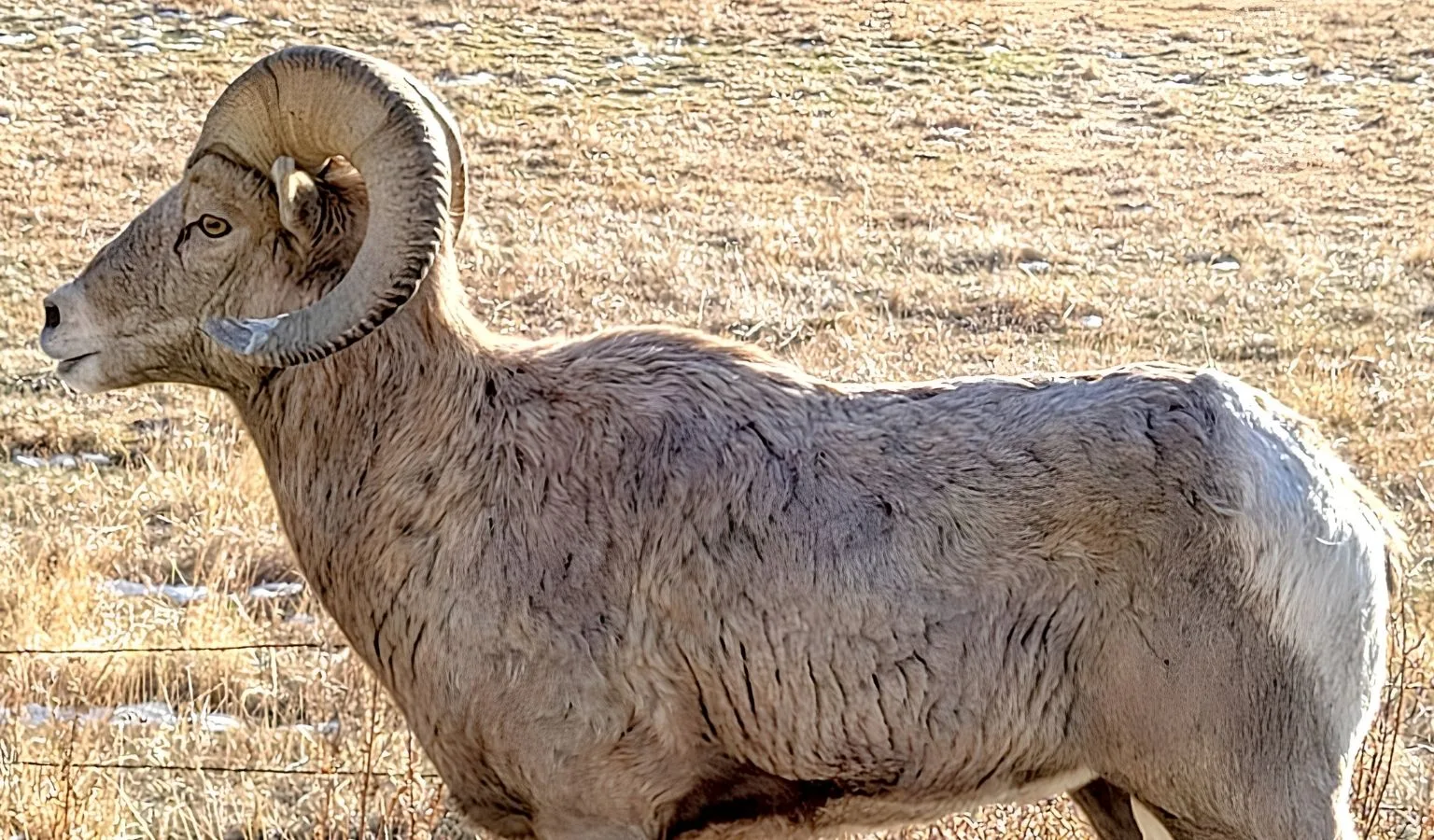
BRETT FRENCH | bfrench@billingsgazette.com
In the early 1800s, bighorn sheep were widespread along the eastern portions of the Missouri and Yellowstone rivers in what would become Montana.
Six years ago, a study was published identifying many of those same areas as possible sites for restoring bighorn sheep that have since vanished.
Earlier this month, Montana Fish, Wildlife & Parks convened a public panel to explore the re-establishment of bighorns in central and Eastern Montana where private lands dominate.
“We’ve kind of tackled the low-hanging fruit,” FWP wildlife biologist Brent Lonner pointed out in his educational video primer for the panel. “Now the question is what other opportunities are available?”
In the past, such relocations have focused on public lands. But of the more than 4,300 square miles of bighorn sheep habitat identified in Eastern Montana in the 2020 study, 44% is private land.
“So there’s a lot of potential out there, but a lot of complicating factors that make it difficult,” Lonner said. “It’s going to be challenging. It’s not easy.”
Thanks from the director
FWP Director Christy Clark told the group at its first meeting, “I guarantee you, we will take your recommendations and your input very seriously as we try to draw some conclusions about how to move forward.”
Before the end of this year, Clark said the panel should help the department “identify recommendations related to hunting access, species management and landowner and broader public support” to help in its decision-making process.
The panel held its first in-person meetings at the Region 3 Office in Bozeman on Thursday, Oct. 22, and Friday, Oct. 23.
The group includes an outfitter, former FWP biologist and members of the Montana Wild Sheep Foundation and Montana Wool Growers Association, among others.
The meetings will be broadcast over Zoom. The link to join and comment, the meeting agenda, and additional background materials are available on the FWP website.
Members of the public are invited to listen in and will have an opportunity to provide comments each day.
Bighorns over the years
Panel members have been provided reams of information to consider before they meet, including a good dose of history.
Before Europeans’ arrival in North America, it’s estimated more than 100,000 bighorn sheep may have populated what is now Montana. Explorers Meriwether Lewis and William Clark reported 27 sightings of the species during their crossing of the state in 1805-1806.
Loss of habitat to livestock, unregulated hunting and disease nearly wiped out bighorn sheep by the early 1900s. Pneumonia can be especially devastating to bighorn populations, FWP has learned over the years, killing as many as half a herd’s adults and leading to years of poor lamb recruitment.
In 1941, FWP began bighorn sheep research and management to increase their numbers. Nine years later, following capture and transplant operations, it was estimated about 1,200 bighorns lived in 16 separate herds.
Over time, FWP has relocated about 2,500 bighorn sheep in 176 separate captures to 40 different areas of Montana. Another 500 Montana bighorns have been trapped and moved to other states. Only twice have 28 animals been moved in from outside of Montana.
Thanks to all of that work, FWP has largely filled in a lot of the places where sheep had lived in the 1800s, Lonner said.
“We’ve certainly recovered sheep numbers across the state,” he added.
Yet the agency has still fallen short of goals established in its 2010 Bighorn Sheep Conservation Strategy — 45 herds with a population of around 6,600 animals. In 2024, the state population was estimated at around 4,700 animals.
“Our distribution has certainly improved,” Lonner said, even if numbers aren’t as high as they may have been in the 1800s.
Yet Craig Neal, owner of the outfitting business Broken Hart Adventures, told the group at its initial meeting, “I think there’s a lot of need to explore different avenues to expand sheep, grow sheep, and take advantage of the sheep that we have.”
The limits of translocations
Although some bighorn sheep translocations have been hugely successful, such as on Wild Horse Island in Flathead Lake, which grew a world-record ram, other herds have boomed and then went bust. The most recent was a herd in the Missouri Breaks that peaked at 318 animals in 2016 before falling to only a couple of animals last year.
Disease, poor habitat and predation have all been identified as challenges to bighorn sheep success.
With much of the habitat on the west side of the state filled, could Eastern Montana provide a new outlet for bighorn transplants?
One hurdle the panel will have to overcome is how that looks on lands where private property may make up a larger percentage of the landscape than public lands. Would private landowners enter agreements to allow public hunting before animals are stocked?
The Montana Wildlife Federation’s board president, Mike Mershon, said the group is “wary of potential solutions that include landowner sheep hunting permits or prioritization when it comes to such a coveted public resource as wild sheep.”
Privatization of wildlife in Montana has long been battled by conservation groups. Could this type of situation open the door to such actions?
“Incentive-based approaches are welcomed,” Mershon added, “but sheep hunting permits cannot and should not be a bargaining chip.”
Clint Nagel, of the Gallatin Wildlife Association, agreed, saying, “It must be seen that the bighorn sheep belong to all the people of Montana, not just the landowners.”
Considering private lands for transplants makes sense, considering how much of it there is in Montana, he added. However, Nagel is concerned about places where domestic sheep or goats were previously grazed.
“These lands absolutely should be taken out of consideration due to the dangers of the spread of disease,” he said. “There needs to be a great deal of scrutiny on the lands chosen for bighorn sheep restoration.”
What’s the panel’s charge?
Brian Wakeling, chief of FWP’s Game Management Bureau, wrote in an email, “The advisory panel’s charge is to recommend to FWP a set of guidelines for approaching bighorn sheep restoration surrounding private lands. The department will evaluate these recommendations and develop a standard approach for responding to proposals, identifying opportunities, and pursuing such actions.”
Wakeling said the process was prompted by several factors, including the availability of possible habitat, the stagnation of the program in the western third of the state and interest expressed by private landowners and bighorn sheep advocacy groups.
Panel member Cody Wetmore, manager of the 80,000-acre Climbing Arrow Ranch north of Bozeman, has a specific interest in the outcome of the process.
“I think my goal out of this group would be to find a way to, you know, utilize a resource like the ranch that I manage, and that private land, and how that integrates with a public resource like bighorn sheep, and getting the public able to hunt them, and you know, navigating that whole difficult and sticky situation,” he said in the initial meet and greet.
Wakeling said he is hopeful the panel can provide insights that FWP has overlooked. Once the panel has developed a set of recommendations, they will be provided to director Clark who will have the final say on implementation.
Approaches based on species
The work stands in contrast to other wildlife FWP has worked to keep off private lands, including disease-free bison on state lands and elk that may carry the disease brucellosis, which is transmittable to cattle.
However, in the case of bighorn sheep, it is domestic livestock that pose a threat to their lives through disease transfer rather than the other way around.
Any growth in the population of predators such as wolves, mountain lions, grizzly and black bears are also typically seen as a concerns for landowners, because of possible depredation.
Despite repeated calls from conservation groups for FWP to acknowledge public support for predator species, the agency has been repeatedly directed by Republican legislation to manage the animals to low population levels.
“Generally speaking, we support efforts to expand and improve native bighorn sheep populations and habitat, and recognize that private lands are a key part of that equation,” Mershon said. “Cooperative efforts to minimize commingling of domestic sheep and wild bighorns are important, as are financial incentives for landowners to conserve habitat and take necessary steps to prioritize wild bighorns. We also prioritize access agreements to go along with public investments.”
Wakeling told the panel he prefers to see the challenges facing the group as opportunities.
When it comes to placing public wildlife on private land to boost conservation of the species, what kind of compromises might be made?
What happens if the landowner sells the property where sheep have been translocated?
“Does that compromise the relationship, or what we’ve done with public resources as a result of that?” Wakeling asked. “Nevertheless, from a conservation standpoint, it’s extremely important to continue increasing the range and increasing the diversity that we have.
“We can’t promise that we’re just absolutely going to adopt whatever you guys might think is the absolute best idea, but we can promise that whatever you produce, whatever you share, is something that we are going to be transparent about.”
Feature photo by Angela Maxwell | Available for use with credit
Montana's outdoor week, in your inbox at 7am Friday.