Confederated Salish and Kootenai Tribes Staff Honored with Statewide Conservation Awards
Posted by Angela Montana on March 3, 2026
Big congratulations are in order for the Confederated Salish and Kootenai Tribes, as four of their Natural Resources rockstars just earned major statewide recognition for decades of boots-on-the-ground conservation work. With more than a century of combined service between them, their awards aren’t just personal milestones — they’re a testament to the Tribes’ long-standing commitment to science-driven stewardship and caring for the land and waters that sustain us all.
Check out their press release:
The Confederated Salish and Kootenai Tribes (CSKT) are proud to announce that four Natural Resources staff members have received prestigious statewide recognition for their decades of leadership in fisheries and wildlife conservation.
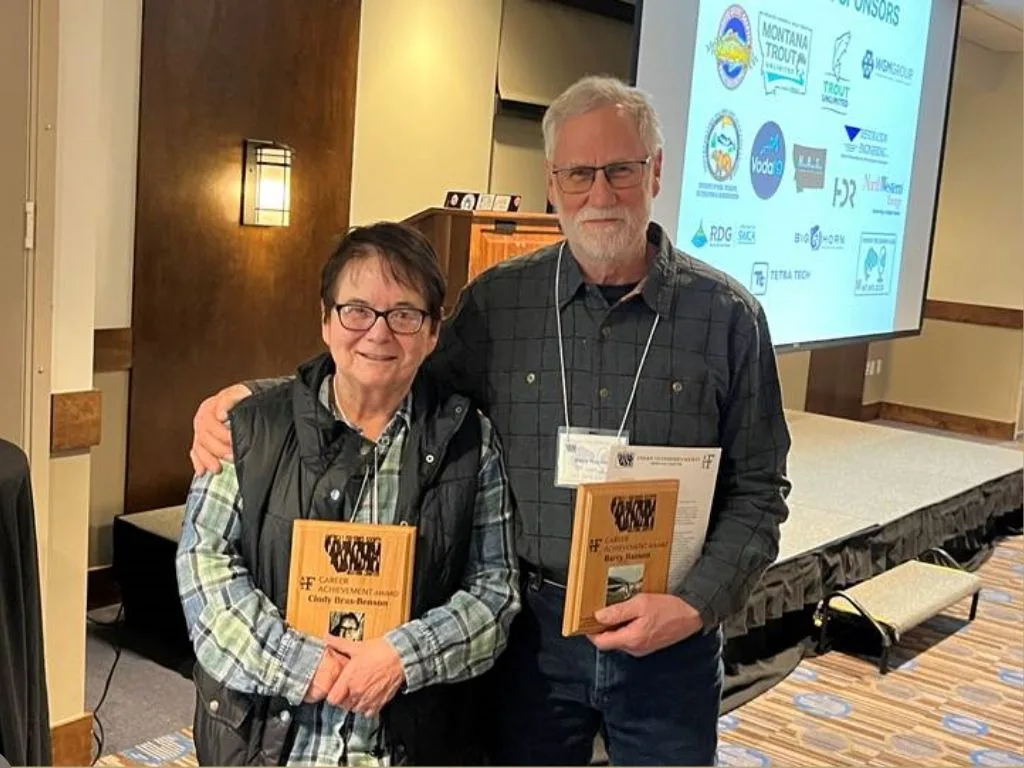
Les Evarts, Barry Hansen, and Cindy Benson were honored with the Montana Chapter of the American Fisheries Society Career Achievement Award, and Art Soukkala received the Montana Chapter of The Wildlife Society Distinguished Service Award.
Career Achievement in Fisheries Conservation
Les Evarts began his career with CSKT in 1989 and served 26 years as Fisheries Program Manager. Over more than three decades, he led major aquatic restoration efforts, advanced bull trout recovery, and managed multimillion-dollar conservation projects with fiscal integrity and vision. His most enduring legacy is the restoration of the Jocko River, screening irrigation diversions, establishing instream flows, reconstructing channel form and function, and securing Tribal ownership of critical riparian lands. Today, the Jocko River stands as one of the healthiest rivers flowing through an agricultural landscape in Montana.
Barry Hansen has dedicated nearly 40 years to aquatic resource conservation, including more than 35 years with CSKT. His work spans instream flow protection, forestry and riparian restoration, shoreline management, and innovative habitat design on Flathead Lake. Barry played a key leadership role in the Flathead Lake and River co-management planning process and helped guide long-term efforts to restore balance between introduced Lake Trout and native fish populations. His perseverance and commitment to science-based management have left a lasting mark on the Flathead Basin.
Cindy Benson joined the Tribal Fisheries Program later in her career and quickly became central to its success. Beginning as a creel clerk on Flathead Lake, she later directed the Mack Days fishing contests beginning in 2002. Under her leadership, the program grew to hundreds of participants and resulted in nearly one million Lake Trout removed from Flathead Lake in support of native fish conservation. Cindy also managed the Native Fish Keepers, Inc. processing facility, maintaining strict production and food safety standards while serving as a public ambassador for fisheries conservation across the region.
Distinguished Service in Wildlife Conservation
Art Soukkala is being recognized for more than 45 years of dedication to habitat restoration and wildlife management. Since joining the CSKT Wildlife Management Program in 1991, Art has helped reintroduce peregrine falcons and northern leopard frogs, addressed carnivore conservation and hydropower mitigation, and led acquisition and restoration of thousands of acres of prairie, shrubland, woodland, and wetland habitats. His innovative wetland restoration work and collaborative approach have strengthened habitat connectivity and biodiversity across the Flathead Reservation.
Together, these four professionals represent more than a century of combined service to the lands, waters, wildlife, and people of the Flathead Reservation. Their recognition reflects not only individual excellence, but also the Tribes’ enduring commitment to science-based stewardship and conservation grounded in Tribal values.

Mountain lions typically maintain a home range, but some undertake astonishing journeys, such as one traveling over 1,500 miles from South Dakota to Connecticut, showcasing their unexpected roaming behavior.
Montana Fish, Wildlife & Parks is rolling out big licensing and regulation changes on March 1, including a new License Ambassador Program to replace the longtime License Provider system in local sporting goods stores. Here’s what the Montana Outdoor Podcast revealed—and where to learn more, find ambassadors, and submit questions.
Montana Fish, Wildlife & Parks is rolling out a new License Ambassador Program ahead of March 1, replacing the longtime License Provider Program due to aging technology. Here’s what we know so far from the Montana Outdoor Podcast—and what to listen for in the full episode.
On the Montana Outdoor Podcast, host Downrigger Dale talks with instructor Racheal Vargas (Montana K9 Safety and Montana Health & Safety Training) about practical, life-saving skills you can learn through training for individuals and groups—including preparation to help friends, family, and even pets in emergencies.
By popular demand, we’re running last week’s in-depth podcast episode for a second week. Guest Brian Lipscomb explains how what happens at Flathead Lake—especially at the dam—can ripple through the Flathead River system and influence ecosystems, communities, recreation, and agriculture far beyond the lakeshore.
Montana Outdoor Podcast host Downrigger Dale talks with Brian Lipscomb, CEO of Energy Keepers, Inc., about the dam on Flathead Lake—now known as the Séliš Ksanka Ql̓ispé Hydroelectric Project. Learn the history, what surprised Dale most, why lake levels stayed high longer this year, and where to find reliable water level, flow, and forecast resources.
Downrigger Dale talks with Yellowstone Summit organizers George Bumann and Jenny Golding for an exclusive preview of the 5th annual online event (Feb. 19–22). Get the key dates, what the Summit is, and how to register—plus how to watch or listen to the episode and explore speakers and sessions.
Skijoring began as practical winter travel—skiers pulled by dogs, reindeer, and later horses—before turning into a spectator sport. From early Nordic Games and brief Olympic-era exhibitions to today’s high-speed, technical races in the American West, here’s how skijoring evolved and why Montana is at the center of its modern resurgence—plus the latest Montana Outdoor Podcast episode to watch.
Mountain lions typically maintain a home range, but some undertake astonishing journeys, such as one traveling over 1,500 miles from South Dakota to Connecticut, showcasing their unexpected roaming behavior.
A coyote was captured on camera chasing a 3-year-old boy through the front gate of his Pasadena home—until his mom’s scream from inside the yard sent the animal the other way. It’s a stark reminder that wildlife awareness isn’t just for the backcountry; sometimes it starts right in the front yard.
Elk hoof disease (TAHD) is a painful, polymicrobial infection that leaves elk lame and struggling to walk. First detected in Southwest Washington in the late 1990s, it surged after 2007–2008 and has spread into parts of Oregon, Idaho, and California. With no vaccine or treatment for wild elk and many unanswered questions about transmission and vulnerability, hunters and wildlife managers across the West—especially in nearby states like Montana—are watching closely.
Minnesota angler Beau Rochel shared a simple DIY multi-hole cover for a Clam X600 ice shelter to help keep feet warmer while fishing. Here’s the basic idea, materials mentioned, and an easy foam-tile alternative that’s becoming a trend for overnight shack anglers.
A mom and daughter in Colorado were stunned when a massive elk herd took over their neighborhood yards. The same elk have also been seen along a nearby highway and even shutting down a local golf course—another reminder that in elk country, wildlife can show up anywhere.
A six-man crew from Helena, Montana, took home more than half a million dollars at Bisbee’s Los Cabos Offshore Tournament in Cabo San Lucas, Mexico. Team Grey Bull beat out a packed field to place third in the Billfish Division after landing a 398-pound black marlin.
Shot over the 4th of July weekend in 2017 near Ajax Mountain, Montana, this rare clip captures a wolverine in action. Wolverines are famously elusive in the Lower 48—only about 300 are thought to remain—and can travel 18–20 miles in a single day.
Wild Rooster Farm’s Bear, an AKC purebred Anatolian Shepherd from Kalispell, Montana, is set to travel to South Africa to join the Cheetah Outreach Trust as a breeding stud in its Livestock Guardian Dog program—aimed at protecting livestock while supporting cheetah conservation.
Fire up the grill for Kokanee Quinn’s bison (or elk) tri-tip topped with a bright red bell pepper chimichurri—parsley, garlic, olive oil, lemon, and a touch of heat. Simple prep, big wild-game payoff.
These venison breakfast sausage stuffed pancakes—credited to Jenn Homa and shared by Kokanee Quinn—deliver a sweet-and-salty, handheld breakfast that’s perfect for cold mornings, early alarms, and everything from rut-chasing to couch lounging.