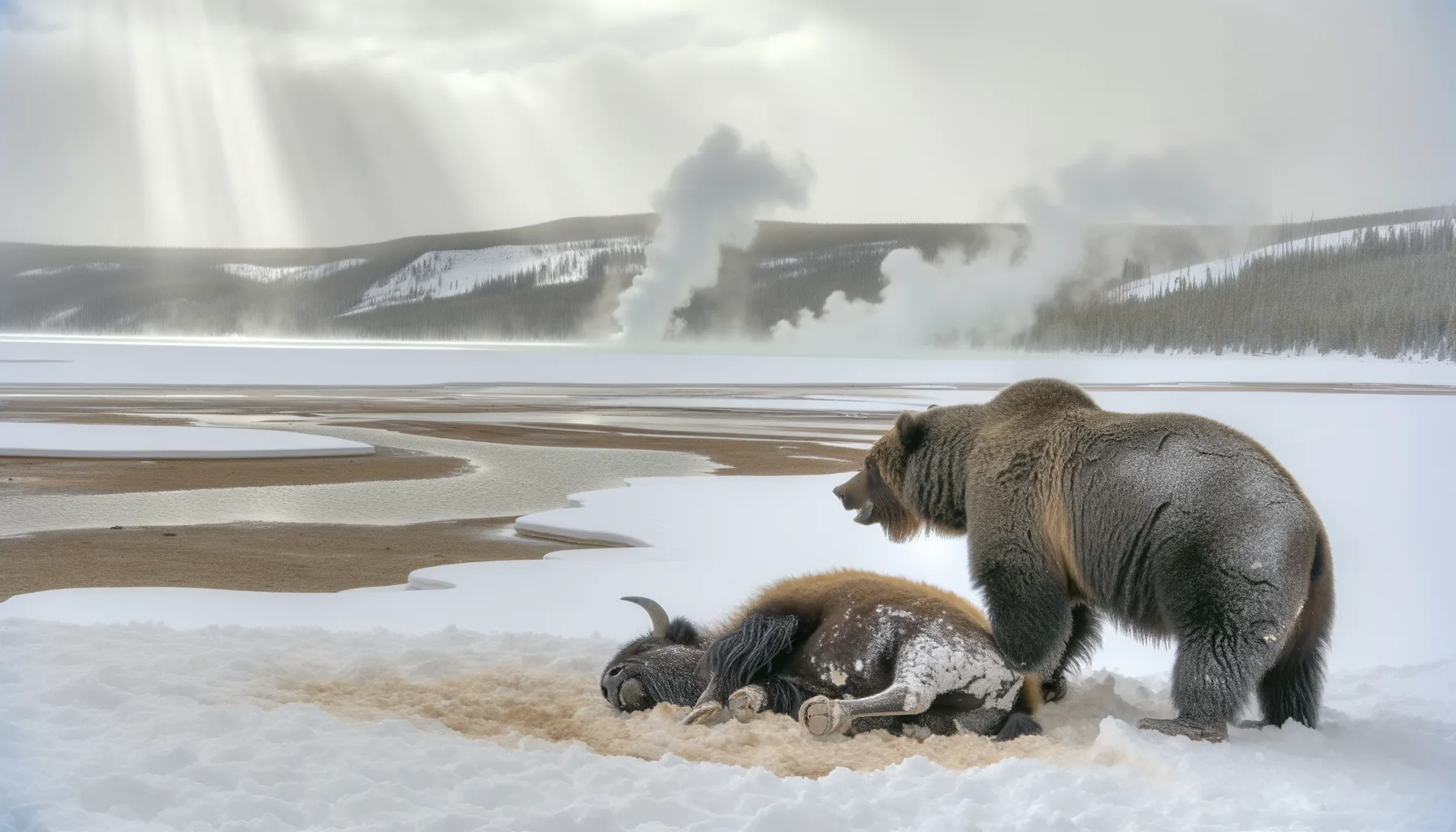
It’s mid-March, the snow is still deep in the high country, and a grizzly bear is already standing over a bison carcass near Yellowstone Lake. That image — captured by Yellowstone biologists on Monday — is your official notice that bear country in Montana is no longer dormant. Not even close.
Yellowstone National Park Service biologists confirmed the first grizzly sighting of 2026 this week, spotting a bear scavenging a bull bison carcass in the northern backcountry of the park. The timing is consistent with recent years — the first sighting fell on March 14 in 2025, March 3 in 2024, and March 7 in both 2023 and 2022. In other words, this isn’t early or unusual. It’s right on schedule. And if Yellowstone’s bears are moving, so are bears across the broader Greater Yellowstone Ecosystem — including the drainages, mountain ranges, and river corridors that Montana spring outdoor enthusiasts are heading into right now.
What “First Sighting” Really Means for Montana
The park boundary is a line on a map. Grizzly bears don’t respect it, and neither does the biology of hibernation emergence. The GYE supports more than 1,000 grizzlies across portions of Montana, Idaho, and Wyoming — and the population has been expanding steadily, now occupying more than 27,000 square miles. That means bears are coming out of dens right now across the Absaroka-Beartooth Wilderness east of Livingston, the Madison Range south of Ennis, the Gallatin Range near Bozeman, and the Centennial Mountains along the Idaho border. If you’re planning a trip into any of these areas this month, bear safety isn’t a summer concern — it’s a today concern.
Importantly, what’s out right now are mostly adult males. Boars exit their dens first, typically in early March, and they are hungry, ranging widely, and focused entirely on calories. Females with cubs follow in April and May — and while a sow with cubs presents its own serious encounter risks, a lone boar in early spring is no pushover either. Any bear coming off winter is food-motivated, potentially aggressive near carcasses, and covering serious ground.
Spring Hunters: You’re Heading Into the Middle of This
Montana’s spring black bear season opens May 15 in most hunting districts, but plenty of hunters are already scouting, glassing, and getting boots on the ground in March and April. If you’re glassing the Beartooth Front near Red Lodge, working the timber pockets above the Boulder River, or hiking into the Gravelly Range looking for sign, understand that you are moving through active grizzly habitat during peak early-emergence feeding activity.
The NPS noted clearly that “bears may react aggressively to encounters with people when feeding on carcasses.” Winter-killed elk and bison are scattered across these landscapes right now — you may not smell them before a bear does, and you may not see the bear before it sees you. Carcass encounters in grizzly country are among the most dangerous situations a backcountry hunter can stumble into.
Shed Hunters: High Risk, High Reward — But Be Smart
Shed antler hunting explodes in March and April across southwest Montana, particularly in the drainages feeding the Yellowstone, Madison, and Gallatin rivers. The same thermal terrain that holds wintering elk — and therefore the best shed hunting ground — is exactly where grizzlies are nosing around in early spring. Areas like Tom Miner Basin, the upper Stillwater drainage, and Sunlight Basin near Cody are prime examples of places where shed hunters and hungry grizzlies occupy the same hillsides on the same March mornings.
- Carry bear spray — on your body, not in your pack. A can buried in a daypack does nothing when a bear materializes from a spruce thicket ten yards away.
- Make noise in dense cover. Early spring vegetation is minimal, but deadfall, creek bottoms, and north-facing timber can still conceal a bear until you’re dangerously close.
- Watch for ravens, magpies, and coyotes. Concentrated scavenger activity on a hillside almost always means a carcass — and a carcass in grizzly country means a potential bear in close proximity.
- Hunt or hike in groups when possible. Solo shed hunters in southwest Montana in March are accepting elevated risk, plain and simple.
Anglers: The Madison and Yellowstone Open Earlier Than You Think
Early-season streamer fishing on the Madison River below Quake Lake, the lower Yellowstone near Gardiner, and the Lamar Valley corridor draws serious fly anglers as soon as flows stabilize. These are some of the most grizzly-dense river corridors in the lower 48. Walking riverbanks, pushing through willows to reach a run, or wading up a tight canyon — all of these put you in close-quarters bear habitat with limited visibility and often significant wind and water noise masking your approach.
Keep your bear spray accessible on the water. A chest harness or hip holster keeps it reachable even while casting. It’s not overkill — it’s what experienced guides on the upper Yellowstone have been doing for years.
The Bottom Line Right Now
The first grizzly of 2026 is out and eating. More will follow every day from here into May. Montana’s backcountry is opening up for shed hunters, spring bear scouts, and early trout chasers at exactly the moment grizzly activity is ramping up from the Beartooths to the Centennials. Adjust your habits accordingly — carry spray, make noise, stay aware of carcass sign, and don’t let a great March day in the mountains turn into a serious incident. The bears are doing exactly what they’re supposed to do. Make sure you are too.
Montana's outdoor week, in your inbox at 7am Friday.