
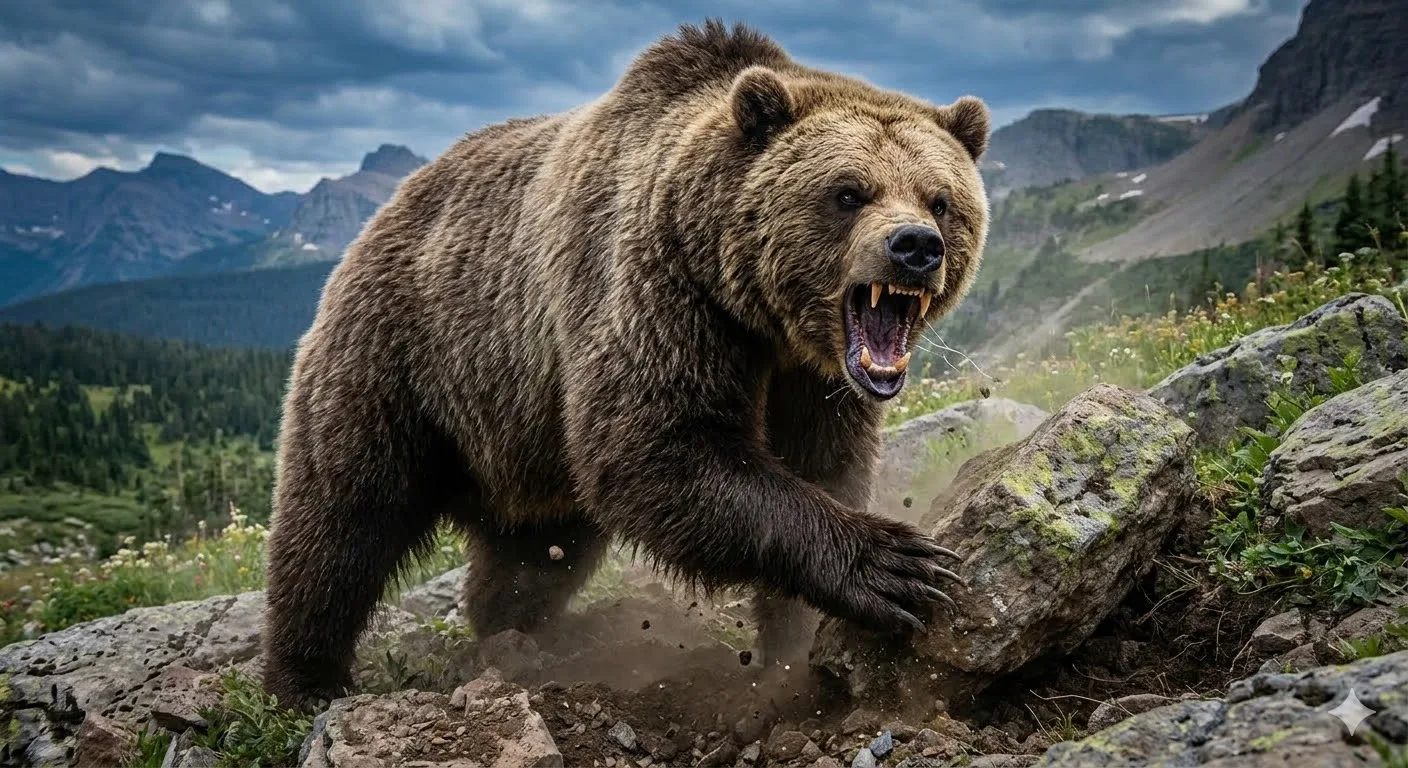
If you’ve ever hiked through the Big Sky Country and felt a sudden urge to make enough noise to wake the dead, you’ve likely been thinking about the grizzly bear (Ursus arctos horribilis).
Grizzly Bear Power: At a Glance
| Feature | Stat / Capability | Why It Matters |
| Bite Force | ~1,200 PSI | Can crush a bowling ball or cast iron. |
| Top Speed | 35 mph | Outruns a human (and Usain Bolt) easily. |
| Lifting Force | ~500+ lbs | Can flip boulders with a single paw. |
| Skin Thickness | Up to 1 inch + 4″ fat | Acts as natural armor against claws and teeth. |
| The “Hump” | Pure Muscle | Provides the torque for digging and uphill sprinting. |
While they might look like giant, forbidden pillows from a distance, if you haven’t figured it out yet, grizzlies are less “cuddly companion” and more “biological bulldozer.” To understand just how powerful these Montana icons are, we have to look past the fur and into the mechanics of what makes them the undisputed heavyweights of the wilderness.
1. Muscle Power: The Hump Isn’t for Show
You know that distinctive mound of muscle between a Grizzly’s shoulders? That’s not a backpack for berries; it’s a massive muscle mass used for digging and striking. It’s safe to say they don’t skip shoulder day much.
- Lifting Strength: A grizzly can flip over boulders weighing several hundred pounds with a single paw just to look for grubs. Researchers have noted they possess the strength of approximately 2.5 to 5 humans in terms of raw physical force.
- Bite Force: Their jaws can exert a pressure of roughly 1,200 PSI (pounds per square inch). To put that in perspective, that’s enough to crush a bowling ball or a cast-iron skillet.
2. Thick-Skinned (Literally)
If you think your winter coat is heavy-duty, a Grizzly’s hide is on another level. Their skin is incredibly thick, particularly around the neck and shoulders, serving as a form of natural armor.
- Battle Ready: This toughness is an evolutionary necessity. During mating season or territorial disputes, Grizzlies trade blows that would liquefy a human. Their skin, backed by a dense layer of fat (up to 4 inches thick before hibernation), protects their vital organs from the 4-inch claws of their rivals.
- Defense Against the Small Stuff: This hide also protects them from the “pests” of the wild. A bee sting or a thorny thicket is barely a nuisance to a bear in full coat.
3. Deceptively Fast
Don’t let the “waddle” fool you. A Grizzly’s strength extends to its cardiovascular engine.
- Top Speed: They can hit speeds of 35 mph. For context, Usain Bolt’s top speed is about 27 mph.
- The Up-Hill Advantage: Because of that massive shoulder hump, Grizzlies are actually terrifyingly efficient at running uphill, meaning the old “run to high ground” myth is a one-way ticket to a very bad day.
Respect the Power
Grizzlies aren’t just strong; they are built with a structural integrity that makes them nearly impervious to the standard hazards of the wild. They are the ultimate testament to Montana’s rugged spirit—tough, powerful, and best admired through a high-powered spotting scope from a very safe distance.
Source and Resource Information:
- National Park Service: Grizzly Bear Biology
- National Wildlife Federation: Grizzly Bear Facts
- Bear Biology: Bite Force and Anatomy
- Grizzly Bear Information
Montana's outdoor week, in your inbox at 7am Friday.