
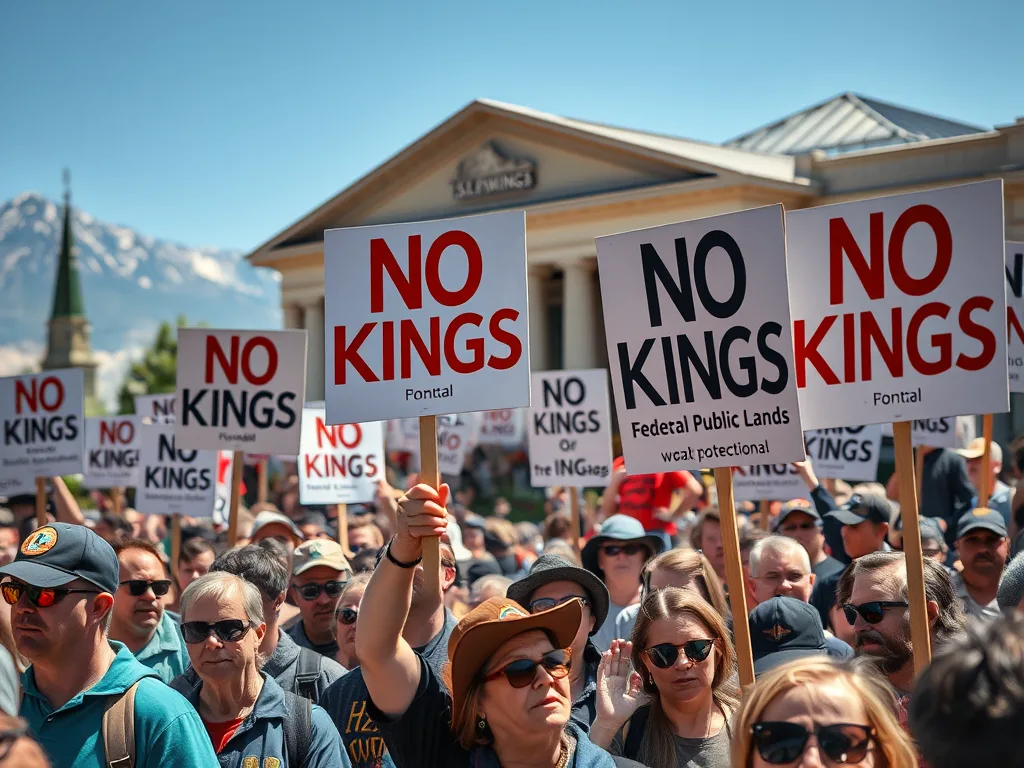
If you tried to drive anywhere near the Gallatin County Courthouse on West Main Street in Bozeman recently, you already know something happened. Protesters shut down blocks around the courthouse — organizer estimates pointed to a massive, multi-block turnout — and that’s not a small rally. That’s a statement. If you’re a hunter or angler in Montana, you need to understand what’s driving those crowds and what’s at stake for the ground you’re planning to hunt this fall.
Why Hunters Should Pay Attention to This Movement
The “No Kings” protest movement isn’t just a general political demonstration. A significant driver of turnout across Montana — and especially in Bozeman, which sits surrounded by some of the most productive public hunting country in the Northern Rockies — is fear over federal public land policy. Specifically, the growing concern that federal lands could be transferred to state control, sold off, or administratively restricted in ways that cut everyday hunters and anglers off from ground they’ve relied on for generations.
This isn’t abstract. We’re talking about the Gallatin National Forest, the Madison Range, the Bridger Mountains, and hundreds of thousands of acres of BLM ground stretching from Ennis north to Townsend and east toward Billings. These are the places where Montana hunters punch elk tags in Hunting Districts 360, 311, and 316. These are the ridgelines where you glass for mule deer in October. These are the river corridors — the Gallatin, the Madison, the Boulder — where you access walk-in trout water that would otherwise be locked behind private gates.
The Transfer Threat Is Real — and It Has History
Montana’s been through this rodeo before. In the mid-2010s, transfer-of-public-lands legislation circulated through the Montana Legislature — tied to the broader American Lands Council push active in several western states at the time — and died, in part because hunters and sportsmen’s groups showed up loud and early. The numbers then were smaller. The crowds in Bozeman right now suggest the awareness level, and the anxiety level, is considerably higher today.
Current concern centers on federal budget and land-management proposals moving through Congress in 2025. Track coverage from Montana’s congressional delegation and groups like Backcountry Hunters & Anglers for the specific legislation and executive actions as they develop. The underlying worry is familiar: if federal lands are transferred to state management, Montana doesn’t have the budget to manage tens of millions of acres at the level the Forest Service and BLM currently do. That leaves one of two outcomes — chronic underfunding that degrades access roads, trail systems, and habitat, or eventual sale of parcels to private landowners. Either way, the hunter who just wants to park at a trailhead on the Custer Gallatin and hike into a drainage nobody else is working gets squeezed out. Honestly, I’ve watched access erode incrementally for twenty years, and I can tell you it doesn’t announce itself. It just quietly disappears.
What This Means for Your Fall 2026 Hunt Right Now
Spring is when you make your fall. Tag applications for elk, deer, and antelope are either open or opening soon, and the decisions you make in the next few weeks determine where you’re standing in September and October. With public lands uncertainty hanging over everything, here’s how to think about your planning right now.
Don’t build your entire fall around a single drainage or a single BLM parcel. Identify two or three alternate zones on the Beaverhead-Deerlodge, Helena-Lewis and Clark, or Lolo National Forests. Redundancy is insurance, plain and simple. While you’re at it, get into OnX Hunt and verify that your planned access routes actually cross federal ground — not private inholdings. Roads that look public on Google Maps are not always public. That’s a hard lesson to learn on opening morning with a loaded pack and nowhere legal to go.
Also take a hard look at Montana’s Block Management program. FWP opens private land to public hunters at no cost through BM, and you don’t apply for a slot — you use the FWP Block Management map and annual hunting guide to find participating properties in your target region, then hunt within the rules posted at each access site. If federal access tightens, those BM acres get a lot more valuable in a hurry. Get familiar with participating units now, before everyone else does.
- Call your elected officials. Montana’s federal delegation — both senators and the House member — need to hear from hunters. Not environmentalists, not abstract advocates. Hunters. A constituent call from someone who fills a freezer every fall carries different weight than a form email. Make the call.
- Join or renew with sportsmen’s advocacy groups. Montana Wildlife Federation, Backcountry Hunters & Anglers, and Theodore Roosevelt Conservation Partnership are actively tracking federal lands legislation. Your membership funds their lobbyists and lawyers — the people doing the unglamorous work that keeps your access intact.
Bozeman’s Turnout Signals Something Bigger
Bozeman isn’t just a college town anymore. It’s a hub for working hunters, outfitters, guides, fly fishing operations, and outdoor industry jobs. When the streets around the Gallatin County Courthouse are packed with protesters, that’s a cross-section of Montana — not one demographic, not one political tribe. That kind of turnout means concern about public land access has moved past the choir and into the pews.
The Madison Valley, the Beartooth Plateau, the upper Gallatin drainage — these places exist for every Montana hunter because they’re federal public land. That’s not politics. That’s where you hang your elk quarter. Pay attention.
Montana's outdoor week, in your inbox at 7am Friday.