Colby Mulder assisted with the delicate process of stirring the eggs during the fertilization process.
The walleye trap netting and egg collection effort is in full swing in the Big Dry Arm of Fort Peck Reservoir! Water surface temperatures have bumped up slightly to around 50-53 degrees throughout our trap netting locations. These are still VERY favorable for walleye spawning activity.
These warm and stable water temperatures have continued to push the walleye up shallow and into our trap nets. Once again, a large portion of the females we’ve been capturing have been ripe and releasing their eggs. In fact, we’ve been able to bring in over 100 ripe female walleye each day over the last two days.
However, we have observed a few more spent female walleye over the last couple of days as well. It’s likely this will be a very short and condensed walleye spawning season based on the large numbers of walleye we’re seeing all at once.
On Monday, we collected a little over 18 million eggs from 112 ripe female walleye. We also had another egg collection today (Tuesday) from 114 females which should give us close to another 15 million more eggs. These three egg collection efforts should put us a little over 50 million walleye eggs total thus far for the 2023 season. This has been an amazing amount of eggs collected in a very short period of time and quite unexpected considering the later than normal start.
Stay tuned for more updates!
Update by Fort Peck Reservoir Biologist Heath Headley
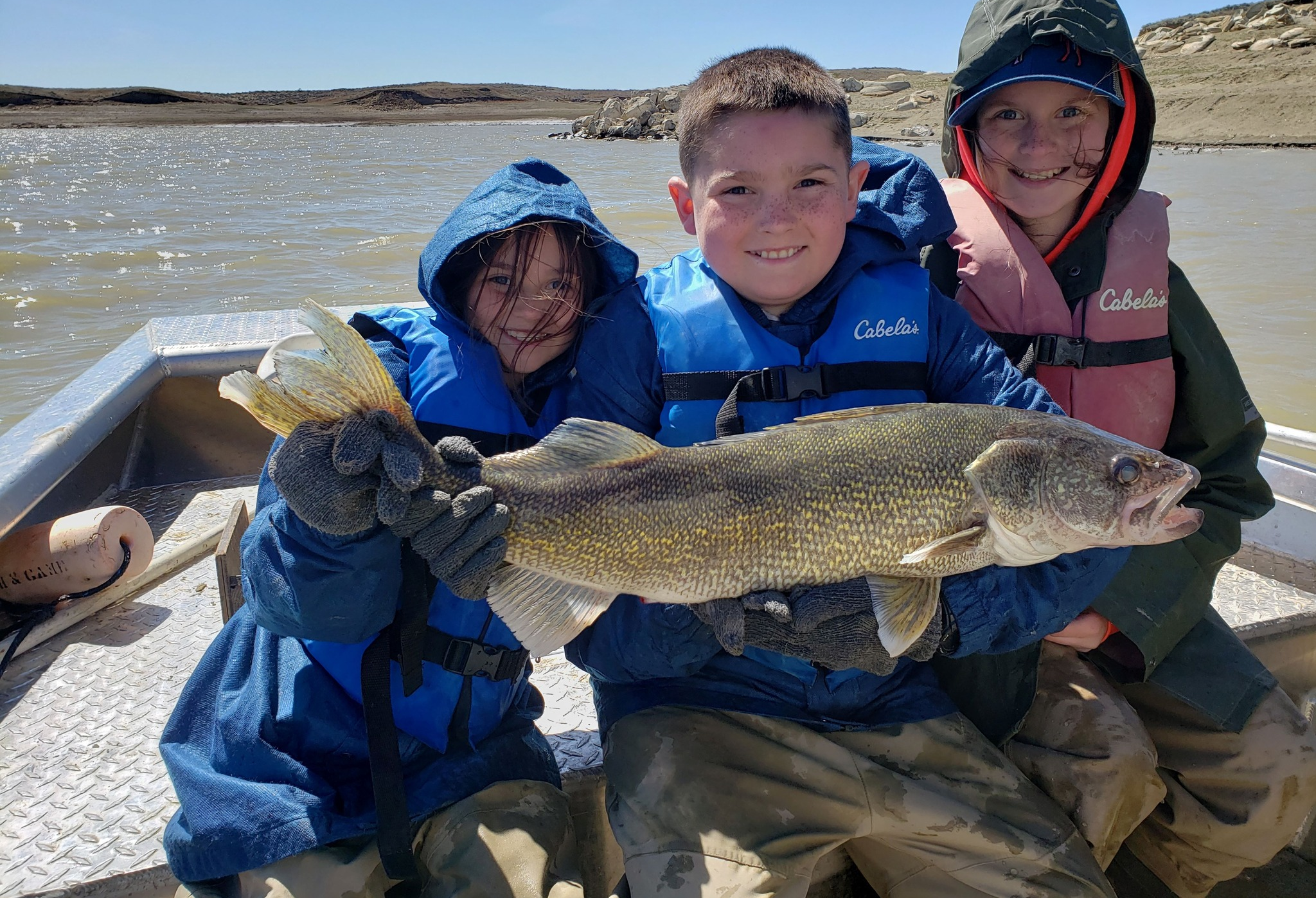
Feature photo: Colby, Will, and Selby Mulder doing some walleye wrangling. Thanks for the help!

Montana FWP has transformed wildlife surveys from paper maps to advanced GPS technology, enhancing data accuracy and insights about elk distribution, which aids in effective wildlife management strategies.
The 2026 Leadore Angus Ranch Bull Sale features approximately 200 yearling Black Angus bulls, designed for high-elevation conditions and optimal profitability for ranchers in Montana and Idaho. Sale dates are March 6 and 12, 2026, with online bidding available. Bulls undergo breeding soundness exams, ensuring robust adaptability and growth potential.
On the Montana Outdoor Podcast, host Downrigger Dale talks with instructor Racheal Vargas (Montana K9 Safety and Montana Health & Safety Training) about practical, life-saving skills you can learn through training for individuals and groups—including preparation to help friends, family, and even pets in emergencies.
By popular demand, we’re running last week’s in-depth podcast episode for a second week. Guest Brian Lipscomb explains how what happens at Flathead Lake—especially at the dam—can ripple through the Flathead River system and influence ecosystems, communities, recreation, and agriculture far beyond the lakeshore.
Montana Outdoor Podcast host Downrigger Dale talks with Brian Lipscomb, CEO of Energy Keepers, Inc., about the dam on Flathead Lake—now known as the Séliš Ksanka Ql̓ispé Hydroelectric Project. Learn the history, what surprised Dale most, why lake levels stayed high longer this year, and where to find reliable water level, flow, and forecast resources.
Downrigger Dale talks with Yellowstone Summit organizers George Bumann and Jenny Golding for an exclusive preview of the 5th annual online event (Feb. 19–22). Get the key dates, what the Summit is, and how to register—plus how to watch or listen to the episode and explore speakers and sessions.
Skijoring began as practical winter travel—skiers pulled by dogs, reindeer, and later horses—before turning into a spectator sport. From early Nordic Games and brief Olympic-era exhibitions to today’s high-speed, technical races in the American West, here’s how skijoring evolved and why Montana is at the center of its modern resurgence—plus the latest Montana Outdoor Podcast episode to watch.
Race organizer and longtime competitor Jennifer Butler joins the Montana Outdoor Podcast to break down skijoring in Montana—how horse-and-skier teams race, what it’s like competing with her son David, and where to watch events like Whitefish Skijoring.
Downrigger Dale goes inside the fast, wild world of Montana skijoring with race organizer and competitor Jennifer Butler—horses pulling skiers at full throttle, a mother-son team with her fearless son David, and a must-watch sneak peek before the full episode drops tomorrow morning.
Elk hoof disease (TAHD) is a painful, polymicrobial infection that leaves elk lame and struggling to walk. First detected in Southwest Washington in the late 1990s, it surged after 2007–2008 and has spread into parts of Oregon, Idaho, and California. With no vaccine or treatment for wild elk and many unanswered questions about transmission and vulnerability, hunters and wildlife managers across the West—especially in nearby states like Montana—are watching closely.
A cow elk in Montana wastes no time going full defense mode when a mountain lion is near her calf. Hooves fly as the mother elk stomps and strikes—an intense reminder that wildlife threats in the backcountry aren’t limited to predators.
A calm-looking elk can still react fast—especially around food. In a clip shared as a reminder, a child’s fingers were nibbled while hand-feeding. Here’s why hand-feeding wildlife is risky and the simplest rule to avoid preventable injuries.
Minnesota angler Beau Rochel shared a simple DIY multi-hole cover for a Clam X600 ice shelter to help keep feet warmer while fishing. Here’s the basic idea, materials mentioned, and an easy foam-tile alternative that’s becoming a trend for overnight shack anglers.
A mom and daughter in Colorado were stunned when a massive elk herd took over their neighborhood yards. The same elk have also been seen along a nearby highway and even shutting down a local golf course—another reminder that in elk country, wildlife can show up anywhere.
A six-man crew from Helena, Montana, took home more than half a million dollars at Bisbee’s Los Cabos Offshore Tournament in Cabo San Lucas, Mexico. Team Grey Bull beat out a packed field to place third in the Billfish Division after landing a 398-pound black marlin.
Shot over the 4th of July weekend in 2017 near Ajax Mountain, Montana, this rare clip captures a wolverine in action. Wolverines are famously elusive in the Lower 48—only about 300 are thought to remain—and can travel 18–20 miles in a single day.
Wild Rooster Farm’s Bear, an AKC purebred Anatolian Shepherd from Kalispell, Montana, is set to travel to South Africa to join the Cheetah Outreach Trust as a breeding stud in its Livestock Guardian Dog program—aimed at protecting livestock while supporting cheetah conservation.
Montana FWP has transformed wildlife surveys from paper maps to advanced GPS technology, enhancing data accuracy and insights about elk distribution, which aids in effective wildlife management strategies.
These venison breakfast sausage stuffed pancakes—credited to Jenn Homa and shared by Kokanee Quinn—deliver a sweet-and-salty, handheld breakfast that’s perfect for cold mornings, early alarms, and everything from rut-chasing to couch lounging.
A grill-fired wild game pizza featuring mountain lion backstrap—originally shared on montana-wild.com by Travis Boughton and reposted as a nod to the Feb. 28 close of the 2025 season.