
Brett French | Billings Gazette Communications
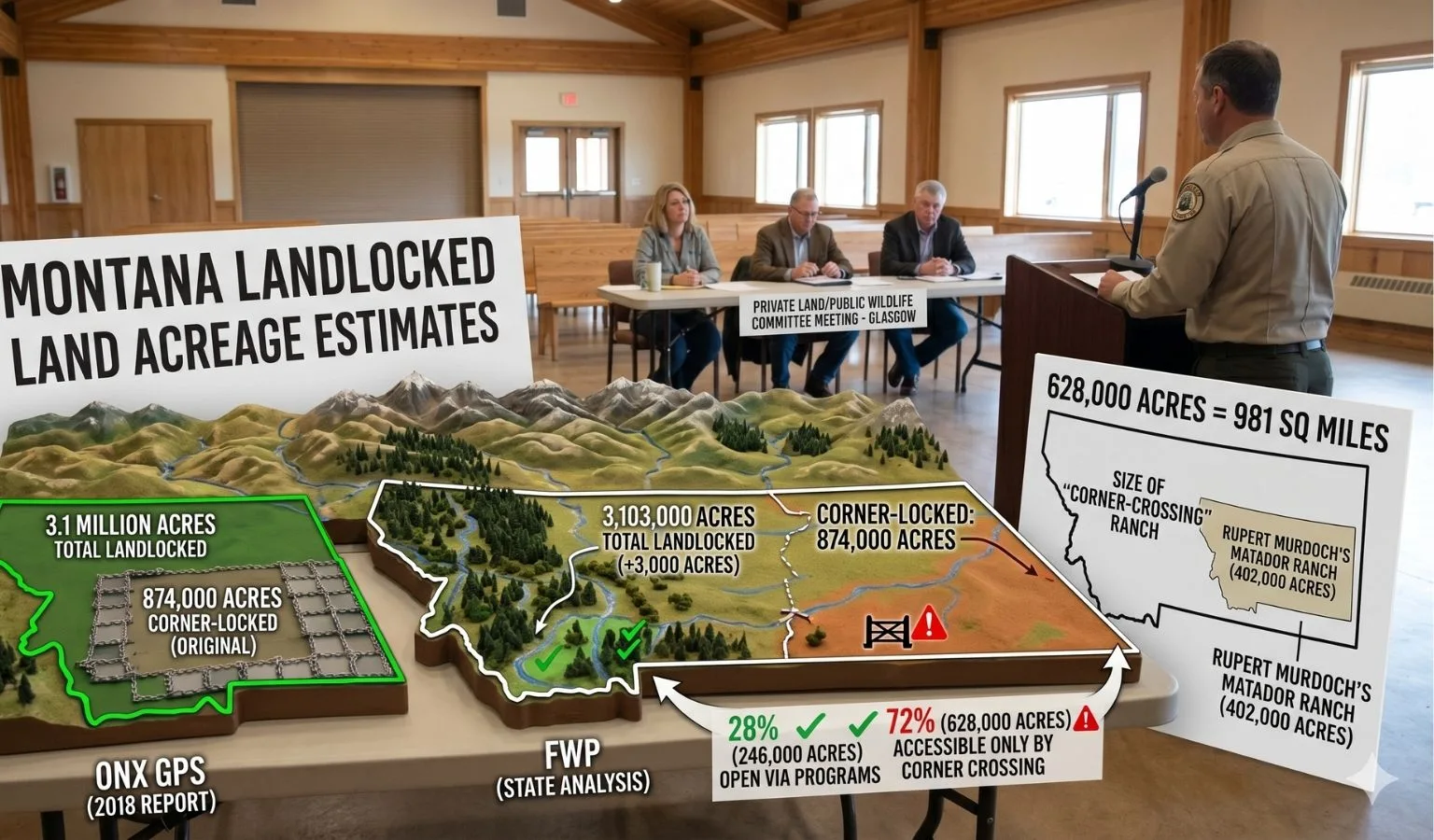
Fish, Wildlife & Parks has come up with its own estimate of landlocked acreage in Montana, and it’s about 3,000 more acres than a private company’s previous calculation.
The state agency unveiled its estimate during a two-day meeting in Glasgow of its Private Land/Public Wildlife Committee meeting.
How Montana’s Landlocked Land Problem Got Mapped
The Missoula-based GPS mapping and navigation company onX raised the issue of landlocked public lands in a 2018 report titled “Off Limits, But Within Reach.” In cooperation with the Theodore Roosevelt Conservation Partnership, 9.52 million acres of inaccessible public lands were identified by onX, mostly in western states.
In Montana, onX found about 3.1 million acres of landlocked public land, an amount FWP’s analysis corroborated.
The methodology behind both analyses relies on layering parcel-level ownership data over federal and state land boundaries to identify parcels of public land with no legal road, trail, or navigable waterway access. The FWP analysis refined the onX numbers by incorporating the agency’s own access program enrollment data, giving the state a clearer picture of what’s genuinely off-limits versus what’s accessible through voluntary landowner agreements.
Breaking Down the Numbers: Private Lock-Out vs. Corner Crossing
“Our analysis breaks that down to being about 2.2 million acres locked by private land, about 874,000 locked by a corner-to-corner access,” Jason Kool, FWP landowner and sportsman coordinator, told the committee.
However, the state said of the 874,000 acres it identified — that’s 1,365 square miles — 28% are already open to public hunters through current FWP access programs.
That leaves 628,000 public acres — 981 square miles — of land only accessible by corner crossing.
It’s worth understanding the distinction between these two categories of landlocked land, because the solutions for each are very different.
- Privately surrounded public land: These are parcels of state or federal land — BLM ground, state school trust sections, or Forest Service parcels — that are completely encircled by private property with no road, easement, or waterway providing legal access. Reaching them legally would require a landowner’s written permission or a negotiated access agreement.
- Corner-crossing land: These parcels technically touch a public land grid at a single corner point — the intersection of four sections, two public and two private. Whether stepping or leaping across that corner constitutes legal trespass has been a long-running legal and political debate in Montana and across the West.
That legal ambiguity around corner crossing is at the heart of much of the current committee discussion. While a Wyoming federal court ruling in recent years found in favor of hunters who corner-crossed onto public land, Montana has not adopted a clear statutory position, leaving hunters in a murky gray area.
How Big Is 628,000 Acres, Really?
Lt. Gov. Kristen Juras, in talking to an interim legislative committee last month, said the amount of inaccessible corner-crossing acreage is minimal compared to the overall public lands in Montana. Yet if the 628,000 acres were combined into one ranch it would be larger than billionaire Rupert Murdoch’s 402,000-acre Matador Ranch and Cattle located in southwestern Montana, one of the largest in the state.
To put it another way: 628,000 acres is larger than Rocky Mountain National Park. It’s more land than the entirety of Glacier National Park. For a state whose outdoor identity is deeply tied to public land access, the scale of what’s effectively off-limits carries real weight — even if the percentage of total public acreage is relatively small.
For Montana hunters and anglers specifically, that acreage represents elk herds, mule deer habitat, sage grouse leks, and blue-ribbon trout drainages that the public technically owns but cannot legally reach. Some of this ground has likely seen very little hunting pressure in decades precisely because of the access barrier — which, ironically, may make it some of the highest-quality wildlife habitat remaining in the state.
The Political Fault Lines
Hi-Line outfitter and Republican state senate candidate Eric Albus echoed the administration’s concerns in his comments to the PL/PW.
“Is it worth alienating a bunch of landowners over .06% that doesn’t have access to it?” he questioned.
Committee member Drew Steinberger stressed there’s value in accessible public lands, even if some people never use them and that the state and PL/PW has a “unique opportunity” to find a solution that can have a long-term effect.
The tension on display at the Glasgow meeting reflects a broader debate that has played out in Montana for generations. On one side are landowners — many of them multi-generational ranching families — who view unrestricted corner-crossing as an encroachment on private property rights and a potential liability issue. On the other are hunters, anglers, and public lands advocates who argue that public land is a constitutional trust held for all Montanans, not a resource that should be effectively privatized by geography.
Both perspectives carry legitimate weight in a state where agriculture and outdoor recreation are economic pillars. Montana’s ranching community manages millions of acres of private land that serves as critical wildlife habitat — habitat that public game herds depend on year-round, not just during hunting season. At the same time, the state’s hunting and fishing economy generates hundreds of millions of dollars annually, and access to high-quality public land is central to that.
FWP Access Programs: A Partial Solution Already in Place
One of the more significant findings in FWP’s analysis is that 28% of the corner-accessible landlocked acreage is already enrolled in existing access programs. Montana FWP operates several voluntary programs that pay landowners to allow public access across their property, including:
- Block Management Program (BMP): Perhaps the most well-known tool, BMP compensates cooperating landowners for allowing public hunter access across their private land. Many of these agreements specifically create pathways to landlocked state or federal parcels that would otherwise be unreachable.
- Hunting Access Enhancement Program (HAEP): A federally funded program administered by FWP that provides landowners payments in exchange for hunting access easements, including walk-in areas that can unlock otherwise inaccessible public ground.
- Stream Access and Fishing Easements: For anglers, FWP also negotiates easements that provide legal walk-in access to stream corridors that cut through private land, opening up sections of rivers and creeks that would otherwise be inaccessible.
These programs demonstrate that voluntary, cooperative solutions between the state and private landowners can and do work. The challenge is scaling them — securing enough funding and landowner participation to meaningfully address the full 628,000 acres of corner-accessible landlocked land, let alone the larger pool of privately surrounded public parcels.
Hunters interested in using Block Management areas or other access program lands should always check the current FWP Block Management directory and verify program rules before hunting, as enrollment changes year to year and specific restrictions apply to each cooperating property.
What This Means for Montana Hunters and Anglers
From a practical standpoint, the FWP analysis gives both hunters and policymakers a more detailed map of the problem. Knowing that 2.2 million acres are surrounded by private land — versus 628,000 that are merely corner-accessible — helps prioritize where access solutions are most realistic.
Corner-crossing land is arguably the lower-hanging fruit. Legislative or judicial clarification that corner crossing is legal would immediately unlock nearly a million acres of public land without requiring a single landowner payment or easement negotiation. The privately surrounded parcels, on the other hand, will require either expanded access programs, land exchanges, or easement acquisitions to open — all of which cost money and time.
For hunters planning trips in Montana, particularly in the Hi-Line counties, the Missouri Breaks, the Powder River country, and other areas where the checkerboard land ownership pattern is most pronounced, understanding which parcels are truly accessible is critical. Tools like onX Hunt — the same company whose original research sparked this conversation — allow hunters to layer ownership data over satellite imagery and clearly see which parcels are public, which are private, and which access programs are in effect for a given area. Always verify access status before you hunt, and when in doubt, reach out to the relevant FWP regional office or BLM field office for clarification.
The Road Ahead for the PL/PW Committee
The Private Land/Public Wildlife Committee’s Glasgow meeting was not the end of this conversation — it was closer to the beginning. The committee is tasked with developing long-term recommendations on how Montana balances private property rights with public wildlife and land access, a mandate that touches on corner crossing, Block Management funding, stream access enforcement, and more.
As Drew Steinberger noted, there is a “unique opportunity” here. The FWP analysis gives the committee hard numbers to work from for the first time, replacing estimates and anecdotes with a data-driven baseline. Whether lawmakers and stakeholders can translate that data into durable access policy — one that landowners, hunters, and anglers can all live with — remains to be seen.
What’s clear is that 3.1 million acres of landlocked public land is not a rounding error. It’s a resource question that goes to the heart of what it means to be a public lands state. Montana hunters and anglers have a direct stake in how this debate resolves, and staying engaged with the legislative process is as important as staying engaged with the land itself.
Montana's outdoor week, in your inbox at 7am Friday.