
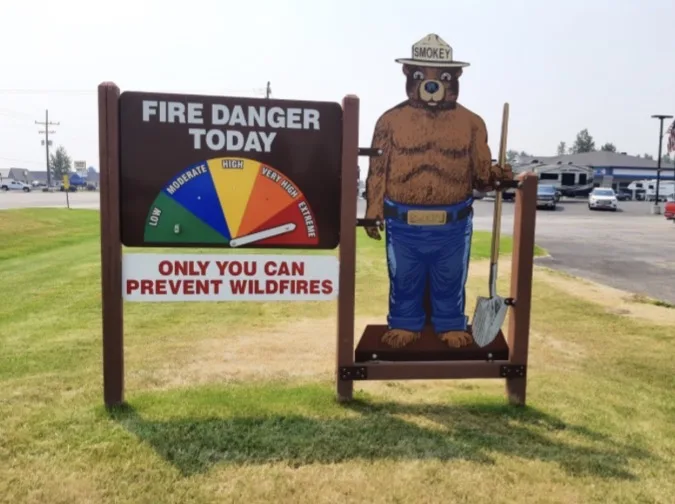
Hamilton, MT, August 7, 2026) — On the same day that Stage 2 Fire Restrictions are taking effect, the Bitterroot National Forest (BNF) announced that it is raising its fire danger level to “Extreme” due to our continued hot weather and record dry fuel conditions.
Extreme is the highest fire danger level possible. When fire danger is “Extreme” fires start quickly, spread furiously, and burn intensely. All fires are potentially serious and development into high intensity burning will be faster and occur even on smaller fires. Direct attack is rarely possible and may be dangerous except immediately after ignition.
The BNF has not reached “Extreme” fire danger levels since July of 2021. Forest officials are asking the public to be especially careful when camping and visiting the forest. “People really need to be more careful because it’s just getting drier and drier out there,” said Matt Young, Fire Staff Officer. “Most of our fires on the forest this year have been human-caused, and our crews are stretched pretty thin right now. We really need the public’s cooperation and support at this time.”
Stage 2 Fire Restrictions are currently in effect for all BNF lands in Ravalli and Missoula Counties. Under Stage 2 restrictions, the following acts are prohibited on federally managed or protected lands, roads and trails:
- Building, maintaining, attending, or using a fire or campfire. Liquid petroleum and LPG stoves that can be turned on and off are allowed.
- Smoking is prohibited outside of vehicles, buildings, and developed recreation sites, unless you are stopped in a 3-foot diameter area cleared of all burnable vegetation.
- Operating motorized vehicles off designated roads and trails is prohibited.
- Operating any equipment with an internal combustion engine, welding, or operating a torch with an open flame is prohibited from 1:00 p.m. to 1:00 a.m. Must patrol area for one hour after ceasing operations.
Anyone caught violating the restrictions could be fined up to $5,000 and face up to 6 months in jail. They may also be held liable for all suppression costs and damages if they start a fire. Visit www.mtfireinfo.org to learn more about current fire restrictions throughout Montana.
BNF wilderness areas including the Selway-Bitterroot and Frank Church in Idaho and the Anaconda- Pintler Wilderness are not included in the fire restrictions at this time. See our forest map for more details at www.fs.usda.gov/alerts/bitterroot/alerts-notices.
The ridge of high pressure responsible for our record temperatures is also transporting smoke from wildfires in Oregon and Washington causing widespread hazy skies and smoke impacts. For the latest air quality information visit todaysair.mt.deq.us. This site displays particulate concentrations and health effects including a daily ‘Wildfire Smoke Update’.
For more information about fires in Montana and other fires across the country, visit http://inciweb.nwcg.govor follow us on Facebook at www.facebook.com/DiscoverBitterrootNF for local fire information.
This summer, there have been 28 wildfires on the Bitterroot National Forest; 15 human-caused and 13 lightning fires.
About the Forest Service: The Forest Service has for more than 100 years brought people and communities together to answer the call of conservation. Grounded in world-class science and technology, and rooted in communities, the Forest Service connects people to nature and to each other. The Forest Service cares for shared natural resources in ways that promote lasting economic, ecological, and social vitality. The agency manages 193 million acres of public land, provides assistance to state and private landowners, and maintains the largest wildland fire and forestry research organizations in the world. The Forest Service also has either a direct or indirect role in stewardship of about 900 million forested acres within the U.S., of which over 130 million acres are urban forests where most Americans live.
Source: Bitterroot National Forest
Photo: USDA Forest Service
Editor’s note: Updated for accuracy.
Montana's outdoor week, in your inbox at 7am Friday.