
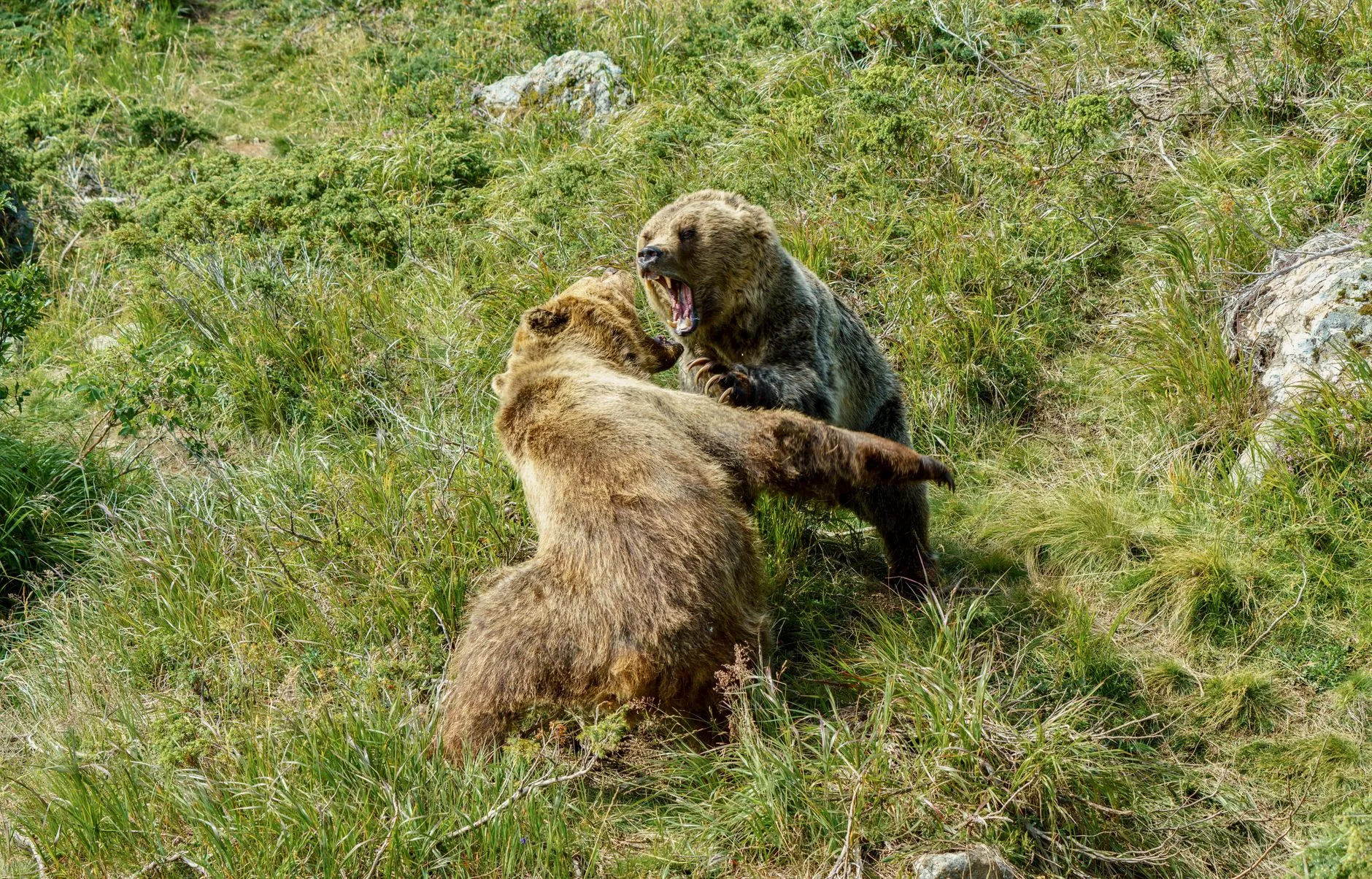
The Actual Numbers: Grizzly Lifting and Pulling Strength
Grizzly bears don’t get measured in a gym, so there’s no single clean benchmark. Wildlife biologists and biomechanics researchers have pieced together a strong picture from documented field observations and comparative physiology, and the numbers aren’t comforting.
The most widely cited estimate: a grizzly can lift or move objects roughly 0.8 times its own body weight with its forelimbs alone. A mature male in the Greater Yellowstone Ecosystem or along the Rocky Mountain Front typically weighs between 400 and 700 pounds — with some Montana boars pushing past 800 going into denning season. Run that math and you’re looking at a conservative lifting estimate in the 500 to 700-pound range for a large adult male.
But raw lift numbers actually undersell what makes grizzlies so dangerous in practice. It’s the pulling — the drag strength across real terrain — where documented incidents get hard to believe. Wildlife managers in the Northern Rockies have recorded grizzlies moving elk carcasses that two adult men couldn’t budge. Montana FWP and Yellowstone researchers have documented grizzlies rolling boulders estimated at 300 to 400 pounds to access ground squirrels underneath. Not shoving them aside — flipping them. Repeatedly.
Along the I-90 corridor and in communities bordering the Blackfoot drainage, there are repeated documented cases of grizzlies peeling open steel dumpsters, bending reinforced lids, and ripping through the walls of poorly secured meat sheds. Bear conflict reports out of the Teton River drainage and the South Fork of the Flathead consistently describe structural damage that looks like it was done with power tools.
The muscle composition driving this is real. Grizzly forelimb musculature is significantly denser than in black bears of equivalent size. Their digging muscles — the serratus, the shoulder girdle complex — are built for sustained explosive force, not just short bursts. A grizzly doesn’t just hit hard. It sustains that force across distance, across terrain, across whatever’s in its way.
Why Montana Backcountry Users Need to Understand This
Montana’s grizzly population has expanded steadily over the past two decades. The Northern Continental Divide Ecosystem — Glacier National Park, the Bob Marshall Wilderness, the Rocky Mountain Front — holds an estimated 1,000 or more grizzlies, one of the densest concentrations in the lower 48. The Greater Yellowstone Ecosystem adds another 700-plus. Bears are showing up in drainages and at elevations where they weren’t common 20 years ago. Honestly, if you’re hunting elk in central Montana and you think you’re outside grizzly range, you should probably look at a current distribution map before your next trip in.
For backcountry hunters, the strength data translates directly into camp and meat storage decisions. A grizzly that locates your gut pile or your boned-out quarters hung at standard deer-camp height isn’t going to be discouraged by a rope and a branch. Montana FWP recommends hanging meat at least 10 feet off the ground and 4 feet from the trunk, but in dense timber in units like the Bob or the Selway-Bitterroot, that’s not always achievable. In those situations, an approved bear-resistant canister or a hard-sided panniers system isn’t optional — it’s basic risk management, same as wearing orange.
The same logic applies to hikers managing food and scented items. A bear that’ll flip a 350-pound boulder for a ground squirrel will dismantle a poorly secured pack in seconds. The Montana Grizzly Encounter Network has documented bears accessing backcountry camps in Glacier in under three minutes from initial contact to full pack destruction. Three minutes.
Carry bear spray — every time, on your hip, not buried in your pack. Montana FWP and peer-reviewed research consistently show bear spray is more effective than firearms at stopping a grizzly charge. That’s documented across hundreds of encounters in the Northern Rockies, and in my experience talking to guides and outfitters who’ve worked the Bob and the Thorofare for decades, the ones who’ve actually been in close encounters say the same thing.
What the Strength Data Actually Means on the Ground
Understanding how much a grizzly can lift or move isn’t about fear — it’s about accurate threat modeling. Hunters and hikers who underestimate grizzly capability make bad decisions about food storage, camp placement, and encounter response. Those who overcorrect and treat every grizzly as an imminent attack misread bluff charges and escalate situations that didn’t have to go anywhere. Both failure modes carry real consequences.
A grizzly that can drag a bull elk uphill through the timber deserves exactly the respect that implies. Set up your camp, store your meat, and plan your hunts with that specific, documented capability in mind — not a vague sense that grizzlies are “big and strong.” There’s a difference between those two things, and it shows up in how you make decisions when it matters.
The Northern Rockies are extraordinary country. Grizzly bears are a big part of why. Go in knowing exactly what you’re sharing it with.
Source information:
https://www.rmef.org/elk-facts/
https://www.google.com/search?q=https://www.nps.gov/yell/learn/nature/grizzlybear.htm
https://fwp.mt.gov/conservation/wildlife-management/bear
https://www.google.com/search?q=https://www.nps.gov/yell/learn/nature/bearfoods.htm
https://www.google.com/search?q=https://fwp.mt.gov/conservation/wildlife-management/bear/conflict
https://www.google.com/search?q=https://www.usgs.gov/centers/norock/science/northern-continental-divide-ecosystem-grizzly-bear-population-monitoring
https://www.google.com/search?q=https://fwp.mt.gov/hunt/safetyandbehavior/grizzly-safety
https://wildlife.onlinelibrary.wiley.com/doi/abs/10.2193/2006-452
https://www.nps.gov/subjects/bears/safety.htm
Montana's outdoor week, in your inbox at 7am Friday.