
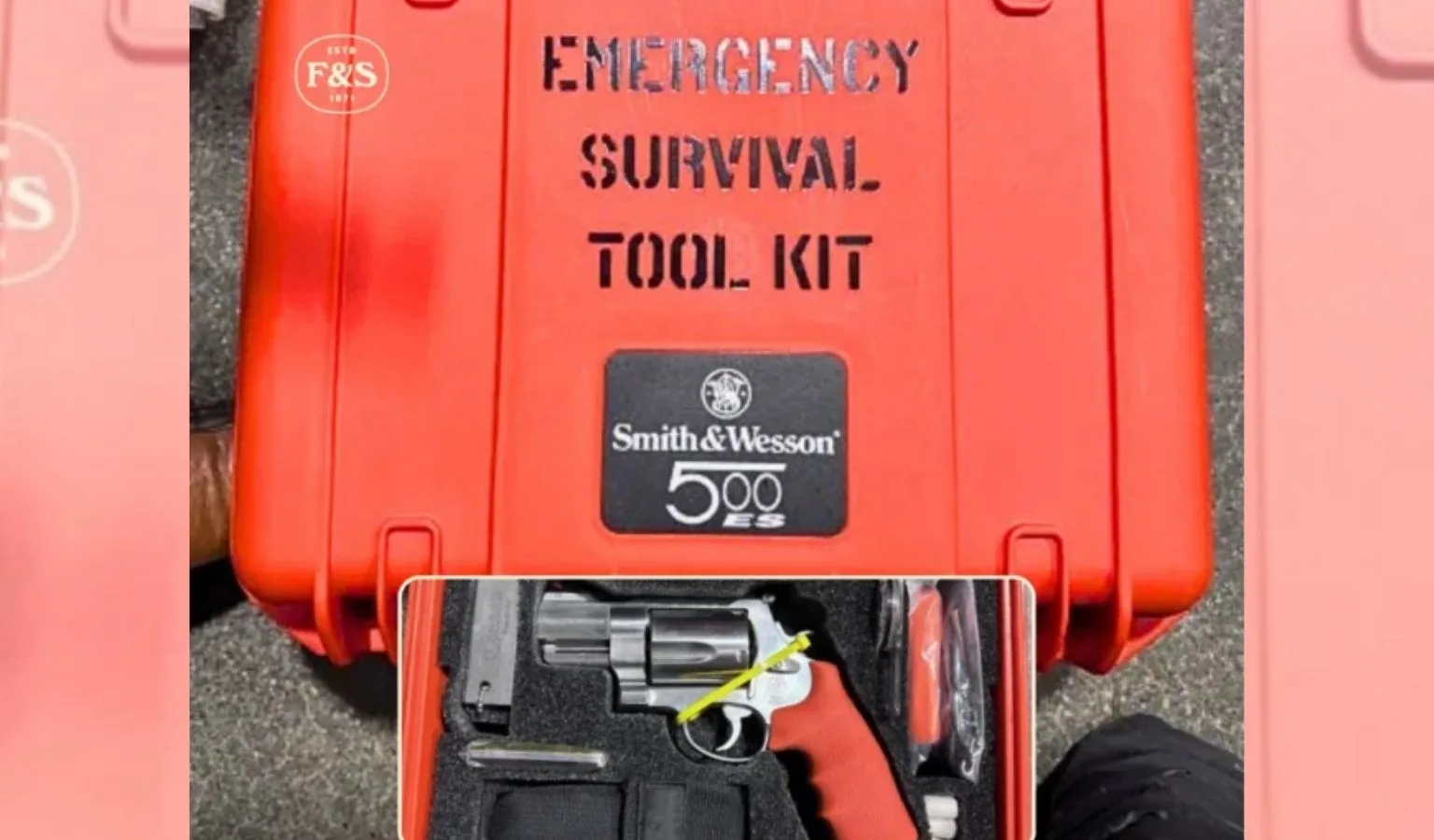
When standard wilderness survival guides recommend packing a whistle and water purification tablets, Field and Stream reported on their social media that Smith & Wesson quietly proposed a significantly louder insurance policy. Back in 2003, the company rolled out the Model 500, engineering the colossal X-Frame strictly because no existing handgun chassis could harness the earth-shaking energy of the .500 S&W Magnum without asking for trouble.
Three years later, the factory took that heavy-artillery logic to its natural extreme with the 500ES Emergency Survival Kit. The concept was delightfully unsubtle: take a short-barreled powerhouse capable of stopping an angry grizzly in its tracks, slap on high-visibility safety-orange grips, and stash it into an impossible-to-miss hard shell case alongside essential backcountry survival gear. It was part rescue kit, part handheld insurance claim, and an instant legend among outdoorsmen who prefer their peace of mind chambered in half-inch lead.
While the original kits quickly disappeared into private safes and collector folklore, the appetite for high-noon wilderness prep never really faded. Fast forward nearly two decades, and the crew at Custom & Collectable Firearms decided the concept was due for a modern revival with their own Grizzly Emergency Kit.
Built for those who take the food chain personally, this special-edition package centers on a four-inch Model 500—offering a sweet spot between packable carry and manageable recoil. The ensemble outfits the modern woodsman with genuine bushcraft utility, bundling a rugged Boker fixed-blade knife, a navigation compass, and a reliable firestarter, all nestled securely inside a heavy-duty Grizzly protective case.
Whether someone is actually navigating prime bear country or simply curating the ultimate conversation piece for the collection, the appeal of a turnkey wilderness contingency plan remains untouched. Is anyone reading this stashing an original neon-orange 2006 survivor or rocking one of the newer custom builds?
Why the .500 S&W Magnum Exists in the First Place
To appreciate why a kit like this resonates so deeply with backcountry hunters and outdoorsmen, it helps to understand what Smith & Wesson actually built when they introduced the Model 500. The .500 S&W Magnum was deliberately engineered to be the most powerful production handgun cartridge in the world at the time of its release — a title it still effectively holds in practical terms. The round fires a large-diameter, heavyweight bullet at velocities that generate raw energy figures that put most rifle cartridges to shame at close range.
Smith & Wesson had to develop the X-Frame platform from scratch because their existing N-Frame revolvers — already the largest in their lineup and the platform for classics like the .44 Magnum Model 29 — simply could not absorb the punishment the new cartridge demanded over a lifetime of shooting. The X-Frame is larger in every measurable dimension, built with beefier cylinders, heavier barrel underlug profiles, and an overall mass that helps tame what would otherwise be genuinely punishing recoil in a lighter gun. The result was a revolver that looks like it belongs in a different size category than anything else hanging in a typical gun shop display case — because it does.
That sheer physical authority is precisely why the platform was always going to find a home in bear country survival thinking. When you’re miles from the nearest trailhead in the Bob Marshall Wilderness or pushing deep into the Absaroka-Beartooth backcountry, close-range stopping power is not an abstract conversation. It’s a very concrete need.
Montana Bear Country: The Real-World Context
Montana is grizzly bear country in a way that few other states can fully claim. The Greater Yellowstone Ecosystem pushes grizzly range across southwest Montana, while the Northern Continental Divide Ecosystem — centered on Glacier National Park and the Bob Marshall Wilderness complex — supports one of the densest grizzly populations in the lower 48. Beyond those core areas, grizzlies continue to expand their range, showing up with increasing regularity in areas where they were absent for generations.
For elk hunters packing out meat in the dark, for sheep hunters glassing remote basins above timberline, or for fly fishers working cutthroat streams in the Beartooths, the possibility of a surprise close-range encounter with a grizzly is not paranoia. It’s a legitimate risk that deserves a legitimate plan. Montana Fish, Wildlife & Parks and federal wildlife managers consistently recommend that backcountry users carry bear spray as a first line of defense, and that guidance is well-founded — bear spray has a strong track record when deployed correctly in bear encounters. Always check current FWP guidelines and recommendations for the specific area you’re entering.
But experienced backcountry travelers know that bear spray and a firearm are not mutually exclusive options. Many serious wilderness hunters carry both, understanding that different encounter scenarios favor different tools. Bear spray requires a conscious, unobstructed deployment at the right moment. A revolver on the hip is there when a charging bear closes distance faster than any aerosol canister can be brought to bear — or when you’re lying on your back in the brush trying to protect your head and neck. These are the ugly, specific scenarios that drive the demand for something like the Model 500 Emergency Kit.
The Original 500ES Kit: What Made It Special
The 2006 Smith & Wesson 500ES kit was a surprisingly thoughtful package for something that could fairly be described as a hand cannon with accessories. The short-barreled configuration — typically a two-and-a-half-inch or similar compact barrel — made the revolver meaningfully more packable than the standard long-barreled hunting configurations of the Model 500. The signature safety-orange grips weren’t just a styling choice; they served a genuine function by making the revolver easier to locate in an emergency, whether dropped in deep snow or fumbled in brush during a high-stress moment.
The hard case itself was built to be as visible as the grips, and the bundled survival gear reflected a genuine understanding of what a person actually needs when things go wrong in the wilderness. The kit’s appeal among collectors today stems partly from its rarity — production runs of specialty packages like this are typically limited — and partly from the fact that it represents a very specific moment in American firearms history when a major manufacturer took backcountry survival firearms seriously enough to build a cohesive system around the concept.
The Modern Grizzly Emergency Kit: Updated for Today’s Backcountry Traveler
The Custom & Collectable Firearms Grizzly Emergency Kit picks up where the original 500ES left off and makes some sensible refinements for the modern user. The choice of a four-inch barrel is worth examining. The original short-barreled configuration maximized packability but sacrificed some velocity and made the already-substantial recoil of the .500 S&W genuinely difficult to control for follow-up shots. A four-inch barrel threads a practical needle — it’s still short enough to carry comfortably in a chest holster or pack, but it recovers enough sight radius and velocity to make the shooter more effective under stress.
The inclusion of a quality Boker fixed-blade knife acknowledges that wilderness emergencies are rarely just one problem. A knife is useful for everything from shelter-building and fire-starting to field dressing game and the hundred small tasks that come up during any backcountry trip gone sideways. A compass in the kit is a nod to the reality that electronic navigation devices fail — batteries die, screens crack, and GPS units get wet. A baseplate compass is not glamorous, but it works when nothing else does. The firestarter rounds out a package that genuinely covers the core bases of backcountry survival: shelter from cold, navigation out of the wilderness, and, yes, protection from wildlife.
Choosing the Right Carry Method
The Model 500 in any barrel configuration is a substantial piece of equipment, and carrying it comfortably for a full day in the mountains requires some thought. Chest holsters designed for large-frame revolvers are a popular choice among backcountry hunters because they keep the firearm accessible without interfering with a pack’s hip belt, don’t drag on one side the way a hip holster does on steep terrain, and position the gun for a natural draw even when wearing a heavy pack. Strong-side hip holsters work well for shorter trips or when a pack isn’t in the picture. The key is choosing a retention system that keeps the revolver secure during aggressive movement — scrambling over talus or crossing log jams — while still allowing a reasonably fast presentation if needed.
Collector Appeal vs. Field Tool: An Honest Look
Let’s be honest about what these kits represent for two distinct audiences. For the working backcountry hunter or guide who spends serious time in grizzly country every fall, this is a purpose-built tool. The value is in the stopping power, the thoughtful accessory selection, and the confidence that comes from carrying a firearm genuinely sized to the threat. For this person, the kit lives in their gear room, not behind glass.
For the collector and firearms enthusiast, these kits occupy a unique niche precisely because they’re not just guns — they’re complete concepts. The original 500ES kits are increasingly hard to find in unissued condition, and the Custom & Collectable Firearms revival adds another chapter to that story. Limited-production specialty packages from reputable makers have historically held their value well, and kits centered on genuinely significant platforms like the Model 500 tend to attract interest from both the shooting community and the broader firearms collecting world.
Both audiences are valid, and both drive the continued appeal of the format. The backcountry hand cannon, whether tucked in a chest holster above timberline or displayed in a collector’s cabinet, speaks to something fundamental about how serious outdoorspeople think about wilderness preparedness — that when the situation is remote enough, wild enough, and serious enough, you want the most capable tool available, not the most convenient one.
Feature photo via Guns.com and Smith & Wesson forum
Montana's outdoor week, in your inbox at 7am Friday.