
BRETT FRENCH | bfrench@billingsgazette.com
A Bozeman hunter’s bird dog has alerted health officials to the possibility that the tick that carries Lyme disease — the most common disease spread by ticks in the United States, estimated at about 476,000 cases each year — may be living in Eastern Montana.
The French Brittany and its owner had been pheasant hunting north of Richey in Dawson County, not anywhere outside of the state that the tick may have hopped aboard.
After being plucked from the dog’s neck, the tick was given to the Schutter Diagnostic Laboratory at Montana State University, according to a National Institutes of Health study.
The tick was stored in alcohol and shipped off to Rocky Mountain Laboratories in Hamilton, an NIH facility, where scientist Tom Schwan identified the tick by its unique traits.
Tick carries Lyme disease
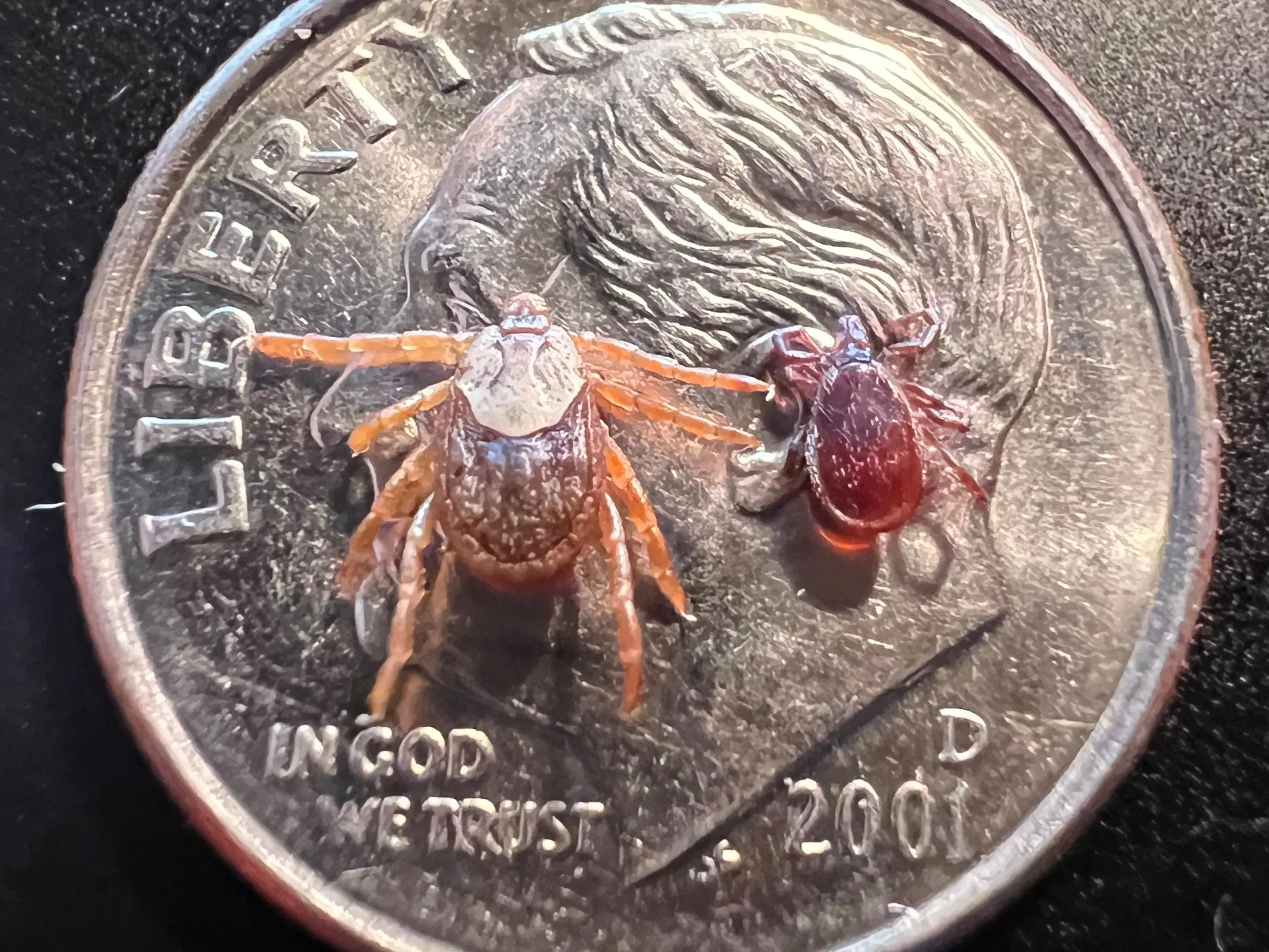
On Feb. 28, the lab issued a press release stating scientists had confirmed the tick was Ixodes scapularis, also known as the deer tick or blacklegged tick (not to be confused with the western blacklegged tick, Ixodes pacificus that lives along the Pacific Coast).
Although more often found on the East Coast and in the Midwest, the species is gradually hitching a slow ride farther west.
What’s more, a detailed DNA sequence analysis of the tick showed it may have been carrying Lyme disease or relapsing fever, another tick-borne disease, according to Marshall Bloom, a veteran RML scientist and chief of the Biology of Vector-borne Viruses Section.
He added the evidence is not definitive enough to make a solid case for Lyme disease infiltrating Montana.
“However, what it does say is, ‘Well, guess what? We should be on the lookout for these Ixodes scapularis ticks in Eastern Montana,’ which is where this tick was from, as well as other parts of the state,” Bloom said.
Unfortunately, the ticks are tiny. During the nymphal stage, when they are most likely to spread Lyme disease, they are the size of a poppy seed. Adults are about as big as a sesame seed.
Tick search this spring
A follow-up investigation is in the works. Philip Stewart, an RML scientist, hopes to return to the Richey area to search for deer ticks to see if the species has established itself in the region, Bloom said.
Devon Cozart, a communicable disease epidemiologist for the Montana Department of Public Health & Human Services, said her agency will be helping with the quest.
“Also this spring, we will look to leverage the public’s help in submitting ticks for identification,” Cozart wrote in an email. “More information will be provided about this program, and the 2024-25 tick surveillance season, in an upcoming DPHHS press release.”
Deer ticks have been identified in Montana before, Bloom said, but following detailed questioning of the infected individuals it was discerned the people likely picked them up while out of state.
However, the ticks have been documented in North Dakota and South Dakota, Montana’s neighbors to the east.
It would have been easy enough for the tick to hitch a ride from North Dakota to Eastern Montana on a deer or other animal, Bloom noted.
Or it may have scheduled a flight.
“It’s possible the tick may have ended up in Montana after attaching to a host, such as a bird, in a different state, and then was carried here,” Cozart said. “Ticks attach to hosts at multiple points in their life cycle, and this is a common method of unintentional travel for ticks.”
Right now, scientists still have several questions.
“For example, it is unknown whether blacklegged ticks are able to survive Montana winters and actively populate,” Cozart said.
According to the Centers for Disease Control and Prevention, the percentage of deer ticks infected with Lyme disease may be as high as 50% in some areas. Strangely, blacklegged ticks in the southeastern U.S. are almost never infected, the agency said.
The ticks get Lyme disease when they feed on an infected animal, often a mouse or other rodent, when they are in their larval or nymphal stage of life.
Although deer can help move the ticks around, they aren’t infected with the disease nor can they give it to ticks. Infected female ticks also don’t spread the disease to their offspring. The female’s 1,000 to 2,000 eggs hatch in the spring. The mother dies after laying the eggs.
The tick’s four-stage life cycle takes about two to three years.
Is climate change at fault?
A research paper Bloom co-authored pointed to climate change as a possible cause for the increasing incidence of tick-borne diseases in the United States. There are 18 diseases ticks carry.
“Climate change may allow ticks to populate sites previously thought too cold and also to extend the season of (tick-borne disease) risk,” the scientists wrote.
“Many of the diverse tick-borne diseases (TBD) in the U.S. appear to be increasing in incidence, leading to concern that factors such as climate change may create challenging scenarios,” according to a JAMA Network article posted last year.
Bloom noted there are several other factors that may be at play, including more people recreating outdoors and more wildlife moving into urban and suburban areas.
“You drive down the streets of Hamilton … and there are deer just about all over,” Bloom said. “So animals like deer, which can harbor the tick, are now moving into more urban areas.”
Montana’s tick history
Montana has long been home to the Rocky Mountain wood tick (Dermacentor andersoni) and the American dog tick (Dermacentor variabilis). Deer ticks, however, are much smaller and the disease they spread more common.
Rocky Mountain Lab was founded around 1900 specifically to study Rocky Mountain spotted fever, another tick-borne disease, that was concentrated along the west side of the Bitterroot River.
“That disease would now be classified as an emerging infectious disease, because at the time, it was brand new, nobody knew what caused it,” Bloom said.
The lab’s website said at the time research began, locals thought the “black measles,” as they called the resulting rash, was caused by drinking melted snow.
“It killed a lot of the people that had it,” Bloom said. “Nobody knew how it was spread, and there was no way to prevent it.”
In 1906, Dr. Howard Ricketts revealed ticks were the cause.
In the 1980s, Dr. Willy Burgdorfer was working at RML with colleagues when they identified ticks from the East Coast as the carriers of Lyme disease. In honor of the discovery, the bacteria was named after Burgdorfer.
As an aside, the Lyme in Lyme disease comes from the area where the disease was first identified and studied, Lyme, Connecticut.
Dr. Tom Schwan, who worked with Burgdorfer, was the first scientist to identify relapsing fever in Montana, another tick-borne disease, which had been reported in other parts of the world, Bloom explained.
“So just to reiterate, the track record in tick-borne infectious diseases at Rocky Mountain Labs is really par excellence,” he said.
What you should do
For a person to be infected with Lyme disease, the tick needs to be attached for more than 24 hours.
“Tick activity in Montana typically begins to increase around May,” Cozart noted. “The best way to prevent tickborne illnesses is to prevent tick bites. This includes performing regular tick checks, wearing EPA-approved insect repellent, showering after being outdoors, carrying tweezers for quick and safe removal, and even removing your clothing for a quick 10-minute session in the dryer to kill any clinging ticks.”
Typical symptoms of Lyme disease include fever, headache, fatigue, and a characteristic skin rash called erythema migrans that resembles a bullseye, according to Rocky Mountain Lab. “If left untreated, infection can spread to joints, the heart, and the nervous system.”
Later this spring, DPHHS will conduct targeted messaging to health care providers about tick identification and tick-borne diseases, Cozart added.
“We will also recommend increased awareness around any suspect or confirmed cases of Lyme disease identified in individuals with recent travel to Dawson County.”
Bloom said the main takeaway lesson is: “People need to be aware of ticks and all of the other diseases that the ticks that are more common in the state of Montana can carry.”
Better vaccination in the works
In the meantime, scientists at Montana State University’s Department of Microbiology and Cell Biology are working to develop a better vaccination for Lyme disease. Right now, the vaccines require frequent boosters, said Patrick Secor, an MSU associate professor working on the study.
The National Institutes of Health has awarded Secor’s lab $2.8 million over five years to study how the bacterium that causes the disease is able to circumvent a vaccinated person’s immune system.
“For the bacteria to survive, they have to go back and forth between the tick and the mouse,” Secor said in an MSU news release. “But the mouse they go back into has probably already been exposed, so the bacterium needs to essentially change its spots so that it can avoid the mouse’s immune response. That’s why we think it’s important for these bacteria to swap genes around.”
Photo Caption: Tom Schwan, RML | On the left is the common wood tick (Dermacentor andersoni) found throughout Montana that can transmit organisms causing Rocky Mountain spotted fever and Colorado tick fever. On the right is the tick that can transmit the organism that causes Lyme disease (Ixodes scapularis). Both ticks are adult females.