
BRETT FRENCH | bfrench@billingsgazette.com
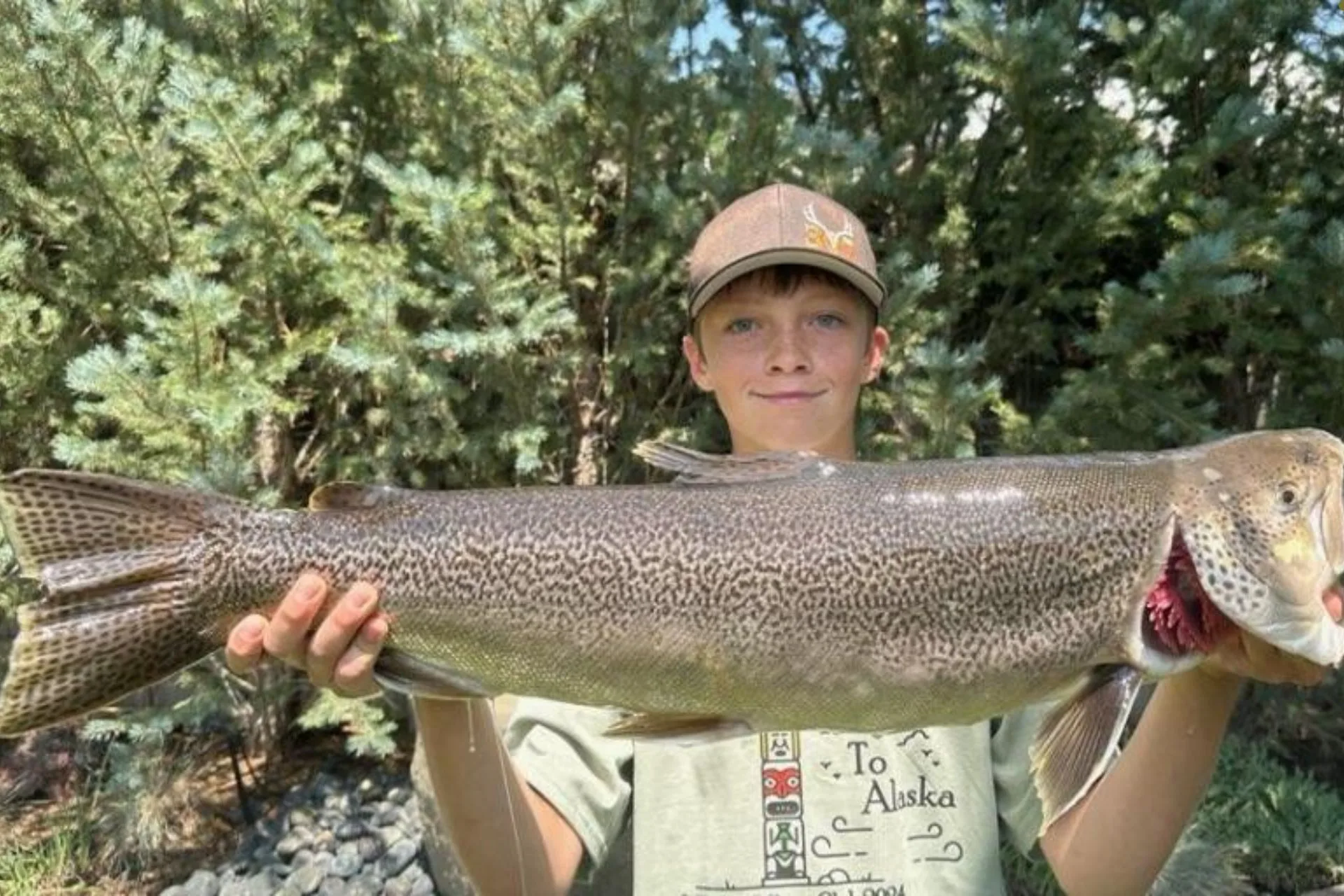
Once the occasional oddity, tiger trout are ready to make a debut in Montana.
The sterile fish, a cross between a male brook trout and a female brown trout, are proposed for planting in four Beartooth Mountain lakes and seven central Montana reservoirs and ponds.
The Department of Fish, Wildlife & Parks announced proposals to stock the fish this spring in south-central Montana’s Region 5 in Crater, Lily Pad, Companion and Corner lakes.
“They can provide excellent sportfishing opportunities as they are aggressive and can grow to large size,” FWP wrote in its draft environmental assessment.
Region 4, in central Montana, has identified Bair, Crow Coulee, Hansen and Leningtons reservoirs as well as Maiden Spring, Kingsbury and Upper Carter ponds
The agency is touting the species ability to eat smaller fish, termed “biocontrol” — to winnow down the supply of stocked rainbow trout, self-sustaining brook trout and even nonnative fish like lake chub that may have been introduced after someone released their live bait.
“Since tiger trout are sterile, their numbers can be highly managed by stocking practices,” FWP noted.
Region 5 fisheries biologist Bryan Giordano said one of the goals is to increase angler opportunity, especially in waters where fish are so numerous that their size is stunted.
Stocking tiger trout, he said, will convert some of those smaller fish into more catchable-sized trout for anglers.
Triploid tiger trout eggs from Wyoming would be used as the source for stocking, the agency wrote.
“A triploid fish has three sets of chromosomes, unlike a fertile fish that have two set of chromosomes (a diploid fish),” according to Wyoming Game and Fish, which grows and stocks the fish. “A triploid fish is not a genetically modified organism nor have the genes of the fish been manipulated or modified in any way. Triploid fish simply have an extra copy of DNA that makes reproduction impossible.
“Triploid tiger trout are created by forcing the egg to retain a chromosome that is normally ejected during egg development. To prevent the egg from rejecting the chromosome, Story Hatchery personnel use a pressure treatment method to retain the chromosome that would normally be kicked out of the egg during an early stage of egg development. Using pressure, at precisely the right time in the egg development, the chromosome is retained; resulting in a sterile fish with three chromosomes.”
The lifespan of an individual tiger trout varies, but they generally live from 4 to 8 years. The fish average between 10 to 16 inches. The state record is a 4-pound, 20-incher caught in 1997 by Joe Sobczak from Bear Lake.
In 2018, Missoula angler Jake Lee caught a tiger trout while fishing Rock Creek. It was deemed a naturally occurring hybrid.
“I’m not surprised, but it is rare in the wild,” Pat Saffel, Region 2 fisheries manager for FWP, told a reporter at the time. “The two species just don’t overlap in area all that often, and they’re pretty distinct species.”
Angler Austin Christensen in neighboring Idaho caught a 27-inch, 9-pounder last year for a new state record. Wyoming also saw a new record set in 2024 when 13-year-old Jaxon Krall caught a nearly 13-pound tiger trout.
Crater and Lily Pad lakes are located at the base of the Beartooth Mountains at an elevation of about 6,400 to 6,600 feet in Stillwater County. Both are accessible by hiking in from the West Rosebud Road.
Crater Lake is about 2 acres with a maximum depth of 36 feet. Lily Pad is 3 acres with a maximum depth of 19 feet.
Companion Lake sits at 9,393 feet and is accessible via the Goose Lake Jeep Trail outside Cooke City. The lake is about 7 acres and 24 feet at its deepest point. Companion contains small brook trout.
Corner Lake is next door to Companion, stretching across 11 acres. It is managed for its self-sustaining Yellowstone cutthroat trout and lake chub.
Comments on the tiger trout introductions will be taken until June 5 and can be emailed to Region 5 fisheries biologist Bryan Giordano at bryan.giordano@mt.gov or mailed to 2300 Lake Elmo Dr., Billings, MT 59105.
In Wyoming’s Viva Naughton Reservoir where the state record was caught, Wyoming Game and Fish Green River Region fisheries supervisor Robb Keith offered tiger trout anglers this advice.
“We see them predominantly close to shore down to 25 feet of water,” he said. “They are found close to structures. They are eating shiners and Utah chubs, so anglers should choose lures, flies and baits that resemble these forage fish.”
Tiger trout get their name from the “pronounced dark vermiculations (tiger stripes, like brook trout) all over a brownish, gray body,” according to the Washington Department of Fish and Wildlife. Washington stocks the fish in more than 40 lakes.
The agency offered this advice for anglers: “For shore anglers, the best time to fish is either early in the morning or in the evening. The fish will be paralleling the shoreline for prey as the water is cooler and the low light conditions prevent them from being detected.
“Some popular lures are: Kastmasters, Triple Teasers, and Jake’s Spin-a-lure. Fly fishers do well with Leech, Muddler, Woolly Bugger and nymph patterns. If fish are taking flies at the surface use a floating line and a dry fly or emerging pattern.”
Wyoming’s Story Hatchery began producing the fish in 2011. Tiger trout were stocked in these Sheridan, Wyoming-area lakes: Willow Park, Cloud Peak, Weston, Muddy Guard reservoirs #1 and #2, and Long and Ringbone lakes in the Cloud Peak Wilderness.
Montana's outdoor week, in your inbox at 7am Friday.