
Fishing is supposed to be a relaxing hobby, but one unlucky angler recently learned that Northern Pike do not respect the rules of catch-and-release etiquette. While trying to weigh a freshly caught pike, the fish decided it wasn’t going down without a fight, thrashing violently and snapping its jaws directly onto the angler’s hand. If a quick bite wasn’t enough of a parting gift, the pike managed to leave behind a literal souvenir: one of its razor-sharp teeth snapped off and lodged deep into the angler’s hand. The stubborn, hitchhiking tooth refused to budge, forcing a trip to the doctor where medical professionals had to minorly operate to extract the freshwater predator’s razor blade from the flesh.
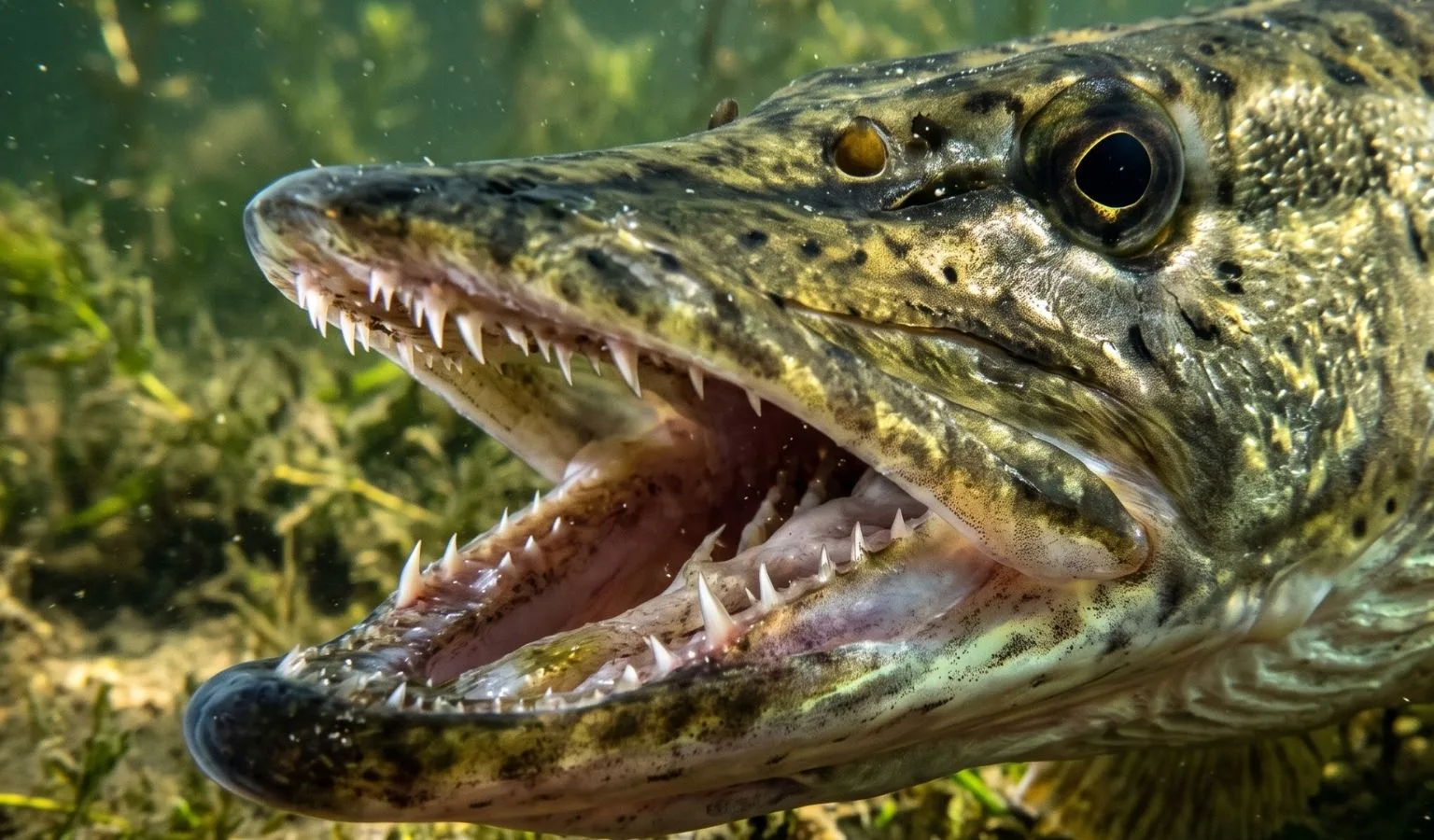
Getting bit by a pike is essentially like jamming your hand into a floating paper shredder. These absolute monsters of the shallows pack anywhere between 300 to 700 needle-like teeth in their mouths, according to wildlife guides at A-Z Animals. Even worse for anyone on the receiving end of a bite, a pike’s teeth are angled backward toward its throat, meaning once something goes in, it is physically designed not to slide back out—as this angler’s x-rays painfully proved. To keep their hunting efficient, pike also boast a continuous “conveyor belt” tooth-replacement system where new blades constantly grow in to replace broken ones, as noted by the Wisconsin DNR.
Why Northern Pike Are Built Like Freshwater Predators
Northern Pike (Esox lucius) didn’t earn their reputation as one of North America’s most aggressive freshwater fish by accident. Every physical feature on this species is purpose-built for ambush hunting and raw killing efficiency. Their elongated, torpedo-shaped bodies allow them to launch from a standstill into explosive, short-burst strikes. Their eyes sit high on a flat, duck-bill snout, giving them a wide field of vision to track prey. And then, of course, there’s the mouth — which is essentially a biological bear trap.
Those backward-angled teeth aren’t just a random quirk of evolution. They serve a very specific function: locking prey in place so it can’t wriggle free. Pike frequently target waterfowl, frogs, small mammals, and other fish — sometimes prey that comes close to matching them in size. When you’re wrestling a meal that doesn’t want to be eaten, a one-way dental system is a significant competitive advantage. For an angler reaching into a livewell or fumbling with a scale, that same system is a serious liability.
The “conveyor belt” tooth replacement cycle means that even a pike that has recently bitten and broken off teeth is never truly unarmed. New teeth are constantly cycling forward, keeping the fish perpetually equipped with a fresh set of cutting tools. It also means that a broken tooth lodged in your hand — as this angler discovered — is a genuine medical situation, not just a minor inconvenience. Fish teeth can carry bacteria, and a deeply embedded fragment left untreated can lead to infection.
Northern Pike in Montana: Where They Live and Why Anglers Seek Them Out
Montana isn’t the first state that comes to mind for pike fishing, but the species has a strong foothold here — particularly in the eastern half of the state and in reservoirs along major river systems. Fort Peck Reservoir on the Missouri River is arguably Montana’s most well-known pike fishery, and it produces genuinely trophy-class fish. Flathead Lake and several smaller northeastern Montana lakes and ponds also hold healthy pike populations.
It’s worth noting that Northern Pike are considered a native species in some parts of Montana’s eastern drainages but are classified as an invasive or undesirable species in western Montana’s trout-dominated waters. Montana Fish, Wildlife & Parks (FWP) has worked aggressively to manage and in some cases reduce pike populations in certain western watersheds where they threaten bull trout, westslope cutthroat, and other native species. If you’re targeting pike in western Montana or in waters where their status is uncertain, always check current FWP regulations — rules on possession, slot limits, and harvest vary significantly by water body.
For anglers fishing where pike are welcome, the experience is hard to match. These fish are aggressive, rod-bending fighters that don’t give up easily — which, as the angler in this video found out, remains true even after they’re out of the water. Pike are most active in cooler water temperatures, making spring and early fall prime seasons. They tend to hold in shallow, weedy areas near structure, ambushing prey from cover. Targeting weed edges, submerged timber, and the shallower flats of larger reservoirs is usually a productive approach.
How to Handle a Pike Without Ending Up in the ER
Pike fishing is fantastic sport, but it demands a different level of fish-handling respect than, say, catching a rainbow trout. If you’re new to targeting pike — or if this video just made you rethink your current approach — here’s what experienced pike anglers know that beginners often learn the hard way.
Use the Right Tools
Long-nose pliers or purpose-built hook removers are non-negotiable when handling pike. Reaching bare fingers into that mouth to retrieve a hook is exactly how you recreate the scene from the video above. Jaw spreaders can help hold the mouth open safely while you work a hook free. Heavy-duty fish grips that allow you to control the fish by the lip — keeping your hand well away from the teeth — are also a worthwhile investment if you’re fishing for pike regularly.
Know the Right Hold
The two most common and safest ways to hold a pike are the “thumb grip” on the lower jaw (using a firm grip similar to bass fishing, though you must be careful given the tooth placement) or, more safely, cradling the fish horizontally with one hand behind the gill plate and one hand supporting the belly. Never put fingers inside the gill cavity, and never, ever dangle a pike vertically by the lower jaw the way you might hold a largemouth bass — pike are not built for that, and neither is your hand.
Weigh with a Net or Cradle
The angler in this video was trying to weigh the fish when things went sideways — a common moment of vulnerability. Rather than holding the fish in one hand while attaching a scale with the other, use a rubberized landing net or a weigh sling to keep the fish contained and controlled. Many modern fish scales clip directly to a net, letting you get an accurate weight without ever palming a flopping, jaw-snapping pike.
Respect the Thrash
Pike are notorious for violent, sudden thrashes — even fish that appear calm and exhausted. Never assume a pike is “done.” Keep your face, forearms, and free hand clear of the fish until it is fully secured. If you’re doing a quick photo and release, minimize the time the fish is out of water and stay focused on control at all times. A distracted second is all a pike needs.
What to Do If a Pike Bites You
If you’re unlucky enough to get bitten — or end up with a broken tooth embedded in your hand like our unfortunate angler — don’t try to be tough about it. Pike bites can go from minor to serious quickly because of the bacteria present in their mouths and the environment they live in. Clean any wound thoroughly with clean water and antiseptic as soon as possible. If a tooth or hook fragment is lodged in the flesh and you cannot easily remove it, go to a medical professional. That is not a situation to improvise with a pocket knife streamside. Infection in a hand can sideline you for weeks, and in worst-case scenarios it can be far more serious.
The angler in this story made the right call going to the doctor. The minor procedure needed to extract that embedded tooth is a far better outcome than what happens when puncture wounds from fish go untreated in the field.
The Bottom Line
The takeaway here? Next time you are weighing a pike, keep your fingers far away from the business end, or you might just end up with an unexpected doctor appointment of your own. Northern Pike are spectacular fish — hard-fighting, visually stunning, and genuinely thrilling to catch — but they command a healthy dose of respect before, during, and especially after you pull them out of the water. Treat them like the predators they are, come prepared with the right gear, and you’ll have great stories to tell that don’t involve x-rays.
Montana's outdoor week, in your inbox at 7am Friday.