
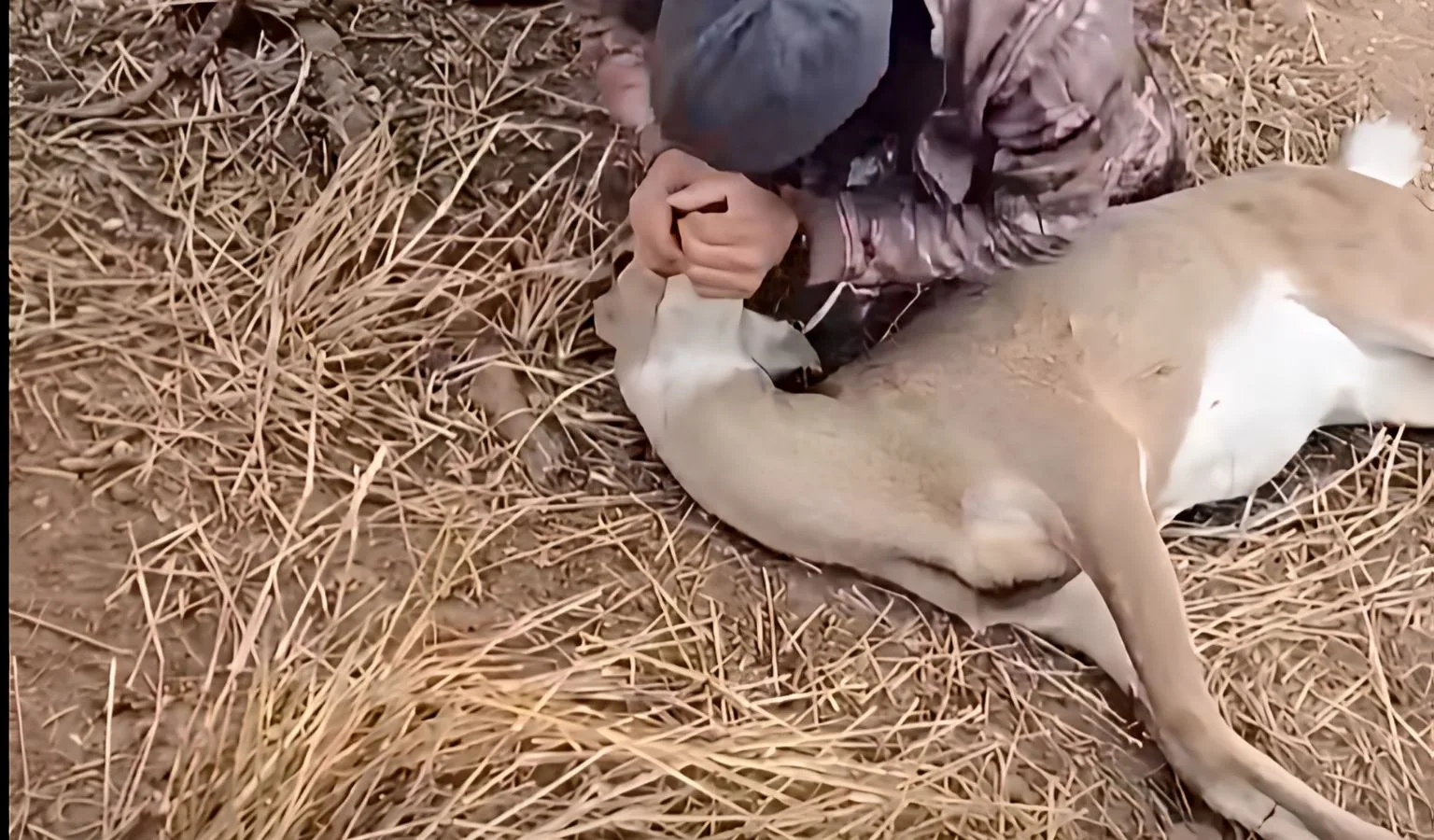
What started as a regular day in the woods, turned into an intense, heart-pounding rescue mission when a group of hunters stumbled upon a young buck in critical distress. The small deer had managed to get its head tightly trapped in a wire fence, thrashing until it was exhausted and visibly choking, unable to draw air.
Recognizing the danger, one of the hunters rushed over to free the animal from the fence. However, by the time the buck was freed, its body collapsed onto the ground—unresponsive and limp.
Refusing to give up on the animal, the hunter jumped into action, performing makeshift cardiopulmonary resuscitation (CPR):
- Chest Compressions: Applying steady pressure to the deer’s ribcage over the heart to simulate blood flow.
- Rescue Breathing: Cupping the muzzle and blowing breath directly into the buck’s mouth and nasal passage to force oxygen into its lungs.
For nearly two agonizing minutes, the buck lay motionless. But just as hope began to fade, the animal twitched, and slowly began to breathe on its own. Within moments, the young buck sat up, regained its footing, and bounded safely back into the timber.
An extra two minutes of decisive action and quick CPR literally made the difference between death and survival for this young buck.
Wildlife Rescue Facts & Resources
| Fact | Overview |
| Fence Hazards | Studies by wildlife agencies indicate thousands of deer, elk, and pronghorn become entangled in woven-wire or top-strand barbed wire fences annually. |
| Animal CPR Mechanics | Performing CPR on medium-to-large mammals follows a similar principle to humans: compression rates near 100–120 beats per minute on the chest, paired with mouth-to-snout ventilation. |
| Wildlife-Friendly Fencing | Modern conservation standards recommend leaving a minimum 16–18 inch gap at the bottom for fawns and maintaining top strand heights under 40 inches to prevent entanglements. |
Source Links & Further Reading
- Learn more about wildlife-friendly fence designs from the U.S. Department of Agriculture (USDA) Conservation Guidelines.
- Read guidance on handling injured or distressed wildlife from the National Wildlife Rehabilitators Association (NWRA).
- Explore reports on fence hazards and ungulate migration paths at the U.S. Geological Survey (USGS) Wildlife Health Center.
Editor’s note: Corrected a typo ("lay motionlessness" to "lay motionless"); all factual claims verified as within accepted ranges.
Montana's outdoor week, in your inbox at 7am Friday.