
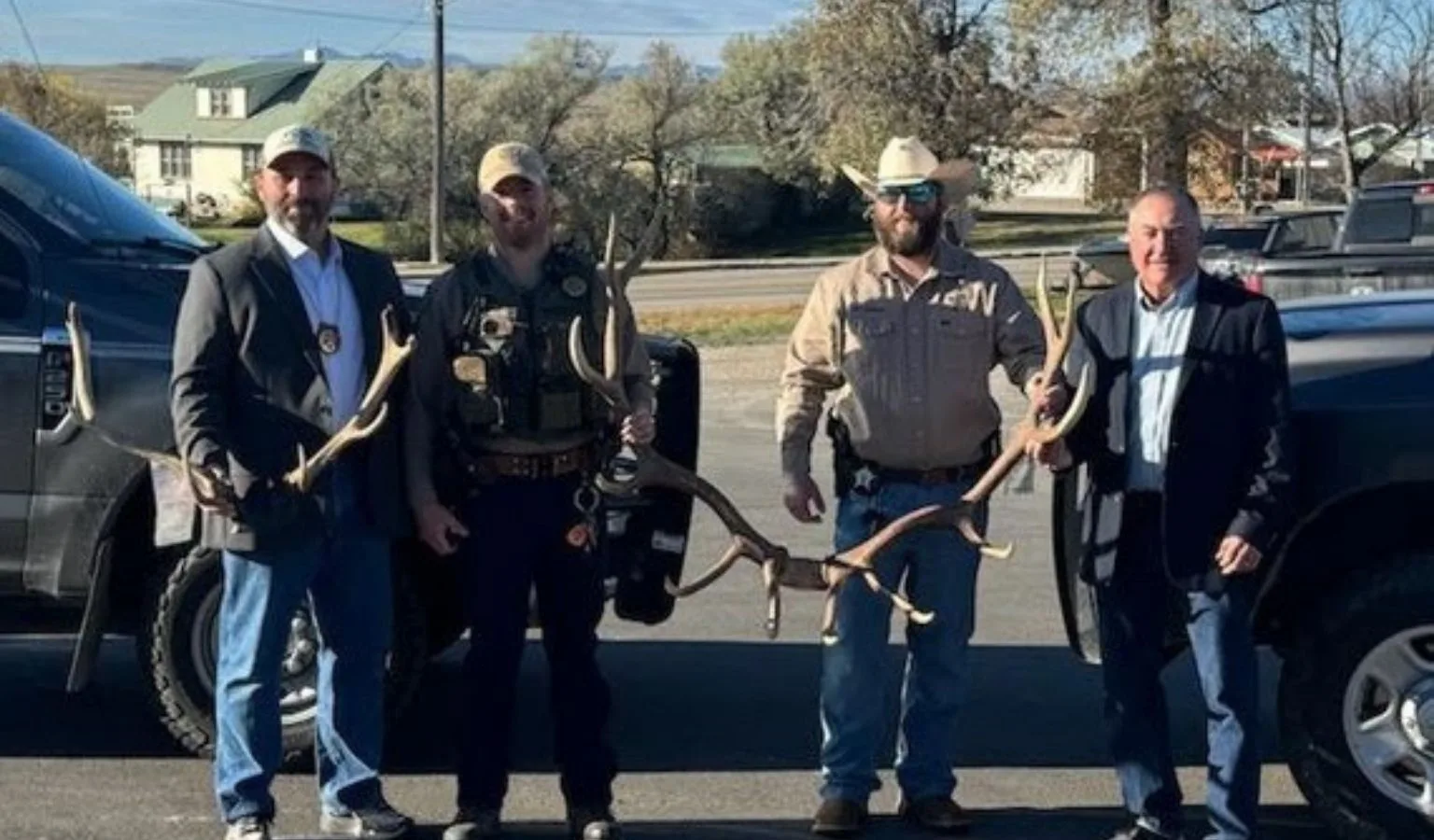
Investigation began with report of trophy bull elk shot with a firearm during archery only season
BILLINGS – As a result of a yearlong investigation by Montana Fish, Wildlife & Parks game wardens, a father and son pled guilty to multiple wildlife violations in Wheatland and Musselshell county courts earlier this month. Both men face thousands of dollars in fines and restitution and will lose hunting privileges for multiple years.
Michael Jason Letasky of Billings pled guilty in Wheatland County District Court to two counts of unlawful possession of a game animal, two counts of hunting during a closed season and one count of a waste of a game animal. He faces over $12,000 in fines and restitution and will lose hunting privileges for 20 years in Montana and all other states in the Interstate Wildlife Violator Compact. Michael’s son Kolton Letasky, of Austin, Texas, pled guilty in Musselshell County Justice Court to two counts of unlawful possession of a game animal and two counts of hunting without a license. Kolton faces over $3,000 in fines and restitution and will lose hunting privileges for four years.
How the Investigation Unfolded
This investigation began on Sept. 22, 2025, when two archery hunters in the Little Belt Mountains reported that a man shot a large bull elk with a rifle during archery only season. Thankfully, both witnesses were able to provide descriptions of the suspect. FWP game wardens and Wheatland County Sheriff’s deputies responded and identified Michael Letasky as the suspect during an investigative traffic stop.
The witnesses led wardens and Wheatland County deputies to the kill site, where they located a large bull elk shot with a rifle. The 6×6 bull elk met Montana’s trophy restitution requirements with a Boone and Crockett score of 321 2/8. The trophy bull elk had been left to waste at the scene, rendering the meat unfit for human consumption.
“The hunters that witnessed this trophy bull elk unlawfully shot during archery season were rightfully upset and immediately reported the crime to authorities,” said game warden Diego O’Brien, who led the investigation. “Their quick and accurate reporting and assistance in locating evidence were crucial to this investigation.”
Violations Spanning Multiple Years and Counties
During their extensive investigation, game wardens discovered that Michael Letasky also shot a raghorn bull elk in 2023 in the same area with a firearm during archery only season. They also discovered that Letasky was in possession of an unlawful black bear that he had failed to report. Additionally, game wardens discovered evidence that Kolton Letasky had killed a mule deer buck in 2024 and bull elk in 2022 in Musselshell County without the required 535-50 mule deer permit or 411-20 elk permit.
What began as a single tip about one illegally taken bull elk ultimately unraveled a pattern of repeated wildlife violations stretching back years and crossing multiple Montana counties. This kind of layered investigation — where one reported crime leads wardens to uncover a broader pattern of misconduct — is not uncommon in Montana poaching cases. Game wardens are trained investigators, and digital forensics, witness interviews, and careful evidence gathering often reveal violations that perpetrators believed would go unnoticed.
What “Archery Only” Season Actually Means — and Why It Matters
Montana’s hunting seasons are carefully structured to balance conservation goals, hunter opportunity, and fair chase principles. Archery-only seasons exist for good reasons: they offer hunters willing to pursue game at close range an exclusive window of opportunity, typically during a period when elk are most active during the rut. Using a firearm during an archery-only season is not a technicality or a gray area — it is a deliberate circumvention of the rules that undermines the entire system.
Hunters who take the time and effort to train with a bow, purchase the appropriate license, and pursue elk the hard way during archery season have a legitimate expectation that the season will be respected by everyone in the field. When someone shows up with a rifle during that window, they are not just breaking the law — they are stealing opportunity from every ethical hunter in that drainage. That’s part of why incidents like this generate such strong reactions from the hunting community.
Trophy Restitution: Why the Fines Are So High
Montana law includes trophy restitution values for certain big game animals based on established scoring systems such as Boone and Crockett. When a poached animal meets or exceeds those thresholds, the restitution value increases substantially — reflecting not just the animal’s biological value, but its significance to the state’s wildlife heritage and to the hunters who pursue these animals lawfully.
The 6×6 bull elk taken by Michael Letasky scored 321 2/8 Boone and Crockett — a genuinely exceptional animal by any measure. Bulls of that caliber are rare, and they represent years of growth, survival, and the kind of genetic quality that FWP works to protect and sustain across Montana’s elk herds. The fact that this bull was then left to waste at the scene adds another dimension of disregard, both for the animal and for the hunters who pursue elk for the meat as much as the experience.
Montana’s waste-of-game laws exist precisely to prevent this outcome. Killing an animal and leaving it to rot — whether out of carelessness, convenience, or a desire to avoid being caught with the evidence — is a serious offense on its own, separate from the unlawful taking itself.
The Interstate Wildlife Violator Compact: Nowhere Left to Hunt
Michael Letasky’s 20-year loss of hunting privileges extends far beyond Montana’s borders. The Interstate Wildlife Violator Compact (IWVC) is an agreement among the vast majority of U.S. states that allows hunting and fishing license revocations to be honored across state lines. In practical terms, this means a hunter who loses their privileges in Montana will find those privileges suspended in every participating state.
For someone who hunts multiple states — as many serious big game hunters do — this compact carries enormous consequences. It is one of the most significant enforcement tools available to wildlife agencies, and it reflects a national consensus that wildlife violations are not local problems with local-only solutions.
The Role of Citizen Witnesses in Wildlife Enforcement
“We appreciate the assistance from Wheatland County Sheriff’s Office and Billings Police Department Digital Forensic Team in this investigation, and thank Wheatland and Musselshell county attorneys’ offices for their prosecution of the charges,” said warden O’Brien.
“Most of all, we appreciate the reporting by the hunters who witnessed the crime. They sacrificed their own hunting trip to ensure justice was served, and this case wouldn’t have been possible without their help,” said O’Brien.
It’s worth pausing on that last point. The two archery hunters who witnessed the illegal shooting made a choice that not everyone would make: they stopped their own hunt, engaged with authorities, guided wardens to the kill site, and followed through as witnesses throughout a yearlong investigation. That is a meaningful commitment, and the outcome of this case is a direct result of their willingness to act.
Montana’s vast landscape makes comprehensive game warden coverage impossible without the eyes and ears of hunters, anglers, hikers, and landowners in the field. FWP game wardens are skilled and dedicated, but they cannot be everywhere. Citizen reporting is not just helpful — in many cases, it is the only reason poachers are ever caught.
How to Report Poaching in Montana
FWP game wardens often rely on reports and good witnesses from the field in many investigations. Anyone with possible information about crimes against wildlife or state lands is asked to call the local game warden, 1-800-TIP-MONT, or visit tipmont.mt.gov to provide details. Those who report information may be eligible for a cash reward of up to $1,000.
When reporting a suspected poaching incident, the more detail you can provide the better. Witness descriptions of the suspect, vehicle make, model, and license plate, the exact location of the incident, and the time and circumstances of what you observed can all be critical. If it is safe to do so, noting the direction of travel a suspect vehicle takes can help wardens intercept the individual — exactly as happened in this case.
You do not need to be certain a crime has been committed to make a report. If something looks wrong in the field, trust your instincts and make the call. That’s how cases like this one get started — and how they get solved.
-fwp-
Montana's outdoor week, in your inbox at 7am Friday.