
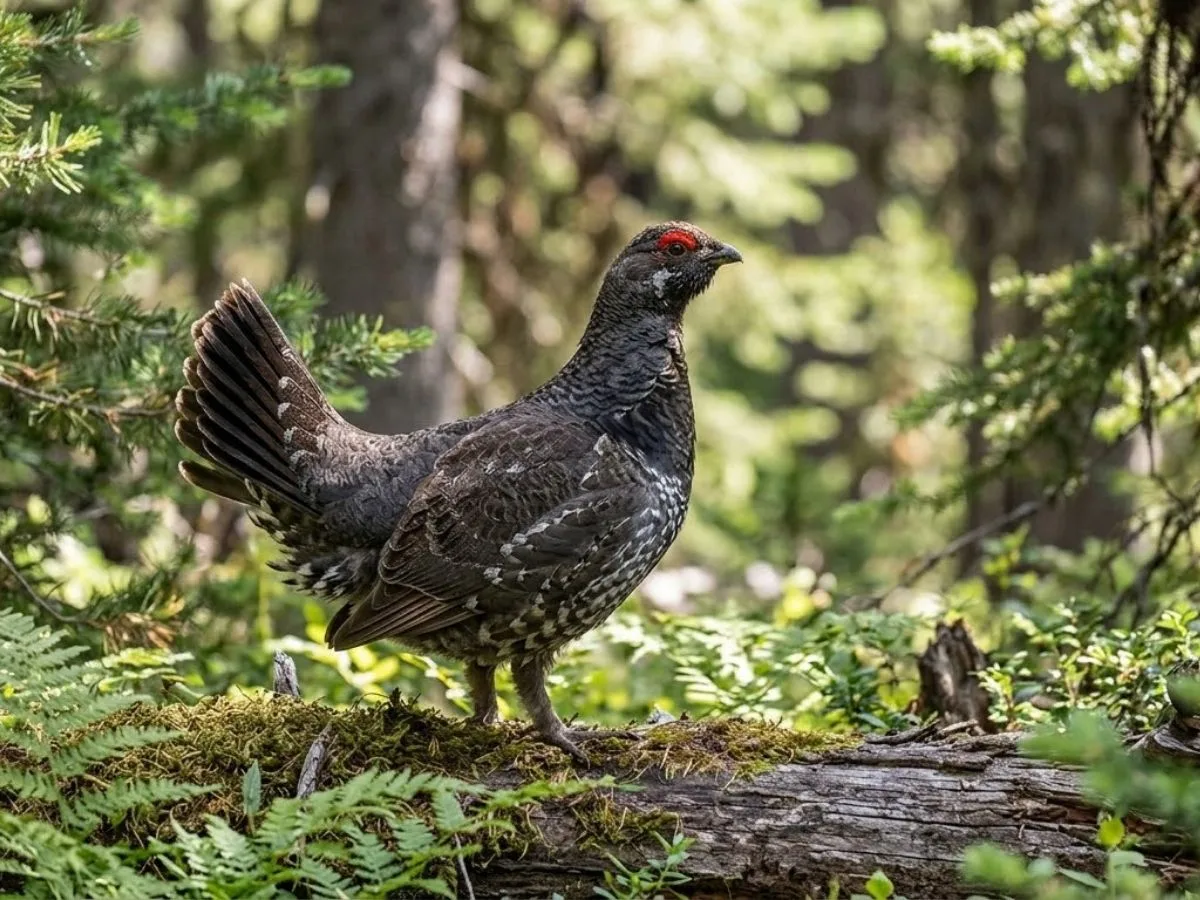
The Dusky Grouse….the bird that proves you don’t need a gym membership if you spend your life walking uphill. Once lumped together with the Sooty Grouse under the ‘Blue Grouse’ umbrella, the Dusky Grouse has since claimed its own throne as the premier game bird of the Rockies. While most creatures head for the valleys when the snow flies, the Dusky pulls a “reverse migration,” walking uphill into dense woods to spend the winter eating nothing but pine needles. It’s a slow-moving, surprisingly tame, and incredibly hardy bird that prefers a low-carb, high-fiber diet of Douglas-fir buds over almost anything else. However, the Dusky is second in size, just behind the Sage Grouse.
When spring hits, the males stop being “inconspicuous” and start being “obnoxious,” but in a good way, I suppose. They find a nice and comfortable area and begin a series of deep, hoots (like whoop, whoop, whoop) that sound like bass to grab a female’s attention. The mating ritual is a full-blown transformation: the male’s eye combs swell into a bright yellow or red, and he reveals hidden purplish-red air sacs on his neck. He struts, fans his tail, and performs “flutter flights” where his wings beat with a loud thumping. Once the show is over, the female handles the heavy lifting, nesting in a simple ground scrape and raising chicks that are literally born ready to hustle—leaving the nest and finding their own food within 24 hours.
Check out this cool footage that shows a mating ritual for a Dusky duo:
If you’re trying to spot one between the Ponderosa pines and those open meadows, keep an eye on the messy old-growth woods where they can blend into the shadows of brown, gray, and black. Basically, they live on the edge (ha) and tend to mostly be on the edge of the forests where the land opens to sagebrush flats.
Four Ways to Identify a Dusky:
- Size & Shape: A heavyset, chicken-like bird with a short bill and strong legs…(it must be all that walking!). Its medium-length tail is a signature feature, fanning out into a perfect semicircle during displays…as you can see above.
- Relative Size: Larger than a Spruce Grouse but smaller than a Wild Turkey….and still smaller than a Sage Grouse, as that is the largest Grouse. Think somewhere between a crow and a goose…something like that.
- Color Pattern: Perfect mountain camouflage. Both sexes are brown, gray, and black. Look for the male’s blue-gray underparts and those bright purplish-red neck sacs and yellow eye combs during the spring.
- Behavior: Known for being “tame” (or just maybe unimpressed by humans), they spend their time foraging on the ground or in trees. Listen for the deep sound of the male’s hoots to find them in the spring.
Source information: All About Birds, Audubon
Montana's outdoor week, in your inbox at 7am Friday.