
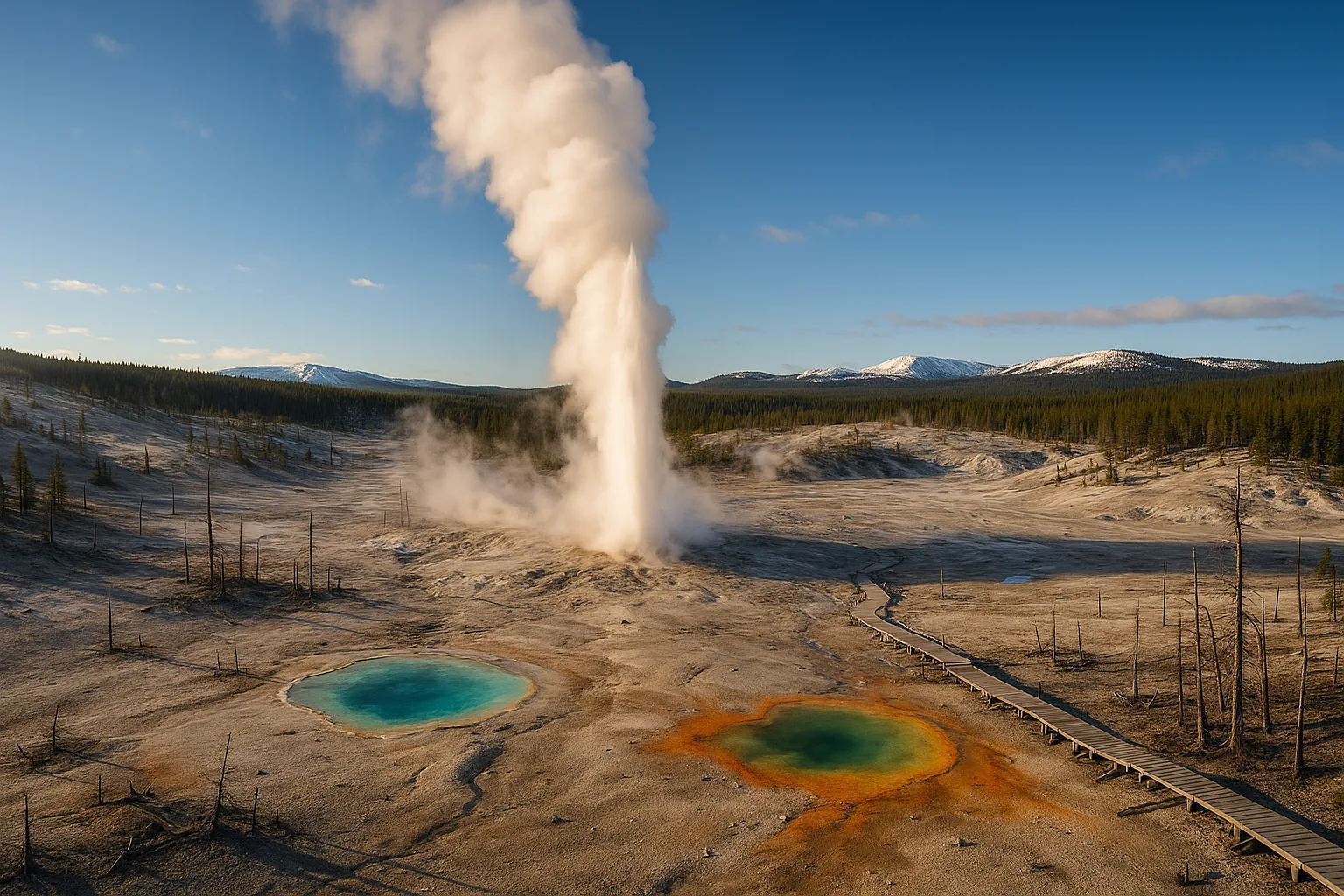
There’s a video making the rounds right now with a title that would make any Yellowstone watcher’s pulse jump: live footage of Norris Geyser Basin shooting water 200 meters into the air, dated March 10, 2026. The channel behind it, USA ARMED, has packaged it with the kind of keyword-stuffed description — “supervolcano,” “eruption 2026,” “hot springs turn red” — designed to trigger every doomsday algorithm on the internet. And it’s working.
- Steamboat Geyser is the tallest active geyser on Earth—but its documented major eruptions are about 300–400 feet (90–120 meters), not 200 meters.
- Norris Geyser Basin is Yellowstone’s hottest and most dynamic thermal area, with both acidic and neutral features in close proximity.
- Viral titles often inflate genuine geothermal activity into apocalyptic “supervolcano” narratives that aren’t supported by confirmed reporting.
- USGS Yellowstone Volcano Observatory monitors Yellowstone continuously; truly extraordinary events don’t stay confined to YouTube descriptions.
- Even without the hype, Norris is compelling: unpredictable eruptions, strange chemistry, and textures formed by silica sinter.
Over four thousand views in just days. Here’s the thing, though. Strip away the breathless framing and there’s actually a genuinely fascinating subject underneath all that noise. Norris Geyser Basin is extraordinary. Steamboat Geyser is the tallest active geyser on Earth. You don’t need to fabricate a catastrophe to make this place sound incredible — it already is.
So let’s talk about what’s real.
What Steamboat Geyser Actually Does — And Why It’s Already Astonishing
Steamboat Geyser sits in the Back Basin of Norris, and when it erupts in a major discharge, it sends water somewhere between 300 and 400 feet into the air. That’s roughly 90 to 120 meters — extraordinary by any measure, and well beyond any other active geyser on the planet. Old Faithful, the park’s most famous performer, tops out around 180 feet on a good day. Steamboat makes it look modest.
The catch is unpredictability. Steamboat went nearly 50 years without a major eruption at one point. Then, starting in 2018, it entered a remarkably active phase, erupting dozens of times per year. Scientists at the USGS Yellowstone Volcano Observatory have been watching that activity closely, trying to understand what’s driving the cycle. The short answer: they’re still working on it.
Norris is the hottest and most geologically restless part of the entire park, with ground temperatures that can exceed boiling even before you factor in elevation. The claim of water shooting 200 meters — about 660 feet — into the air goes beyond what’s been documented in Steamboat’s recorded history. That doesn’t mean the video isn’t showing something real happening at Norris. It means the framing around it is doing what a lot of these channels do: take genuine geothermal activity, add superlatives, and let the algorithm do the rest.
Echinus Geyser and the Stranger Details Worth Knowing
One thing the video description does get right — and credit where it’s due, this is a genuinely interesting detail — is the story behind Echinus Geyser. Named by mineralogist Albert Charles Peale after his 1878 visit, the name comes from echinoderm, the scientific family that includes sea urchins. Peale thought the sinter formations around the geyser’s vent looked like the spiny shells of those animals. He wasn’t wrong.
The silica deposits at Norris can form into textures that look almost biological, which is part of what makes the basin so visually arresting even when nothing is actively erupting.
Echinus sits about 200 meters from Steamboat in the Back Basin — and that proximity matters. The two features share a hydrothermal system that’s unusually acidic compared to most of Yellowstone’s thermal areas. Most of the park’s famous hot springs and geysers are neutral to alkaline. Norris runs both acidic and neutral chemistry side by side, sometimes within feet of each other. That’s the “chaotic mix” the description references, and it’s accurate.
The acidity at Echinus, in particular, can approach that of vinegar. The microorganisms that thrive in those conditions are part of what makes Norris a site of ongoing scientific interest — some of the heat-loving bacteria discovered there have had real applications in biotechnology. None of that requires a fictional supervolcano eruption to be compelling. But here we are.
Why the “Supervolcano” Framing Keeps Spreading
The broader pattern with channels like USA ARMED is worth naming plainly. Yellowstone occupies a unique place in the American imagination — it’s simultaneously a beloved national park and the site of one of the largest volcanic systems on the continent. That combination makes it irresistible for a certain style of content creation that blurs the line between genuine geothermal footage and apocalyptic speculation.
The USGS monitors Yellowstone continuously with seismometers, GPS sensors, and stream gauges. If something genuinely extraordinary happened at Norris in early March 2026, you’d know about it from sources that don’t need to put “ARMED” in their channel name.
That said — go watch the footage for what it actually shows. Norris in any state of activity is worth your time. The steam, the color, the sheer alien quality of the landscape. If the camera caught Steamboat in even a minor eruption phase, that alone is something most people never see in person. Just read the title with appropriate skepticism.
Yellowstone doesn’t need the hype. It just needs people to actually show up and pay attention.
Frequently Asked Questions
Did Yellowstone’s Norris Geyser Basin erupt in 2026?
There is no confirmed major eruption event at Norris Geyser Basin in early 2026. Viral videos with dramatic claims should be cross-referenced with USGS Yellowstone Volcano Observatory updates, which monitor the park continuously.
How high can Steamboat Geyser erupt?
Steamboat Geyser, the world’s tallest active geyser, can send water 300 to 400 feet (roughly 90–120 meters) into the air during a major eruption. Claims of 200-meter (660-foot) eruptions exceed its documented historical record.
Is the “200 meters into the air” claim plausible for Steamboat?
The article’s point is that 200 meters goes beyond what’s been documented in Steamboat’s recorded history. The footage could still show real geothermal activity at Norris, but the headline-style framing overshoots known benchmarks.
Is Yellowstone’s supervolcano going to erupt soon?
USGS scientists say there is no indication of an imminent supereruption at Yellowstone. The volcano is actively monitored, and current activity remains within normal background ranges.
What makes Norris Geyser Basin different from the rest of Yellowstone?
Norris is the hottest and most geologically dynamic thermal area in Yellowstone, featuring an unusual mix of both acidic and neutral geothermal features. It’s home to Steamboat Geyser and sees frequent ground temperature and hydrothermal disturbance events.
Why is Echinus Geyser called Echinus?
Mineralogist Albert Charles Peale named it in 1878 after echinoderms (sea urchins), because the silica sinter formations around the vent resembled the spiny texture of those animals.
How close is Echinus Geyser to Steamboat Geyser?
Echinus sits about 200 meters from Steamboat in Norris’s Back Basin, and the proximity matters because they share a hydrothermal system with unusually acidic characteristics.
What should I look for when evaluating viral Yellowstone geothermal videos?
Focus on what the footage actually shows, and be cautious with titles that stack apocalyptic keywords. For truly extraordinary events, look for confirmation via official monitoring and reporting rather than relying on a single channel’s description.
Related Reading
- New Puddle in the Park
- Washington man receives jail sentence for thermal trespass and a closure violation in Yellowstone National Park
- Yellowstone National Park seeks public input on environmental assessment for North Entrance Road Reconstruction Project
- What Happened to Yellowstone’s Most Bizarre Attraction?
- Bison Herd Faces Off With a Pack of 23 Wolves in Yellowstone’s Lamar Valley (Video)
- Illegal Killing of Yellowstone Wolf Near Park Border Sparks Montana Poaching Investigation
- Viral Footage of Man and Yellowstone National Park Wolves Confrontation
Watch the full video on YouTube