
BRETT FRENCH | bfrench@billingsgazette.com
U.S. District Court Judge William Mercer indicated a willingness to let the Bureau of Land Management proceed with a proposed wild horse gather on Monday, Oct. 19, if the agency would hold off on adopting out those animals until horse advocates could argue their case.
“Cards on the table,” Mercer said, if the BLM could commit to holding the horses until the court case was finished, it would undermine The Cloud Foundation’s argument of irreparable harm.
The BLM’s attorney, Davis Backer, said multiple courts had ruled that removal of some horses from a herd doesn’t constitute irreparable harm and that without talking to the BLM he couldn’t say the agency would agree to such a tactic.
Halt to gather sought
Mercer presided over a two-and-a-half-hour hearing on Tuesday, Oct. 13, in Billings regarding The Cloud Foundation’s motions for a temporary restraining order and preliminary injunction seeking to halt the BLM’s gather on the Pryor Mountain Wild Horse Range.
Much of the nearly 40,000-acre range is located in Carbon County, with a portion in north-central Wyoming’s Big Horn County. Two other agencies help the BLM co-manage the horse herd, including the Custer Gallatin National Forest and the National Park Service, which oversee adjacent lands.
The BLM has proposed to begin trapping up to 37 horses on Oct. 19 and continuing to Nov. 15. Horses targeted for removal would be those showing signs of inbreeding, like a club foot. Recognizing the agency’s plans, Mercer said he would issue a decision no later than Monday.
Harm to the herd
Part of the judge’s extensive questioning focused on whether the horse removal would result in irreparable harm to the herd.
Mercer asked if he allowed BLM to proceed with the gather but hold the horses until the case had been fully briefed, wouldn’t that allow repatriation of the animals if the agency were to later lose in court?
Jessica Blome, the attorney representing The Cloud Foundation, said holding the wild animals in corrals will acclimate them to humans and a human-manipulated diet. She also said it could be costly for the BLM.
Mercer pointed out that wouldn’t be The Cloud Foundation’s concern.
Backer argued the gather was “relatively modest” and would still leave the herd at 150 animals. He also noted the land is not solely managed for wild horses and that halting the gather would be unfair to the agency.
Preserving a bloodline
The judge also questioned how he could rule in the horse advocates’ favor while not knowing which animals are removed.
The Cloud Foundation has argued that taking some horses could harm the herd’s genetics, bloodlines or unique colors representative of the first horses brought to the Americas by the Spanish in the late 1400s.
The BLM has countered that the horses’ genetics aren’t that unique, and its website now claims they are descendants of “a mixture of many domestic breeds.”
Blome also said it wasn’t up to the BLM to argue about the herd’s genetics since it was charged by the Secretary of the Interior when the wild horse range was created in 1968 to preserve a herd seen at the time as a “national heritage.”
The range was established to protect an estimated 200 horses from a BLM roundup deemed necessary because the herd was overgrazing the range. The current herd is estimated at 187 animals. The BLM, under its latest plan, has a goal of 107 to 120 horses.
Wild horse gathers, as opposed to roundups, are passive. Horses are lured into corrals with food and water. Only those willing to enter are captured as opposed to a roundup where certain horses could be individually targeted for removal.
Blome said her client only needed to show that there’s a reasonable likelihood of harm to halt the gather. The BLM’s attorney, Backer, said The Cloud Foundation needed to prove the agency’s decision was arbitrary and capricious. He pointed to 20,000 pages that are part of the record as evidence there was no “paucity of analysis” to support the BLM’s decisions.
Further explanation requested
Citing past rulings where judges have been barred from using their decisions to overrule agency scientists, Mercer asked Blome what evidence he could consider to make such an argument.
Blome said the BLM’s claim that the condition of the horse range’s forage is counter to what other wild horse advocates are seeing, including the Pryor Mountain Wild Mustang Center based in Lovell, Wyoming.
Mercer countered that just because the public offers comments doesn’t mean the BLM has to agree. He said Blome hadn’t given him “clarity” to support such an argument.
Blome said the BLM had flip-flopped on decisions without explaining why or having a “reasoned explanation” for its decisions.
Mercer zeroed in on some of the BLM’s claims regarding range degradation for which Backer could not provide answers. Instead, he pointed to the agency’s scientists as having a controlling say in how the land is administered, which shouldn’t be micromanaged by the court.
Emergency situation
However, the BLM has said it moved up the proposed gather from next summer to this fall because the range’s forage conditions are so poor that animals could die from malnutrition over the winter.
Moving up the gather date left wild horse advocates “utterly surprised” and scrambling to file the court motions, Blome said.
She further argued the agency has neglected its duties to repair water sources for the horses, therefore concentrating the animals near existing water holes.
The BLM has “manufactured this emergency,” Blome said, and the claims that horses could die over the winter is not substantiated by data. Besides, those deaths would be acceptable as natural selection instead of the BLM’s “artificial intervention.”
Across the West, she added, the BLM has been requesting emergency actions regarding wild horse herd reductions without supporting data in other cases she has been hired to challenge.
Bond sought for halt
The BLM has requested that if the gather is halted by the court the agency be reimbursed for expenses. Mercer questioned how he should arrive at a dollar figure. The BLM estimated its costs at $92,000 a month.
Blome argued the cost should be minimal if the gather is halted early enough. Mercer asked if a bond of $5,000 would be amenable to the group. Blome said she was confident her clients would agree but couldn’t say without conferring with them.
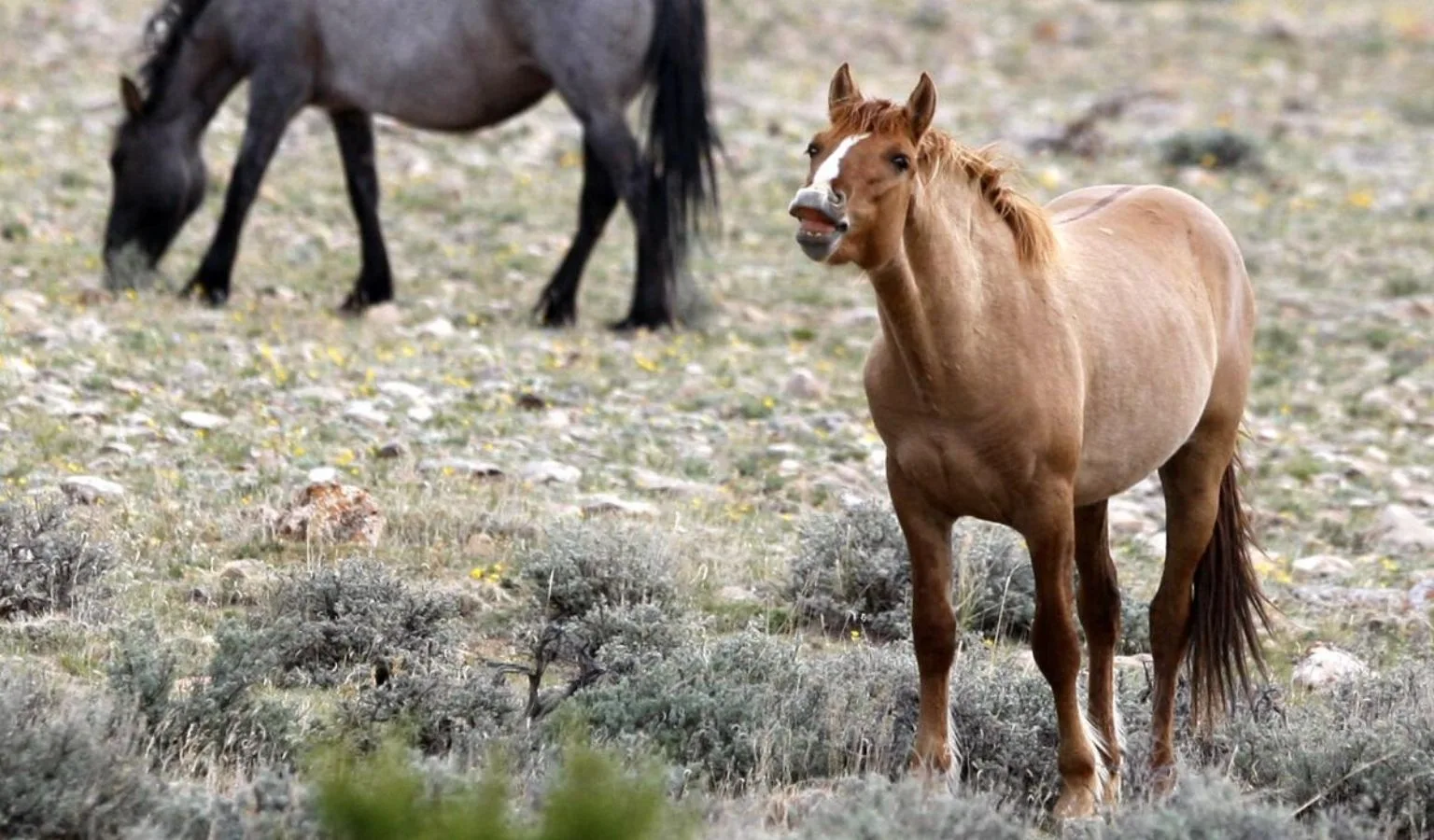
Feature image: Billings Gazette File Photo
Montana's outdoor week, in your inbox at 7am Friday.