
From Idaho Fish and Game
If you told me years ago that my fisheries degree would have me studying aeronautical charts and piloting drones, I’d have called you crazy. But here we are.
Each year, Idaho Fish and Game licensed drone pilots take to the sky to survey Chinook salmon spawning grounds. Navigating trees, wildfire smoke, and curious birds, we collect images of the streambed along 170 miles of historic Chinook spawning habitat in the Upper Salmon River and its tributary streams.
Before the advent of drones, Fish and Game utilized fixed-wing planes, helicopters, and physical ground counts to count Chinook salmon nests—or redds. While our staff, volunteers, and tribal organizations still walk hundreds of miles of stream each year, the Salmon Regional Office conducts many of our surveys using drones.

So, what exactly are we counting?
You may recall from previous blog posts that Chinook salmon spawn in Idaho streams during late summer after returning from the ocean, depositing eggs and burying them for incubation through fall and early winter.
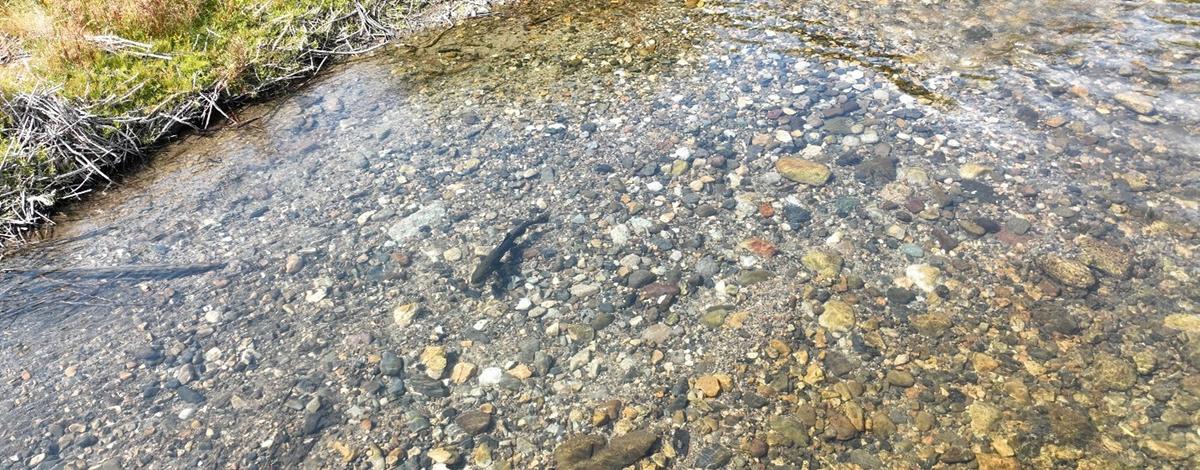
In the video below, a female Chinook salmon continues work on her redd, burying deposited eggs and diverting oxygenated water over them for incubation. The disturbance they create in the streambed can be identified and counted as a redd and used as a metric to describe spawning escapement—or the number of fish that successfully return to spawning grounds in Idaho.
https://idfg.idaho.gov/media/oembed?url=https%3A//vimeo.com/1032480896%3Fshare%3Dcopy%23t%3D0&max_width=800&max_height=450&hash=k7IeqW0_FHFLXA0ikTfzeAWe0RnZmGeIllBgM5KonFs
Identifying redds from the air is a bit different from traditional on-the-ground methods, with unique subjectivity that requires specific training and some experience. Last year, we highlighted how Fish and Game identifies redds from an aerial perspective in this vlog, with specific examples of redds counted in the Upper Salmon River during the 2023 spawning ground surveys.
So, how exactly do we do it? Once in the air, the drones do most of the work, flying the river corridor around 150 feet in the air at nearly 12 miles per hour, photographing the streambed every 30 feet or so.
As pilots, we are tasked with identifying hazards and ensuring each survey is carried out safely. The images are stored on memory cards within the drone, so the actual identification and counting of redds happens after the survey.
Back at the office, two pilots go through all the images and count redds independently, as a means to “double check” one another. The official count offers information about spawner abundance, which is crucial when monitoring fish populations.
Although, to put a year of redd counts into perspective, we must compare them to something. We do this by comparing the current year’s count to previous years’ averages, dating back to when populations were considered healthy. This way, by sampling every year using the same techniques, around the same time and in the same places, we can identify trends in abundance for a highly variable fish species like Chinook salmon.

Drones represent a relatively new technology that help fisheries staff conduct field work with greater efficiency. Over the past several years, significant advances in drone technology have allowed us to survey more than 20 miles of stream in just a day, a feat that would take days to walk. Furthermore, we can archive images of Chinook salmon redds for later validation, hopefully reducing observer bias and improving the accuracy of our redd counts.
Chinook salmon spawning ground surveys in Idaho represent a storied history, beginning in the 1950s and continuing to provide crucial information regarding Chinook salmon spawning escapement.
Fish and Game continues to maintain these meaningful datasets using the best techniques and training. Cutting-edge technologies, like drones, help us monitor natural production of Chinook salmon in areas that are difficult to survey on the ground and at a much larger spatial scale.
Montana's outdoor week, in your inbox at 7am Friday.