

The Helmet Vanga, or Euryceros prevostii, is what Montana Tech Biological Sciences senior Caleb Lashway calls a special bird.

Found only in the virgin rainforest of Madagascar, the black bird with a blue bill and rust-colored wings and tailfeathers is rare.
“If you find them, it means you have gotten away from everything in the beautiful, uncut forest,” Lashway said.
Lashway, a native of Helena, has fond memories of watching the gorgeous creatures years ago while he was growing up in Madagascar.
He spent the first seven years of his life in Helena. His parents then decided to become missionaries so his family moved, first to France and then to the island nation off the coast of Africa, for the next decade.
“The birds there are amazing,” Lashway said.
He came back to Montana for college after high school graduation, but ended up pausing his studies after five semesters.
“I was burnt out,” Lashway said. “I had not really given myself a break from Africa before adjusting back to Montana.”
Lashway spent five years as a janitor for a Holiday Inn before making his way to Montana Tech. Lashway has been an avid birder since he was a young child. He remembers that he was born at just the right time to catch his grandfather’s renaissance in birding. Gary Swant had been a teacher and got into birding in retirement. Swant quickly became one of Montana’s top birders; it’s something he passed down to young Caleb. When he returned to Montana, Lashway continued to grow his birding experience, and became a co-owner of Swant’s business GoBird Montana, which gives birding tours of southwestern Montana and is also contracted to do bird surveys with Federal agencies. Today, Lashway competes for the rank of top birder and is a growing scientist as well.
“I got a job doing bird surveys in Butte for the Superfund cleanup site,” Lashway said. “That was really more in line with the biology I always wanted to be a part of. I spent years doing surveys, and did really well, and started to do more and more surveys and doing more stuff for GoBird Montana. I ended up in a position of sitting at roundtables with everybody who had a masters or doctorate degree.”
In some meetings, it became apparent that his lack of a degree was holding him back. Montana Tech Biological Sciences Professor Dr. Stella Capoccia was in some of those meetings and saw where Lashway was facing a roadblock. She asked Lashway to stop by her office so she could help him figure out what it would take to get a degree. In Spring 2022 he enrolled as a transfer student in a four-credit class to get back into the swing of things. He enrolled full-time the next semester and is now expected to graduate in Spring 2025.
Lashway is a member of Capoccia’s research team, which conducts bird counts on local waterbodies as part of the Berkeley Pit Waterfowl Protection Program. The program uses data collected by Capoccia’s students to help prevent birds from landing on the toxic Berkeley Pit.
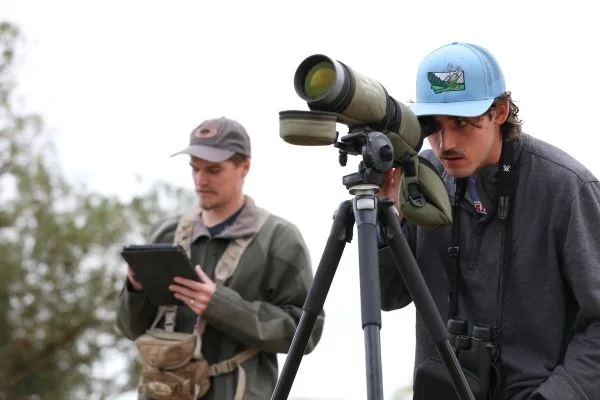
Waterfowl surveys involve glassing with a spotting scope across a water body and counting every single bird, by species, that’s on the water at that time. The numbers are inserted into an Excel spreadsheet. Another type of survey, point-count surveys, involve standing in one spot for 10 minutes and counting every single bird seen or heard.
“That’s more of a long-term study survey tactic,” Lashway said. “In a restoration area, what you see or hear should change over a 20-year period as the willows grow and the grass comes back. If it doesn’t start changing then it might be time to start asking ‘why after nine years does this site only have meadowlarks and grassland sparrows?’”
Lashway says the surveys are important.
“Undeniably, waterfowl are using this part of Montana, especially the Warm Springs area, more,” Lashway said. “We also survey the Clark Fork and other areas that are being cleaned up. You can look at birds that were there before the cleanup, and you can look at the birds after. Hopefully you see a diversity in bird numbers as the vegetation grows back.”
Lashway says local water bodies are incredible resources for birders. “Warm Springs is crazy because it has all the ducks,” Lashway said. “Those ponds have shallow water and deep water so you have some of everything. I get kind of infamous for having bird lists that have every single waterfowl species in the State consistently.”
Warm Springs can also be challenging, because the area is large and unless you know where to look or have the right equipment, it can be hard to see what’s out there.
“One of the tricks is that there are 16,000 waterfowl there right now, but they are all up the middle, so unless you look through a spotting scope, you wouldn’t know because you can’t see them with the naked eye, because they are half a mile out,” Lashway said.
Lashway and Swant give free public tours several times per year and educate the public about the local ecosystem.
“If we ignore repeat customers, about 80% of participants have never been out to Warm Springs before or even know it was there, and a lot of them are from Deer Lodge, Anaconda, or from Butte,” Lashway said.
Part of the reasons it is great to have Lashway as a student at Montana Tech is that he’s sharing his deep knowledge of birds with other students who are just beginning to identify them.
Ian Barville is a Biological Sciences senior from Spokane, Washington who chose Montana Tech because of an opportunity to participate on the University’s first track and field team.
In Spring 2023 he contacted Dr. Capoccia to see if he could join her research group.
“I kind of figured it would be fun,” Barville said.
Barville’s assumptions were partly right.
“Sometimes they are boring, but sometimes they are really fascinating as you are trying to figure out what they are trying to do,” Barville said. “I saw a group of ruddy ducks in the breeding season get into a brawl. They were pushing each other into the water with one single female off to the side. They look really goofy because they have these bright blue bills, and they were out there wrestling each other in the water.”
Mostly though, learning to identify and count birds is hard work. In the summer there were some days where Barville would meet Lashway at 6 a.m. to do counts before the 100-degree heat set in.
“Like any science there’s always a lot to learn,” Barville said. “There are a lot more bird species locally than most people are aware of. It definitely gets easier to learn the more you learn. You just kind of have to keep at it, be a sponge and soak up information.”
One challenge is the fact that birds often have beautiful spring plumage that stands out, but when fall comes, they molt into drab winter colors that all look the same. Also, birds sometimes end up in places they aren’t supposed to be, throwing their counters for a loop.
Barville was with Lashway when a least tern was spotted. The bird is only found along the Missouri River in Montana, but one showed up during one of the local counts.
“The birds don’t always fly where you expect them to,” Barville said. “They don’t have a sheet telling them where to go.”
Lashway also spotted a whimbrel recently. The birds usually are found in Hudson Bay, the east or west coasts, or in South America. They are rarely spotted in Montana.
“That bird is on an adventure,” Lashway said.
In addition to conducting counts locally, Barville, Lashway, and another Montana Tech student, Anika Ploeger, were able to travel to Billings to assist the U.S. Fish and Wildlife Service with surveys on the Yellowstone River.
Barville says the wide variety of research he’s been able to do as an undergraduate is among the best experiences he’s had in college.
“If you are interested in research, Montana Tech has a lot of research opportunities, and it’s definitely a great way to further your education, as well as your connections within the school, and to gain experience. I would highly recommend just being open minded to pursuing research. There are a lot of opportunities here.”
Barville is working on applications to the Peace Corps, and he plans to go on to get a masters degree.
Lashway says he would like to eventually get a master’s degree too, thought it might be more naturalist focused than ornithology focused.
No matter what the future holds, neither one figures they will go too long without having birds on the brain.
“Once you get to a certain level, you just can’t stop,” Lashway said.
Montana's outdoor week, in your inbox at 7am Friday.