
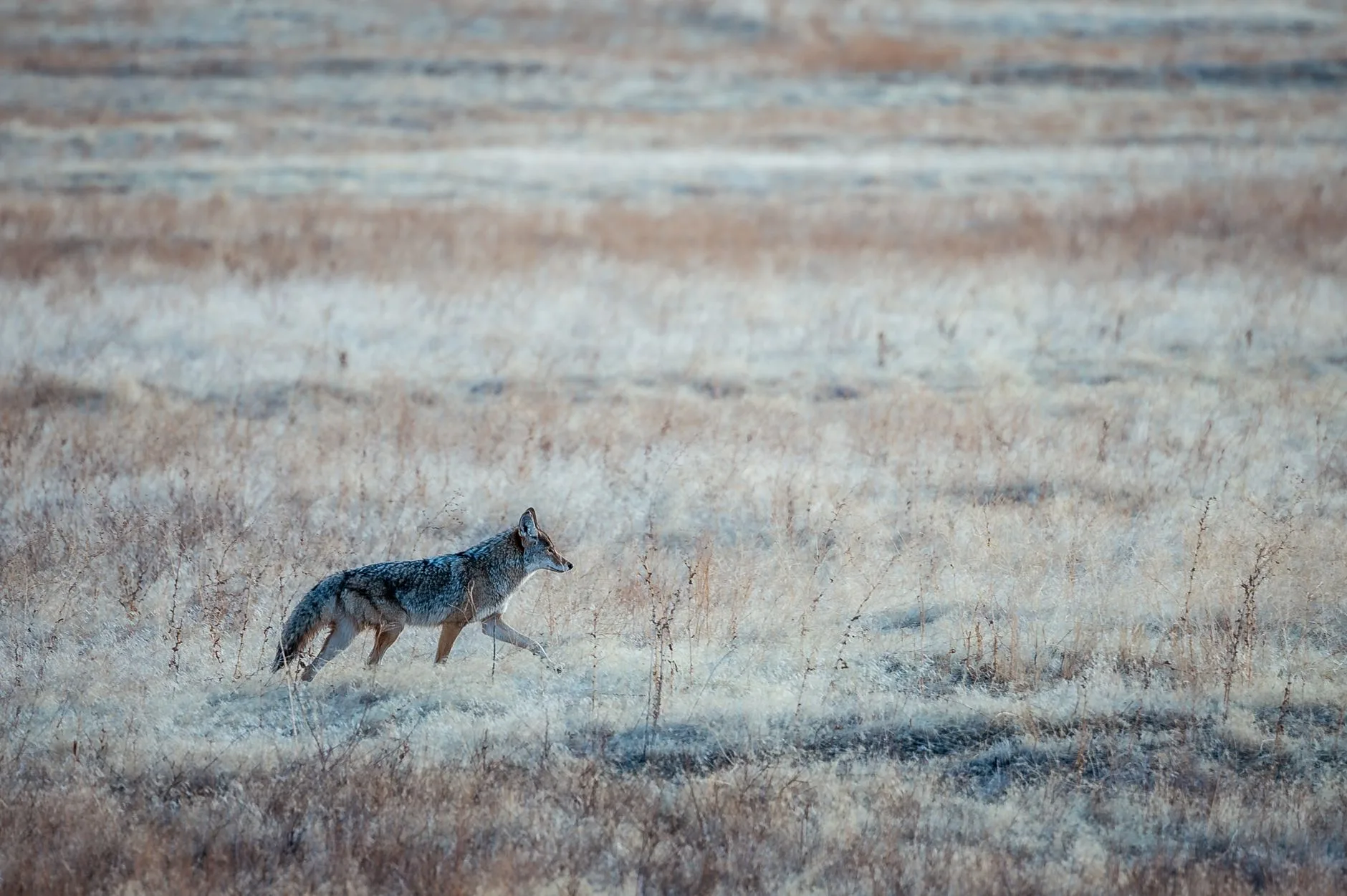
A Powder River County rancher called it the strangest coyote he’d ever seen — bigger than normal, brindle-colored, with floppy ears and a gait that didn’t quite fit. He shot it thinking it was just an oversized coyote. When he laid it out in the bed of his truck, his neighbor leaned over the tailgate and said what they were both thinking: That’s a coydog.
The debate over whether coydogs — coyote-dog hybrids — actually exist has largely been settled. They do. The more interesting question, especially for anyone spending serious time in Montana’s river bottoms, wheat country, or mountain foothills, is: what does that actually mean in the field?
Coydogs Are Real, But Rarer Than You Think
Documented coyote-dog hybridization has been confirmed through genetic testing across North America. The biology isn’t in dispute. Coyotes and domestic dogs (Canis latrans and Canis lupus familiaris) are closely related enough to interbreed and produce fertile offspring — though it’s far less common than most people assume.
The main reason coydogs are rare comes down to timing. Coyotes have a narrow breeding window in late winter — typically January through March in Montana — and they’re seasonally monogamous. Domestic dogs cycle twice a year on a completely different schedule. That mismatch limits successful pairings considerably. When they do occur, it’s almost always a male dog that breeds with a female coyote, and the resulting pups often carry a survival disadvantage because male coyotes don’t provision pups the way a bonded coyote pair would.
Montana Fish, Wildlife & Parks doesn’t track coydogs as a distinct population category — they fall under general predator classifications — but FWP biologists acknowledge that hybrids can and do occur, particularly in areas where feral or free-roaming dogs overlap with coyote territory. Eastern Montana’s sprawling ranch country and the agricultural corridors along the Yellowstone and Musselshell Rivers offer exactly that kind of overlap. If you’re running traplines or calling predators out toward Miles City or Forsyth, you’re hunting in coydog country.
How to Identify a Coydog in the Field
This is where it gets genuinely useful for Montana hunters and callers. Pure coyotes are remarkably consistent in appearance: grizzled gray-brown, lean, with erect ears, a narrow muzzle, and a downward-carried tail. A coydog breaks from that template in ways that are hard to ignore once you know what to look for.
Common coydog traits reported by Montana hunters and trappers include:
- Larger body size — noticeably heavier than a typical coyote, sometimes pushing 50–60 pounds
- Coat variation — brindle, solid black, reddish, or patchy coloring that doesn’t match the standard coyote palette
- Floppy or semi-erect ears — one of the most consistent tells
- Broader head and shorter muzzle — a blockier, more dog-like skull profile
- Behavioral oddities — less wariness around humans, slower to flee, sometimes approaching out of what seems like curiosity rather than caution
That last point matters for hunters. A coydog responding to an electronic call or a hand call may behave differently than a pure coyote — less circling, less hanging up at distance, more of a direct approach that can actually make the shot easier, but also throws off your read of the situation. Several Montana predator hunters have described calling in animals they initially misread as dogs before the shot. Honestly, that moment of hesitation is exactly what you want — it means you’re paying attention.
Behaviorally, coydogs tend to be less socially cohesive than their wild counterparts. Pure coyotes in Montana function in family units with defined territorial behavior and sophisticated communication. Coydogs appear to lack some of that structure, which probably explains why they don’t establish themselves as a self-sustaining population. They’re outliers, not a breeding wave rolling across the Hi-Line.
What This Means for Montana Hunters and Ranchers
Under Montana law, coyotes are classified as a predator with no closed season and no bag limit — you can hunt them year-round with a valid hunting license. A coydog, legally speaking, occupies murky ground. If it’s running wild and presents as a coyote, most hunters treat it as one. But if there’s any real chance the animal is a domestic dog — feral or otherwise — shoot-on-sight gets complicated fast. Shooting a domestic dog, even one running livestock, carries legal exposure in Montana, and you’ll want to know that before you squeeze the trigger on something with a blocky head and an odd coat.
For ranchers dealing with livestock depredation, the identification question matters too. FWP’s predator damage program and USDA Wildlife Services respond to confirmed coyote depredation — a coydog muddying the waters doesn’t change your reporting options, but it can affect how you describe what you’re dealing with. In my experience, calling it a “large coyote with unusual coloring” is both accurate and keeps the conversation moving in the right direction.
Coydogs are real, they show up in Montana, and when you encounter one, you’ll probably know it. They don’t look quite right. They don’t act quite right. And in a state where every rancher has an opinion about predators and every coyote hunter has a story, the weird one that didn’t run — that’s usually the one worth telling.
Montana's outdoor week, in your inbox at 7am Friday.