
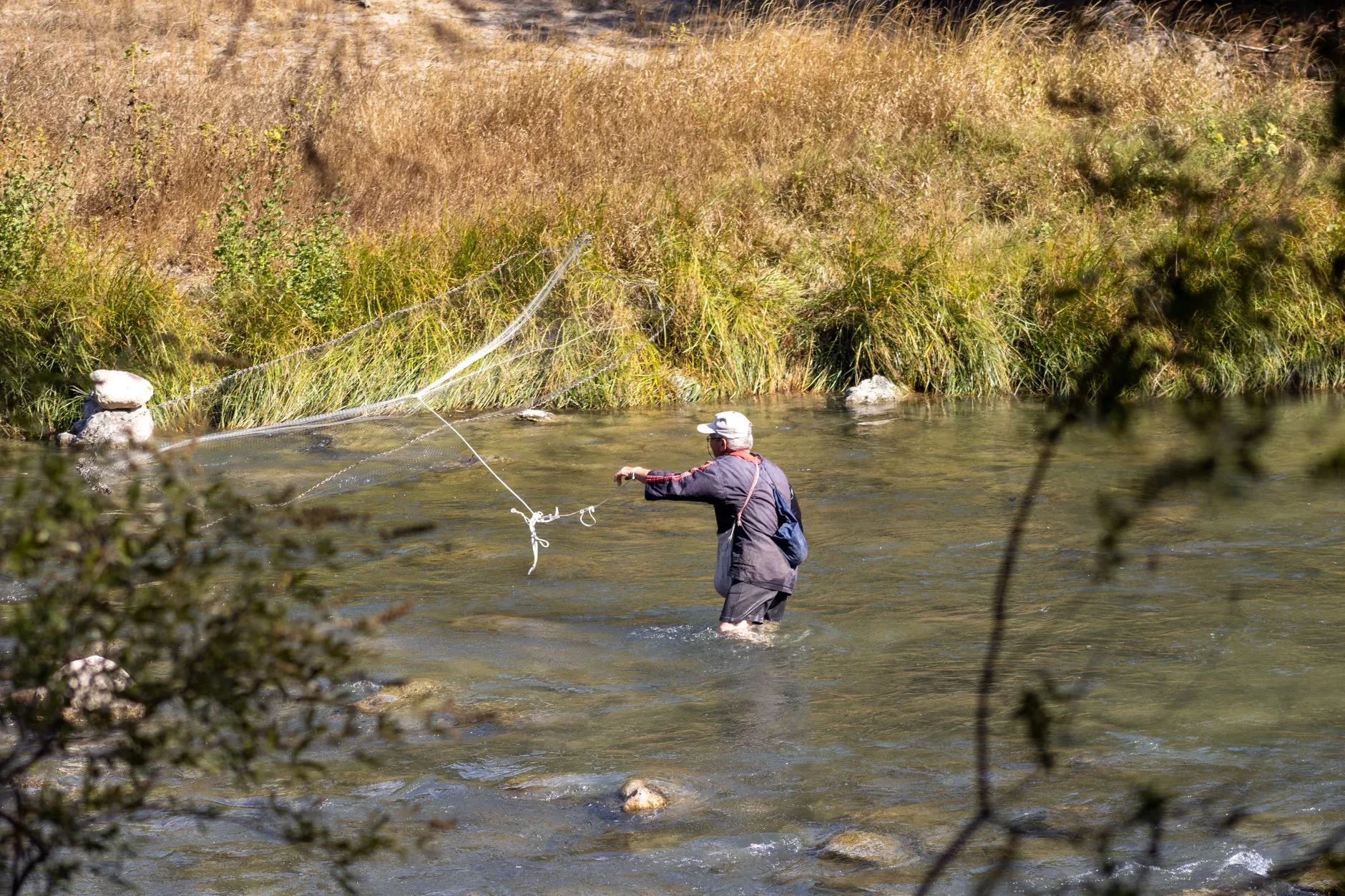
A Japanese angler fishing a managed stream on the Yozawa River wrote one sentence that I haven’t been able to shake: “They are the same as the fish lined up at the supermarket, but… ‘Bought versus caught’ makes a huge difference.”
I’ve been fly fishing Montana’s freestone rivers for two decades. I’ve read stacks of technique articles and spent more on gear than I care to admit. That one line from a stranger’s fishing journal cut deeper than any of it.
The writer was working a CDC Hen Hackle Dun in natural, picking off yamame and rainbow trout, and documenting each take with a level of precision most of us abandon the second we unhook the fish and move upstream. He noted posture changes, cast angles, line placement. He wrote about foam lines obscured by cherry blossom petals drifting downstream. He photographed specific rocks that held fish. The whole thing reads less like a trip report and more like field notes from someone who genuinely wanted to understand what was happening in front of him.
The Documentation Gap
Most Montana anglers — myself absolutely included — run on memory and muscle. We hit the same runs on the Madison or Rock Creek, we adjust for flow and season, and we rely on years of pattern recognition that lives somewhere between our eyes and our casting arm. But how often do we actually write it down? How often do we track what worked, where, and why — especially on those days when everything clicks and the fish seem to be cooperating for once?
The Yozawa fishery is nothing like our water. It’s stocked, managed, designed to produce consistent catches. Montana’s blue-ribbon streams are wild and moody and will humble you without warning. But the principle holds regardless: intentional observation beats casual repetition every single time.
What Montana Anglers Can Borrow
You don’t need a put-and-take operation to benefit from this mindset. A lot of it translates directly to home water.
Start photographing your holding positions — not just the fish, but where you stood, where the fly landed, which piece of structure held the trout. A quick phone shot from the bank can decode a stretch of river you’ve fished a hundred times without ever really seeing. And record your failures too. The Yozawa angler noted a deep pool under a bridge that gave him nothing. That’s as valuable as a hot spot. Montana’s pocket water and tailouts shift with every runoff cycle, and knowing what didn’t work saves real time on your next trip.
The journal also describes casting “slow at first, conscious of the trajectory, and a crisp stop.” That’s exactly what guides preach on the Bighorn and the Missouri tailwaters. Rushing the backcast costs fish, especially in technical water where one sloppy loop puts everything down. The angler also kept crouching, staying low, staying out of sight. Honestly, if you’re standing tall in September on the Beaverhead, you’ve already blown the run. Every educated brown in that stretch knows you’re there.
The Gratitude Problem
The Yozawa angler says “thank you” to every fish he catches, even though, as he puts it, “we don’t speak the same language.” That’s not sentimentality. That’s respect for the transaction. You carved time out of your week, drove however far you drove, read the water, adjusted your rig, made a good cast — and the fish gave you that moment. That means something.
Whether you’re releasing a westslope cutthroat on the South Fork of the Flathead or keeping a limit of rainbows out of a backcountry lake in the Beartooths, the difference between bought and caught is measured in effort, intention, and memory. A fifteen-dollar filet from the grocery store feeds you. A trout you worked for feeds something else entirely.
The Evening Walk Home
The journal entry ends with the angler walking slowly back to his car at dusk, listening to the distant chimes of “Furusato” — a Japanese folk song about hometowns and rivers. He wondered if the song was written about the Yozawa.
I’ve had that same feeling on the Gallatin at last light, or hiking out from the Upper Missouri when it’s too dark to see your fly and you’re too tired to cast anyway but not quite ready to be done. That part never makes it into the journal. Nobody photographs it. But it’s half the reason we fish — the river itself, the hour you spent inside it, and the pull to be back there next week.
In my experience, the anglers who grow the fastest aren’t the ones with the best gear or the most days on the water. They’re the ones who pay attention and actually remember what they noticed. Keep a journal this season. Write down what worked and what didn’t. You might be surprised what you learn when you slow down long enough to look.
Source inspiration: Yozawa Fly Fishing Area Journal
Montana's outdoor week, in your inbox at 7am Friday.